
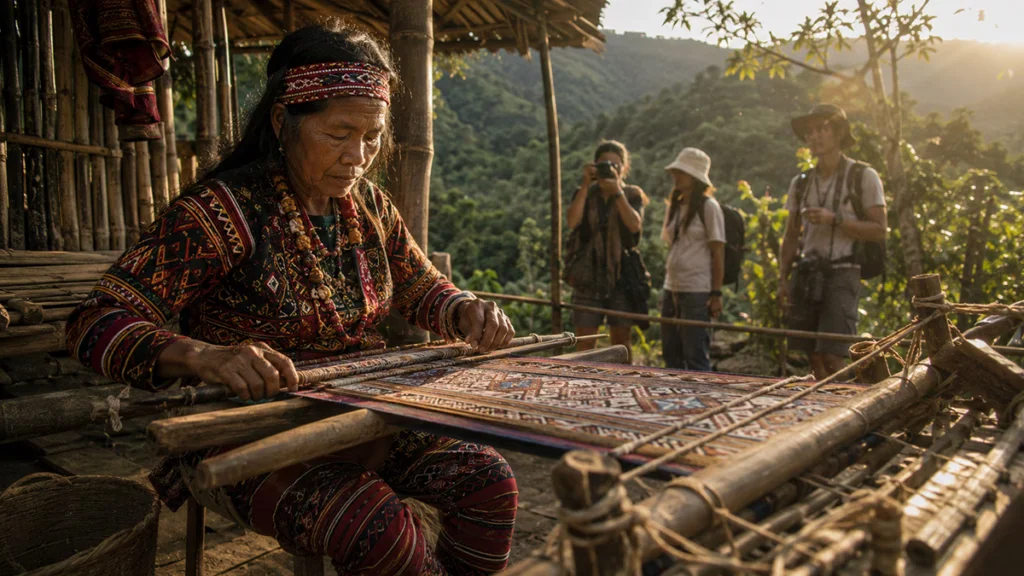
I met Aling Lili on a humid afternoon in Mansalay, Mindoro. She is part of the Mangyan indigenous peoples of Mindoro. She sat cross-legged outside a bamboo hut, fingers moving across a loom with hypnotic precision. Geometric patterns emerged from the warp and weft: ancient symbols handed down through generations of Hanunoo Mangyan weavers. Tourists crowded around her with cameras clicking, marveling at the artistry.
“Beautiful,” one woman whispered. “So authentic.” Aling Lili smiled politely. Her hands never stopped moving. Later, after the tour group climbed back into their air-conditioned van, I asked her about the land behind her house. She gestured toward the forested hills: slopes her ancestors had cultivated for centuries. “The company says it belongs to them now,” she said quietly. “They have papers. We only have stories.”
That’s when I understood the cruel irony. Everyone celebrates Mangyan culture. Provincial tourism boards plaster the ancient Hanunoo script across billboards. Government officials pose for photos at cultural festivals. Visitors like me gush about the “authentic indigenous experience.” Yet the same people whose embroidery adorns museum exhibits still fight for basic recognition of their land rights.

Key Takeaways
- The Mangyan indigenous peoples of Mindoro face ongoing struggles for land rights, yet their culture is celebrated by tourists and government officials.
- Cultural commodification has become a means of exclusion, where admiration for traditions often ignores the present-day challenges faced by the Mangyan communities.
- While the Indigenous Peoples’ Rights Act recognizes their rights, bureaucratic hurdles often prevent effective implementation, leaving many Mangyan without legal land title.
- To support the Mangyan, empathy must translate into action, prioritizing land rights, cultural education, and genuine political representation.
- Ultimately, true solidarity involves recognizing the Mangyan as decision-makers rather than mere subjects of cultural admiration.
This is the Mangyan paradox: cultural celebration has become the most sophisticated form of exclusion. We admire the art while ignoring the artist’s struggle, and we romanticize the heritage while remaining silent about displacement. We consume the culture while the people who created it remain invisible in every decision that affects their lives.
And here’s what should keep you up at night: your fascination might be part of the problem.
The Long Shadow of Displacement: History of Mindoro Island’s Indigenous Peoples
The Mangyan people had inhabited Mindoro Island long before Spanish galleons appeared on the horizon. Eight distinct ethnolinguistic groups, the Iraya, Alangan, Tadyawan, Tawbuid, Buhid, Hanunoo, Ratagnon, and Bangon, developed sophisticated agricultural systems in Mindoro’s interior highlands. They created writing systems, including the ancient Baybayin-derived Hanunoo script, still used by some communities today.
Then colonization arrived with its predictable script.
Understanding the history of Mindoro Island requires acknowledging what happened to its original inhabitants. Spanish missionaries pushed the Mangyan deeper into the mountains, away from coastal settlements. American administrators introduced land titling systems that ignored indigenous concepts of communal ownership. Post-independence governments continued the pattern: prioritizing lowland settlers and commercial interests over ancestral claims.
By the 1960s, logging concessions had been carved through ancestral domains. Mining operations followed. Agricultural corporations claimed “idle” land that had sustained Mangyan communities for generations. Each wave of development pushed indigenous families further into marginal areas, higher up the slopes, deeper into legal limbo.

The Indigenous Peoples Rights Act of 1997 offered hope. On paper, it recognized ancestral domain claims and required Free Prior Informed Consent for projects affecting indigenous communities. Reality proved more complicated. Bureaucratic obstacles, lack of legal resources, and outright resistance from local governments meant many Mangyan communities still lack recognized titles decades later.
Meanwhile, something strange happened across Mindoro Island. As Mangyan people lost land and political power, their culture became increasingly celebrated. Folk festivals showcased Mangyan dances. Museums collected traditional tools. Schools taught the Hanunoo script as a point of regional pride.
Cultural preservation became the consolation prize for political exclusion.
When Culture Becomes Commodity
Drive through Mindoro today, and you’ll see Mangyan imagery everywhere. The distinctive Hanunoo script decorates restaurant signs. Provincial tourism campaigns feature women in traditional necklaces and woven skirts. Souvenir shops sell “authentic” baskets and embroidered bags.
The aesthetic has been thoroughly monetized.
Puerto Galera’s tourism industry advertises “indigenous cultural experiences” alongside beach resorts and dive shops. Tour operators organize visits to Mangyan villages, where visitors can watch weaving demonstrations and purchase handicrafts. Some resorts employ Mangyan staff in traditional dress to perform cultural shows for guests.
On the surface, this looks like cultural appreciation: It creates income opportunities and raises awareness. It gives indigenous culture visibility in a nation where many ethnic groups face erasure. But talk to Mangyan indigenous peoples themselves, and a different picture emerges.

The Common Sense Perspective
Mang Danilo, an Iraya community leader in Abra de Ilog, described it this way: “They want our script for their logos. They want our textiles for their hotels. They want our dances for their festivals. But what are the responses when we ask for teachers who speak our language? When do we need a health clinic in our barangay? When do we petition for our ancestral land certificates? Suddenly, they cannot hear us.”
The statistics support his frustration. Despite cultural visibility, Mangyan communities experience some of Mindoro’s highest poverty rates. School dropout rates remain elevated due to a lack of mother-tongue instruction and culturally relevant curriculum. Health indicators lag behind provincial averages. Political representation is minimal; few Mangyan individuals hold elected positions or civil service roles.
Aling Rosa from Naujan explained it with brutal clarity: “They celebrate our past but ignore our present. We are museum pieces, not citizens.”
This is where Mindoro cultural tourism becomes exclusion. When a culture is reduced to performance and product, when indigenous people are valued for their aesthetic contribution but not their political voice, admiration becomes another form of erasure. The real, complex, struggling communities disappear behind a romanticized image of noble savages in photogenic traditional dress.
Heritage tourism freezes culture in amber. It demands that indigenous people perform an idealized version of their traditions for outside consumption while their actual lives, contemporary challenges, and political demands remain invisible.
The Mechanics of Marginalization
Why does this paradox persist? Why can Mindoro simultaneously celebrate Mangyan culture and exclude Mangyan people from meaningful participation in society?
Several structural forces maintain this dynamic.
The Actual Mechanics
First, government heritage programs focus on documentation and display rather than empowerment. The National Commission for Culture and the Arts collects artifacts and records oral traditions. The Department of Tourism develops cultural tourism initiatives. These efforts generate reports, exhibitions, and promotional materials, but rarely transfer decision-making power to indigenous communities themselves. Mangyan culture becomes something to be managed and marketed by external authorities rather than controlled and defined by the people who live it.

Second, private sector interests benefit from the status quo. Mining companies and agribusiness corporations prefer to deal with compliant local governments rather than indigenous communities asserting ancestral domain rights. When a corporation wants to develop contested land on Mindoro Island, it’s far easier if Mangyan claimants lack legal recognition and political influence.
Cultural celebration provides perfect camouflage for continued exploitation. A company can sponsor a cultural festival, donate to a heritage center, and employ a few Mangyan artisans while simultaneously opposing the ancestral domain claims in Mindoro that would restrict commercial operations.
Third, entrenched ethnic hierarchies shape social relationships across the Philippines. Despite constitutional protections and anti-discrimination laws, indigenous peoples face persistent stereotyping as backwards, rudimentary, or less capable than lowland Filipinos. These attitudes pervade everything from hiring decisions to social interactions to political representation.
Cultural romanticism paradoxically reinforces these hierarchies. When we fixate on traditional practices and ancient ways, we implicitly position indigenous people as relics of the past rather than full participants in contemporary society. The narrative becomes: appreciate their heritage, but don’t expect them to operate businesses, hold offices, or participate as equals in modern institutions.

The Outcome
This is why you’ll see Mangyan embroidery featured in provincial branding but rarely see Mangyan executives in provincial government. It’s why schools teach about the Hanunoo script as a historical artifact but don’t provide Hanunoo-language instruction for indigenous students. It’s why tourists visit Mangyan weavers, but would be shocked to find a Mangyan doctor or lawyer.
The celebration itself becomes a cage, defining indigenous people by their cultural difference rather than their common humanity and equal rights.
Pathways to Genuine Inclusion
So how do we escape this paradox? How do we honor indigenous culture without using that celebration as a substitute for justice?
The answer starts with a fundamental shift: from admiration to solidarity, from documentation to empowerment, from cultural appreciation to political support.
Real solutions require transferring power, not just celebrating heritage.
The Starting Point
Land rights must be the foundation. Accelerating the processing of ancestral domain claims and Certificate of Ancestral Domain Title applications gives Mangyan communities legal standing to control their territories. This isn’t about preserving a cultural museum; it’s about securing the economic base that allows communities to thrive on their own terms.
Indigenous lawyer Arnold Fernandez, who works with Mangyan communities on land claims, put it bluntly: “Without land security, everything else is performance. Culture needs a place to live.”

Access to education requires genuine cultural integration, not token gestures. That means hiring Mangyan teachers, developing curriculum in indigenous languages, and creating pathways for Mangyan students to pursue higher education without abandoning their identity. Several successful models exist, including the Mangyan Heritage Center’s cultural education programs and mother-tongue instruction pilots in selected schools.
The Crux of the Matter
The key is that these programs must be designed and controlled by Mangyan educators, not imposed by outsiders who think they know what indigenous students need.
Healthcare infrastructure means bringing services to communities rather than expecting isolated families to travel hours for basic care. Mobile clinics, community health worker programs trained in cultural competency, and healthcare facilities in ancestral domain areas address practical barriers that currently prevent Mangyan people from receiving adequate medical care.
Political representation requires intentional inclusion. Some localities have mandated the presence of representatives of indigenous peoples on local councils. But representation goes beyond token seats; it means ensuring Mangyan voices shape policy decisions about land use, education, healthcare, and development in areas where they are the original inhabitants.
For those of us who aren’t Mangyan, solidarity means redirecting our energy. Instead of taking photos of weavers, support organizations advocating for ancestral domain rights. Rather than buying souvenirs, learn about the legal battles facing the communities that made them. Instead of attending cultural performances, show up for public hearings where land claims are being contested. And here’s the uncomfortable truth: genuine solidarity sometimes means not visiting at all. Not every Mangyan community wants to be a tourist attraction. Some groups explicitly reject cultural tourism as exploitative. Respecting their autonomy, including their right to say no to outside attention, is more important than satisfying our desire for authentic experiences.

Is Cultural Celebration the New Colonization?
Let’s ask the question that makes heritage advocates uncomfortable: What if cultural celebration is itself a form of colonization?
Consider the pattern. Colonizers have always been fascinated by indigenous cultures, even as they destroyed indigenous societies. Spanish friars documented native languages while forcing conversion. American anthropologists measured skulls and collected artifacts while supporting policies that dispossessed indigenous people. Museums worldwide house treasures from colonized peoples whose descendants live in poverty.
Admiration has never prevented exploitation. Sometimes it enables it.
When we celebrate Mangyan culture while ignoring Mangyan land claims, we’re following an old script. We’re extracting value, aesthetic pleasure, and moral satisfaction from indigenous people without supporting their actual well-being or autonomy. We’re defining them by what we find interesting rather than by what they find important.
This dynamic appears globally. Australian tourism markets Aboriginal art while Aboriginal communities fight mining companies. Canadian museums display First Nations artifacts while indigenous people lack clean water. Māori cultural performances attract tourists to New Zealand while Māori people experience disproportionate poverty.
The pattern is consistent: cultural celebration as a substitute for justice, admiration as a replacement for restitution, heritage tourism as the consolation prize for dispossession.

The Real Test
Here’s the test: Does cultural appreciation increase or decrease indigenous people’s power? Does it support their priorities or ours? Does it position them as decision-makers or as displays?
If appreciation doesn’t translate to land security, political representation, economic opportunity, and self-determination, it’s not appreciation at all. It’s consumption. And consumption of culture without support for the people who created it is just another form of taking.
That doesn’t mean all cultural exchange is colonial. It means we need to be ruthlessly honest about who benefits. If tourists, tourism operators, government agencies, and souvenir manufacturers profit from Mangyan culture while Mangyan families remain economically marginalized and politically powerless, then the relationship is extractive rather than reciprocal.
Real appreciation would look different. It would mean Mangyan communities controlling their own cultural representation, and cultural tourism revenue flowing to indigenous-controlled enterprises rather than to outside operators. In addition, it would mean that outsiders support indigenous priorities rather than define them.
In other words, it would mean treating Mangyan people as authorities on their own lives rather than as colorful subjects for our travel photos.
The Choice You’re Actually Making
So here we are, back where we started: Aling Lili at her loom, fingers moving in patterns older than the nation-state that now governs her life. Tourists admire her work. Government officials celebrate her culture. And her family is still uncertain whether they’ll be allowed to stay on the land they’ve inhabited for generations.
You have a choice to make, and it’s not the one you might expect.
The choice isn’t between appreciating Mangyan culture or ignoring it. Surface-level appreciation is easy, comfortable, and ultimately meaningless. The choice is between admiration and solidarity, between consumption and support, between celebrating the aesthetic and backing the struggle.
What Will You Contribute?
Will you dig deeper than the cultural festivals and handicraft markets, and will you learn the names of the communities fighting for land recognition? Are you willing to support organizations advocating for indigenous rights in the Philippines? Will you hold elected officials accountable for implementing the Indigenous Peoples’ Rights Act? Will you challenge tourism practices that exploit rather than empower? Or will you settle for the pretty picture: the fascinating culture, the photogenic traditions, the comforting narrative that appreciation equals progress?

The Mangyan paradox exists because we allow it to exist by letting cultural celebration substitute for political support. We accept heritage tourism as economic development while ignoring who actually controls the revenue. We mistake our fascination for allyship.
Aling Lili doesn’t need your admiration; she needs land security. Like any parent, she needs her children to attend schools that respect their language and identity. She needs a say in the decisions that affect her community. In other words, she needs the same rights that other Filipino citizens take for granted.
Everything else is just pretty patterns on a loom, beautiful and hollow, celebrated and ignored.
The question is simple: Which side of the paradox will you stand on?
P.S. Next time you see a tourism brochure featuring indigenous culture, or a government proclamation celebrating heritage, ask yourself one question: Where are the indigenous people in the decision-making room? If they’re on the posters but not at the table, you’re witnessing the paradox in action. And if you don’t challenge it, you’re participating in it.
FAQ
The term Mangyan actually refers to eight distinct ethnolinguistic groups in Mindoro: Iraya, Alangan, Tadyawan, Tawbuid, Buhid, Hanunoo, Ratagnon, and Bangon. They have different languages, cultural practices, traditional territories, and social structures. Lumping them together as simply Mangyan oversimplifies their diversity, like calling all Europeans the same. Each group has unique traditions, though they share the common experience of marginalization across Mindoro Island’s history.
Not necessarily, but context matters enormously. The critical questions are: Who organized the visit? Does the community have control over tourism activities in their area? Where does the money actually go? Do you respect community boundaries and protocols? Purchasing directly from Mangyan artisans, who set their own prices, differs from buying mass-produced items marketed as indigenous. Visiting through community-controlled tourism initiatives is different from tours organized by outside operators. The key is whether the interaction increases or decreases indigenous people’s autonomy and economic power.
The Indigenous Peoples’ Rights Act of 1997 (IPRA) recognizes indigenous peoples’ rights to ancestral domains, self-governance, and Free, Prior, and Informed Consent for projects affecting their communities. On paper, it’s progressive legislation. In practice, implementation has been inconsistent. Processing ancestral domain claims takes years or decades. Government agencies often lack funding or the political will to enforce the law. Corporate and political interests resist provisions that might limit development projects. IPRA created a legal framework, but laws alone don’t overcome entrenched economic interests and ethnic hierarchies.
Yes. Several Mangyan communities have successfully secured ancestral domain titles and use them to control resource use in their territories. Some communities have established their own schools with indigenous language instruction and culturally relevant curriculum. The Mangyan Heritage Center in Calapan, while imperfect, represents an effort at community-controlled cultural preservation. Certain cooperatives allow Mangyan artisans to market their work directly rather than through exploitative middlemen. These examples remain exceptions rather than the rule, but they demonstrate what’s possible when indigenous communities have genuine authority.
International attention can help, but it must be directed strategically. Support organizations working directly with Mangyan communities on land rights, access to education, and legal advocacy. Avoid organizations that treat indigenous people as charity cases rather than partners. If you visit Mindoro, choose community-controlled tourism over outside operators. Amplify Mangyan voices rather than speaking for them. Educate yourself about the specific legal and political struggles so you can speak knowledgeably to others. The goal is to support indigenous self-determination, not to become another outsider defining their needs.
Absolutely, but the question is who controls that preservation and celebration. When indigenous people determine how their culture is represented, preserved, and shared, cultural work supports self-determination. When outsiders extract, document, and display indigenous culture for their own purposes while indigenous people remain marginalized, celebration becomes exploitation. Culture isn’t separate from politics and economics. Real cultural preservation requires secure land rights, economic stability, and political power. Without those foundations, the celebration rings hollow.
Complex and varied. Some lowland Filipinos in Mindoro are genuine allies who support Mangyan rights and push for inclusive policies. Others benefit from the status quo and actively resist ancestral domain claims that might limit commercial activities. Many fall somewhere in between: harboring unconscious biases but not actively opposing indigenous rights. The ethnic hierarchy that marginalizes Mangyan people is systemic, not just individual prejudice, but individuals still make choices. Lowland Filipinos in Mindoro have a particular responsibility and opportunity to support indigenous neighbors, challenge discriminatory practices, and advocate for policy changes.
Tourism’s impact depends entirely on who controls it and how revenue is distributed. Community-controlled tourism that respects Mangyan autonomy and channels income directly to indigenous families can provide economic opportunities without exploitation. Tourism organized by outside operators who use Mangyan culture as a selling point, while communities see little benefit, perpetuates exploitation. The problem isn’t tourism itself; it’s tourism that treats indigenous people as props rather than partners, that values their aesthetic contribution but ignores their political voice, and that extracts cultural value without supporting community wellbeing.
That admiration without action is complicity. Cultural appreciation that doesn’t translate to support for indigenous land rights, political representation, and self-determination is ultimately hollow and potentially exploitative. The Mangyan paradox exists because we’ve accepted cultural celebration as a substitute for justice. Breaking that pattern requires moving beyond fascination to solidarity, beyond consumption to advocacy, beyond celebrating the past to supporting indigenous people’s contemporary struggles. The question isn’t whether you appreciate Mangyan culture; it’s whether you’ll support Mangyan power.
The Mangyan Heritage Center in Calapan provides information about Mangyan culture and contemporary issues. Organizations like the National Commission on Indigenous Peoples, while imperfect, maintain information about IPRA implementation and ongoing struggles. Academic researchers studying indigenous rights in the Philippines often publish accessible work. Most importantly, follow and amplify Mangyan voices when they speak about their own experiences and priorities. The goal is to learn from indigenous people themselves rather than relying solely on outside interpreters, journalists, or advocates.
Other Articles You Might Like
- Mindoro Hospitality: The Heart of the Island
- Mindoro Fishing Families: A Tale of Survival
- Mindoro Culture and Its Rich Craft Traditions
- Mindoro Traditional Food You Need to Try Today
- Mindoro Gold Mining: Beyond the Gold That Never Existed
- History of Mindoro Island and Its Rich Heritage
SUGGESTIONS FOR LODGING AND TRAVEL
Lodging is widely available throughout the Philippines. However, you may want to get some assistance booking tours to some of the Philippines’ attractions. I’ve provided a few local agencies that we’ve found to be very good for setting up tours. For transparency: We may earn a commission when you click on certain links in this article, but this doesn’t influence our editorial standards. We only recommend services that we genuinely believe will enhance your travel experiences. This will not cost you anything, and I can continue to support this site through these links.
- For Hotel Accommodations in the Manila area, I highly recommend The Manila Hotel. It is centrally located and within walking distance of Rizal Park and Intramuros. Many other attractions are easily accessible from there as well. I have provided a search box below to help you find hotels (click “Stays” at the top) or flights (click “Flights” at the top). This tool will provide me with an affiliate commission (at no cost to you).
Local Travel & Lodging Assistance
- Guide to the Philippines: This site specializes in tours throughout the Philippines. They seem to have some flexibility in scheduling, and pricing is very competitive.
- Kapwa Travel is a travel company focused on the Philippines. It specializes in customizing trips to meet customers’ needs.
- Tourismo Filipino is a well-established company that has operated for over 40 years. It focuses on tailoring tours to meet customers’ needs.
- Tropical Experience Travel Services – Tours of the Philippines: This company offers a range of tour packages, allowing you to tailor your trip to your preferences.
Lastly, we recommend booking international travel flights through established organizations rather than a local travel agent in the Philippines. I recommend Expedia.com (see the box below), the site I use to book my travel.

