
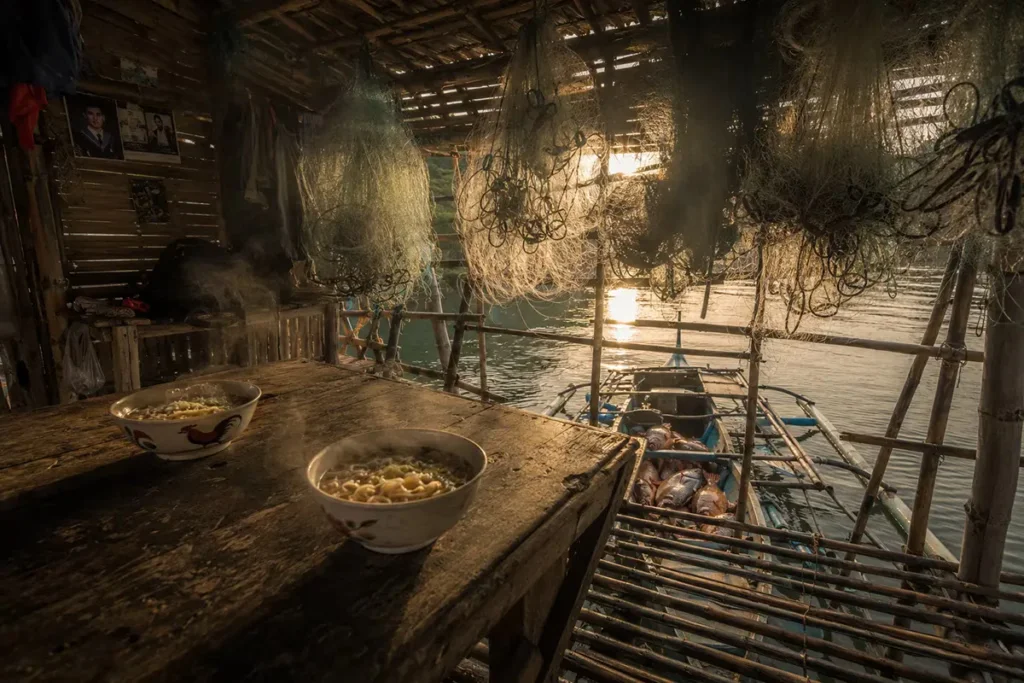
I sat across from Mang Tomas in his bamboo house perched on stilts above the water in Puerto Galera. His fishing net hung from the rafters, still damp from the morning catch. On the table between us sat two bowls of Lucky Me instant noodles, the cheap chicken flavor that costs eight pesos at the sari-sari store.
Through the floor slats, I could see his bangka boat tied to a post below. In its bottom was maybe twenty kilos of Lapu-Lapu, their scales catching the late afternoon sun like scattered coins.
“You’re not eating the fish?” I asked him.
He laughed, but there was no humor in it. “Boss, that fish is worth 400 pesos per kilo in Manila. You think I can afford to eat 8,000 pesos?”
That moment changed how I understood everything about food culture on Mindoro Island.
Key Takeaways
- Mindoro fishing families sell most of their catch for income, leaving them unable to afford the fish they catch.
- Economic pressures force these families to consume cheap instant noodles instead of nutritious seafood.
- Middlemen profit from the fishing industry, while fishermen receive little compensation for their labor and catch.
- Malnutrition results from protein-deficient diets, impacting children’s growth and education.
- Cultural shifts over generations show how fishing families have gone from consuming their catch to relying on less nutritious food.
The Backward Economics of Coastal Poverty

Most tourists wandering through Mindoro’s beaches assume the fishing families eat like kings. Fresh seafood every day, maybe some rice, coconuts from the trees, and mangoes when they’re in season. The culinary habits on Mindoro Island should reflect its abundance, given the surrounding waters.
It sounds like paradise until you do the math.
A fisherman on Mindoro’s coast might net 15,000 pesos in a good month. That’s about 270 dollars. His expenses include boat fuel, net repairs, bait, and the informal fees that middlemen extract at every turn. What’s left feeds a family of five or six.
The fish he catches belongs to the market, not to his table. Every piece represents cash he desperately needs for school fees, medicine, and the electric bill that climbs higher each year. Eating your own catch isn’t sustenance; it’s financial loss.
So, he sells the good fish and feeds his children Lucky Me noodles at seven pesos per pack. Sometimes, if his wife has energy after mending nets all day, she’ll crack an egg into the pot. That’s the luxury version.
I’ve watched this scene repeat itself in Sablayan, in Bulalacao, in Mansalay. The cruel arithmetic stays the same. The sea provides, but the fisherman’s family goes without.
The Middleman’s Cut Makes Everything Worse

Lito operates one of the buying stations in Calapan. I met him at the port before dawn, watching fishermen line up to sell their night’s work. He’s not a villain in this story, just another player in a system that’s been calcified for generations.
“I pay them 200 pesos per kilo for Lapu-Lapu,” he told me, squinting at a particularly nice specimen. “In Manila, the restaurant pays 600. But I have transport costs, ice, and the risk that the fish spoils in transit. I’m not getting rich either.”
He’s probably telling the truth. The real money vanishes somewhere in the chain between the ocean and the dinner plate, divided among truckers, wholesalers, and retailers, each taking their percentage. By the time Lapu-Lapu reaches a Manila restaurant, it costs 900 pesos per kilo. The fisherman who risked his life to catch it during a storm got 200.
The system works beautifully if you’re anywhere but at the beginning of the chain.
Mang Tomas can’t bypass Lito. He doesn’t have a truck, doesn’t have contacts in Manila, and doesn’t have the capital to front ice and transport costs while he waits for payment. He takes the 200 pesos because 200 is infinitely better than zero.
Then he goes home and boils noodles.

When Your Livelihood Becomes Unaffordable
The younger fishermen understand they’re trapped. Jeffrey is twenty-six, the third generation in his family to work these waters. He dropped out of college because his father got sick and someone needed to take the boat out.
“My grandfather ate fish every day,” he said. “My father, maybe three times a week. Me? If I eat the fish, my kids don’t eat at all.”
The culinary habits on Mindoro Island have shifted dramatically in just three generations. What was once daily sustenance has become an unaffordable luxury for the families who harvest it.
The economy has shifted underneath these families like tectonic plates. Thirty years ago, fish prices were lower, but so was everything else. A kilo of rice costs five pesos. Electricity was a luxury, not a utility bill. Kids didn’t need laptops for online classes.
Now, everything costs more except what fishermen earn. The gap widens every year.
Jeffrey’s kids eat fish maybe twice a month, usually the smallest specimens that won’t fetch good prices, or occasionally a bit of dried fish from the cheaper varieties. The rest of their diet is rice, noodles, and whatever vegetables his wife can grow in the small plot behind the house.
“People think we live next to the ocean, so we must eat well,” Jeffrey said. “They don’t understand that living next to something and being able to afford it are completely different things.”
The Protein Problem Nobody Talks About
Dr. Santos runs a rural health clinic in Mansalay. She sees the consequences of this backward economy every single day in her examination room. Malnutrition in fishing communities, she told me, looks different than starvation, but it’s just as damaging.
“These children eat enough calories,” she explained, reviewing a chart for a seven-year-old boy whose family I’d met. “Rice and noodles provide that. But they’re protein-deficient, lacking essential fatty acids, and missing vitamins you only get from a varied diet. The parents feed them, but they’re still malnourished.”
The instant noodle packets list their contents honestly. One serving provides 290 calories, mostly from refined carbohydrates and palm oil. Protein content is maybe six grams, barely enough to matter. Vitamins and minerals are minimal despite the “fortified” label that manufacturers slap on the package.
A growing child needs 19 to 34 grams of protein daily, depending on age. A serving of Lapu-Lapu provides about 26 grams of high-quality protein, plus omega-3 fatty acids that support brain development. The fish swimming under Mang Tomas’s house could transform his children’s nutrition.

Instead, it transforms into school uniforms and notebooks after passing through four sets of hands.
The Medical Practitioner Perspective
Dr. Santos said the test scores tell the story better than medical charts. Kids in fishing families perform worse in school than their inland peers, whose parents might be poor but eat their own harvest. Protein deficiency in childhood permanently affects cognitive development. The opportunity cost of selling fish instead of eating it plays out over decades.
“I tell the mothers to keep some fish for the family,” Dr. Santos said. “They look at me like I’m foolish. And from their perspective, I am. What good is a smart child who can’t go to school because you couldn’t pay the fees?”
The Cultural Shift That’s Breaking Traditions
Rosa is sixty-eight. She’s lived in Bulalacao her entire life, raised seven children, and buried a husband who drowned during a typhoon. She remembers when the culinary habits on Mindoro Island meant that fishing families ate what they caught without thinking twice.
“We were poor then, too,” she said, sitting outside her daughter’s house, watching her grandchildren play. “But we ate fish. Every day, sometimes twice. My children grew strong.”
She gestured toward the kids, thin-limbed and energetic. “These ones? Pancit canton and rice. Maybe egg if there’s extra money. Their father catches more fish than my husband ever did, but they eat worse than I did during the war.”
This is a Recent Situational Shift
The cultural memory of abundance is only one generation deep. Rosa’s grandchildren don’t remember a time when fish was a daily food. For them, instant noodles are normal. Fish is the special-occasion meal, the opposite of how their great-grandparents lived.
This shift happened fast, within living memory. It wasn’t a gradual cultural evolution. It was economics outpacing adaptation, forcing families to choose between tradition and survival. Survival won, but it wore the face of a Lucky Me packet.
Rosa’s daughter, Maricel, sees it differently. She’s forty-three and practical about the choices she makes. “Mama talks about the old days, but she forgets the typhoons that destroyed everything, the times when father couldn’t go out for weeks, and we had nothing. Now, at least we have steady buyers, and we know what we’ll earn. The fish brings cash. Cash brings options.”
“Options like instant noodles,” Rosa muttered. Maricel didn’t argue. She just stirred the pot on her clay stove, adding hot water to noodles while her husband’s catch sat in a cooler, waiting for the buyer’s truck.

Why Cooperative Solutions Keep Failing
I asked everyone I met the obvious question. Why don’t the fishermen form cooperatives, negotiate better prices, maybe even process and sell directly?
The answers varied in detail but shared a theme: trust is expensive when you’re poor.
Miguel tried to start a cooperative in Puerto Galera three years ago. Got twenty-three families to sign up, collected initial contributions, and even secured a small grant from an NGO that thought they were funding the next big success story.
“It fell apart in six months,” Miguel said. He wasn’t bitter, just tired. “Someone’s cousin needed surgery, took money from the fund without permission. Then families started accusing one another, claiming that some boats were hiding part of their catch. We spent more time fighting than fishing.”
The structural challenges run deeper than personality conflicts. A successful cooperative needs members who can wait for payment, absorbing operational costs until the fish sells at better prices through direct channels. Fishing families can’t wait. They need money today for food, tomorrow for fuel. The middleman’s instant payment, however unfair, beats the cooperative’s better price by two weeks.
Several government programs have tried to fix this. Low-interest loans for fishing equipment, training in value-added processing, and even attempts at direct market access through government purchasing programs. They fail for the same reason cooperatives fail: poverty makes planning impossible.
When your children are hungry today, you can’t invest in solutions that pay off next quarter. You sell the fish for whatever Lito offers, go home, and boil noodles.
The Environmental Price of Economic Pressure
Captain Reyes works for the municipal government, doing what he can with almost no budget to enforce fishing regulations. He’s fighting a battle he knows he’ll lose.
“Illegal fishing is getting worse,” he told me at his office, really just a desk in the corner of the municipal building. “Dynamite, cyanide, nets with illegal mesh sizes. I understand why they do it. When you’re desperate, you fish however you can.”
The environmental consequences feed back into the economic trap. Overfishing and destructive methods reduce fish populations. Smaller catches mean less income. Less income means more desperation. More desperation means more destructive fishing. The cycle accelerates.

Several families told me they catch maybe half as much as their fathers did from the same waters. The fish are smaller too, often juveniles that should be left to grow and reproduce. Everyone knows they’re destroying their own future.
But the future is a luxury when the present is crushing you.
Environmental groups occasionally give presentations on sustainable fishing practices. The fishermen sit politely through the talks, nodding at the right moments. Then they go back to their boats and do exactly what they did before, because sustainable fishing in depleted waters means catching even less, and they can’t afford less.
The environmental crisis on Mindoro’s coast is really an economic crisis wearing a different mask. Fix the economics, and fishermen will protect their waters. Leave the economics broken and watch everything collapse together.
What Actually Works, When It Works
Not every story ends with noodles. In Sablayan, a different model is showing tiny signs of success. Father Domingo, a priest who’s lived in the area for twenty years, helped broker an arrangement with three restaurants in Puerto Princesa.
The restaurants commit to buying set quantities at negotiated prices directly from a group of twelve fishing families. The families guarantee quality and sustainable practices. A small processing facility, funded through a combination of church money and government grants, handles cleaning and ice packing.
“It works because everyone gets something immediately,” Father Domingo explained. “The families get better prices paid within twenty-four hours. The restaurants get consistent quality and can advertise their sustainable sourcing. Nobody has to wait weeks for payment or trust complicated systems.”
The twelve families in this program now eat fish three or four times a week. Their children’s test scores improved noticeably, though Father Domingo acknowledges that correlation isn’t causation and other factors might be involved.
Still, the mothers report the difference. “My son can concentrate better in school,” one told me. “He’s not falling asleep in class anymore.”
The program works because it’s small, personal, and based on relationships rather than structures. Father Domingo knows every family. The restaurant owners visit regularly. Trust is built through presence, not paperwork. Scaling this model is the challenge. It works for twelve families. Mindoro has thousands. Father Domingo has tried to replicate it elsewhere with mixed results. The magic ingredient seems to be his personal credibility, built over two decades, which can’t be copied or exported.

The Question Tourists Never Ask
Visitors to Mindoro take photos of fishermen at sunset, post them on Instagram with captions about authentic island life and simple living. They eat Lapu-Lapu at beachfront restaurants, which complements its freshness, and they marvel at what appears to be Mindoro Island’s idyllic food culture.
However, they never ask what the fisherman’s family ate for dinner.
I understand the appeal of the narrative. Island fishing communities represent something we’ve lost in modern life: direct connection to food sources, traditional skills, and a supposedly simpler existence. We visit these places partly to remind ourselves that such life still exists.
But romantic poverty is still poverty. The fisherman hauling nets at dawn is working one of the most dangerous jobs in the world for wages that trap his family in malnutrition. There’s nothing simple about calculating whether to spend eight pesos on noodles or ten pesos on dried fish. There’s nothing authentic about children who live next to abundant sources of protein yet subsist on refined carbohydrates.
Tourism brings money to Mindoro, but most of it flows into resorts and dive shops rather than fishing communities. The structural economics that force fisherfolk to sell their catch rather than eat it persist whether or not tourists visit.
The few operations that successfully integrate fishing families into tourism revenue are exceptions. Most fishermen remain locked in the same system their grandfathers navigated, except that everything now costs more and the fish are scarcer.
When you eat Lapu-Lapu in Puerto Galera, someone’s child is eating Lucky Me. That’s not romance. That’s the math of coastal poverty, served with a wedge of calamansi.
What Changes Nothing and What Might
Charity doesn’t solve this. I’ve watched mission groups hand out food packages to fishing families, feeling virtuous about their generosity. The packages get consumed, the families say thank you, and absolutely nothing changes. Next week, they’re buying noodles again.
Individual choices don’t solve it either. You can pay extra at restaurants that source directly from fishermen, and you should, but twelve families in Sablayan hardly dent the problem affecting thousands. Government programs might solve it if implemented with understanding rather than political theater. Direct market access, processing facilities, cold storage, transport infrastructure: these aren’t sexy solutions, but they’re the ones that alter economics. The challenge is that politicians prefer ribbon-cutting ceremonies to maintenance budgets, and infrastructure requires both.

What might actually work is less satisfying than we’d like. Slow, unglamorous improvements in market access. Patient relationship-building between fishing communities and buyers. Investment in processing capability that lets families add value before selling. None of this fits in a social media post or a charity campaign.
The most important change might be a shift in perspective. Stop treating fishing communities as picturesque remnants of simple living. Recognize them as workers trapped in exploitative economics. Their problem isn’t a lack of fish or skill. It’s a market structure that extracts value at every step except the first one, where the actual work happens.
Mang Tomas doesn’t need your sympathy. He needs a price structure that lets him feed his children the protein he catches rather than sell it to feed yours.
The Conversation We’re Not Having
Here’s what bothers me most about this situation. Mindoro’s fishing communities exist in plain sight. Their boats line the coasts, their catches feed restaurants across Luzon, and their children attend schools where teachers notice the malnutrition. Everyone knows.
And everyone treats it as inevitable.
The middlemen say they can’t pay more because margins are tight. The restaurants say they can’t pay more because customers won’t accept higher prices. The government says it can’t intervene because markets must remain free. The families say nothing because they’re too busy trying to survive.
The Long and Short of it
Meanwhile, a fisherman boils noodles in a house built above water, full of fish he can’t afford to eat. The culinary habits on Mindoro Island reflect economic failure rather than cultural preference.
This isn’t a natural disaster or an unfixable problem. It’s a choice we make collectively every time we accept the current structure as unchangeable. The question isn’t whether solutions exist; Father Domingo’s small program proves they do. The question is whether we care enough to implement them at scale. I think about Jeffrey, the third-generation fisherman who dropped out of college. His kids might be fourth generation in these waters, or they might be the generation that finally gives up and moves to Manila’s slums. Either outcome is failure.

The ocean around Mindoro can sustain fishing communities indefinitely if managed properly. The economic systems governing those communities can be restructured to benefit the people doing the actual work. None of this is impossible.
But it requires admitting that the current system doesn’t work, never really worked, and serves everyone except the families with nets drying on their rafters.
We All Need to Jointly Address This Situation
That conversation makes people uncomfortable. It’s easier to post sunset photos and praise the fresh seafood than to ask why the person who caught it is eating instant noodles. People find it’s easier to donate a food package than to demand market restructuring. In addition, it’s easier to treat poverty as picturesque than to recognize it as a policy failure.
I sat with Mang Tomas for an hour that afternoon, eating noodles while fish literally swam beneath our feet. He told me about his father, his grandfather, the generations of men who worked these waters. He told me about his children’s dreams, their school projects, and their complaints about noodles for dinner again.
“They ask me why we don’t eat the fish,” he said. “What do I tell them? That we’re too poor to afford what we catch?”
I didn’t have an answer then. I don’t have one now. But I think the question deserves more than silence.
The next time you eat fresh Lapu-Lapu in a beachfront restaurant on Mindoro Island, taste the cost. Someone’s family couldn’t afford it. That’s not romantic, authentic, or simple. That’s just wrong.
And unlike typhoons or depleted fish stocks, it’s wrong in a way we could actually fix if we decided it mattered enough.
FAQ
Some do, but usually only the smallest fish that won’t fetch good market prices, or species with lower value. The prime catch represents desperately needed cash for bills, school fees, medicine, and other essentials. Eating a kilo of fish worth 400 pesos feels financially irresponsible when instant noodles cost 7 pesos per meal. The economic pressure to sell rather than consume is constant and overwhelming, which shapes culinary habits on Mindoro Island more than tradition or preference.
Direct selling requires infrastructure most fishing families don’t have: reliable transportation, ice and cold storage, business contacts, the ability to wait days or weeks for payment, and capital to absorb the risk if fish spoils before selling. Middlemen provide immediate cash payments, which fishing families need today, not next week. Several cooperative attempts have failed because poverty makes it impossible to wait for better prices later when you need money now.
As occasional food, they’re fine. As a dietary staple, they’re problematic. One packet provides about 290 calories, mostly from refined carbohydrates and palm oil, with only 6 grams of protein. Growing children need 19 to 34 grams of protein daily, plus essential fatty acids and vitamins that noodles don’t provide in meaningful amounts. The fish these families catch would deliver complete protein, omega-3 fatty acids, and micronutrients crucial for childhood development. The nutritional gap between what they catch and what they eat creates measurable malnutrition.
Government programs have attempted to address the issue through low-interest loans, market access initiatives, and fishing equipment subsidies. Most fail because they don’t address the core problem: fishing families need immediate income, not deferred benefits. Successful interventions require unglamorous infrastructure investments, such as processing facilities, cold storage, and transport networks, that enable fishermen to access better markets without waiting for payment. These programs require sustained funding and maintenance rather than one-time political gestures.
The relationship is cyclical. Economic desperation drives destructive fishing practices like dynamite, cyanide, and illegal mesh sizes because families need maximum catch regardless of long-term consequences. This depletes fish populations, reducing future catches and income. Lower income increases desperation, leading to more destructive practices. The environmental and economic crises feed into each other. Sustainable fishing requires economic security that allows families to think beyond immediate survival.
Choose restaurants and operations that verifiably source directly from fishing families at fair prices, though these are rare. Understand that your meal likely came at the cost of a family’s nutrition. Support infrastructure development and market reform rather than charity handouts that change nothing structurally. Most importantly, stop romanticizing fishing poverty as authentic island life. These are workers trapped in exploitative economics, not picturesque subjects for Instagram. Recognition of the problem matters more than feel-good gestures.
Small-scale successes exist, such as Father Domingo’s program in Sablayan, which connects 12 families directly with Puerto Princesa restaurants. It works because of personal relationships, immediate payment, and built trust over the years. Scaling these models is challenging because the success factors (personal credibility, small-group dynamics, individual attention) don’t transfer easily to programs that affect thousands. The successful elements involve patient relationship-building and infrastructure investment, neither of which photographs well for donors or politicians.
Most lack education or capital for alternative work. Fishing is generational knowledge and identity, not just a job. Moving to cities for other work typically means urban poverty rather than escape from poverty, trading sea access for slum conditions. Many families are also tied to coastal property that they can’t sell for meaningful amounts. The bigger question is why we accept that people catching food should be too poor to eat it, rather than asking why the occupation doesn’t provide basic dignity.
Other Articles You Might Like
- Mindoro Culture and Its Rich Craft Traditions
- Mindoro Traditional Food You Need to Try Today
- Samar Travel: Eating in the Heart of the Wilderness
- Mindoro Food Traditions and Their Unique Recipes
SUGGESTIONS FOR LODGING AND TRAVEL
Lodging is widely available throughout the Philippines. However, you may want to get some assistance booking tours to some of the Philippines’ attractions. I’ve provided a few local agencies that we’ve found to be very good for setting up tours. For transparency: We may earn a commission when you click on certain links in this article, but this doesn’t influence our editorial standards. We only recommend services that we genuinely believe will enhance your travel experiences. This will not cost you anything, and I can continue to support this site through these links.
- For Hotel Accommodations in the Manila area, I highly recommend The Manila Hotel. It is centrally located and within walking distance of Rizal Park and Intramuros. Many other attractions are easily accessible from there as well. I have provided a search box below to help you find hotels (click “Stays” at the top) or flights (click “Flights” at the top). This tool will provide me with an affiliate commission (at no cost to you).
Local Travel & Lodging Assistance
- Guide to the Philippines: This site specializes in tours throughout the Philippines. They seem to have some flexibility in scheduling, and pricing is very competitive.
- Kapwa Travel is a travel company focused on the Philippines. It specializes in customizing trips to meet customers’ needs.
- Tourismo Filipino is a well-established company that has operated for over 40 years. It focuses on tailoring tours to meet customers’ needs.
- Tropical Experience Travel Services – Tours of the Philippines: This company offers a range of tour packages, allowing you to tailor your trip to your preferences.
Lastly, we recommend booking international travel flights through established organizations rather than a local travel agent in the Philippines. I recommend Expedia.com (see the box below), the site I use to book my travel.

