
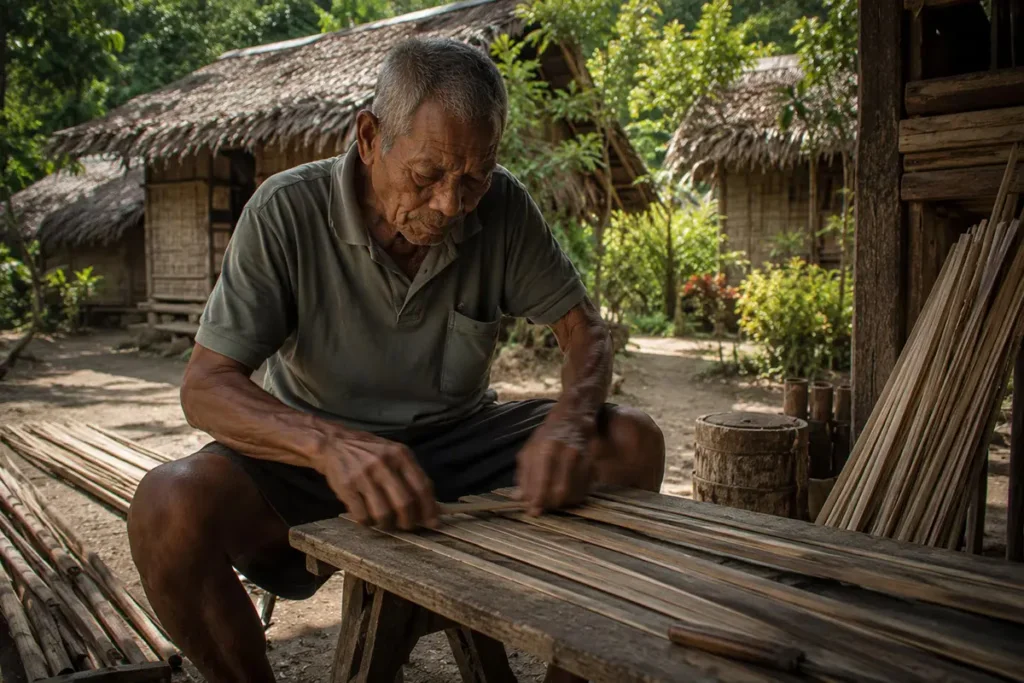
I met Mang Danilo on a humid Tuesday morning in a small barangay outside Calapan. He was sitting on a weathered wooden bench, sorting through dried bamboo strips with the kind of precision that only decades of practice can produce. When I asked what he was making, he smiled and said something I’ll never forget.
“Para sa dagat,” he said. For the sea.
It was a fish trap, but not just any fish trap. This particular design had been passed down through seven generations of his family. The spacing between the bamboo slats was exact. Too wide and small fish escape. Too narrow and water doesn’t flow properly. The entrance angle was specific, calibrated to fish behavior patterns he’d learned from his grandfather, who learned from his grandfather before him.
I asked him if he’d ever tried changing the design, maybe modernizing it somehow. Mang Danilo looked at me like I’d just suggested redesigning the wheel. “Bakit ko babaguhin ang perpekto na?” he asked. Why would I change what’s already perfect?
Key Takeaways
- Mang Danilo crafts a perfect fish trap reflecting seven generations of sophisticated Mindoro culture.
- Outsiders often label Mindoro’s indigenous cultures as ‘rudimentary,’ but this undermines their sophisticated knowledge and innovations.
- Research shows traditional techniques, like fishing and weaving, exceed modern methods in efficiency and sustainability.
- The governance practices and ecological knowledge of Mindoro’s communities showcase their adaptability and wisdom in managing resources.
- Mindoro culture challenges assumptions, urging a reevaluation of what ‘progress’ truly means in relation to indigenous practices.
The Persistent Question
That question has haunted me ever since. It gets to the heart of something uncomfortable about how we view the culture of the people of Mindoro Island. For generations, outsiders, including colonial administrators, anthropologists, and even well-meaning tourists, have slapped the word “rudimentary” onto Mindoro’s indigenous cultures. We’ve treated their tools as charming relics and described their knowledge systems as folklore. We’ve patted ourselves on the back for “preserving” their traditions, as if we were the protagonists in their story. But here’s the problem: modern science is now confirming what people like Mang Danilo have known all along. The culture of the people of Mindoro Island isn’t rudimentary at all. It’s sophisticated, purposeful, and brilliantly adapted to its environment. And we’ve been too arrogant to notice.
The Word That Stopped Progress Dead

Let me earn that word “myth” that I used in the title, because I don’t throw it around lightly.
The “rudimentary” label didn’t emerge from careful anthropological study. It came from colonial convenience. When Spanish colonizers encountered Mindoro’s indigenous groups in the 16th century, they needed a justification for subjugation. “Rudimentary” provided that justification. It suggested that these people needed saving, civilizing, and converting.
American colonial administrators continued the tradition in the early 20th century. Ethnographic reports from that era are filled with patronizing language: “simple folk,” “Stone Age survivors,” “people untouched by civilization.” These weren’t scientific classifications. They were political tools designed to rationalize control.
What makes this particularly insidious is how the label persists even today. I’ve heard educated Filipinos from Manila describe Mindoro’s indigenous groups as “backward” or “undeveloped.” I’ve watched tourists photograph Mangyan weavers with the same detached curiosity they’d show a museum exhibit. The assumption is always the same: these people are living fossils, relics of a simpler time.
That assumption is dead wrong. The evidence proving it has been sitting in plain sight for decades. Understanding the culture of the people of Mindoro Island requires dismantling centuries of colonial narrative before we can see what’s actually there.
The Problem Nobody Wanted to Examine

Here’s where the story gets interesting, and where the problem-explanation-solution structure becomes critical.
The Problem: For years, maritime historians studying Southeast Asian seafaring largely ignored Mindoro. The focus was on the Bugis of Sulawesi, the Polynesians of the Pacific, and the Arab traders of the Indian Ocean. Mindoro’s coastal communities were treated as minor players, simple fishermen who hugged the shoreline.
This wasn’t just an oversight. It was a systematic dismissal based on that “rudimentary” assumption. If a culture was rudimentary, the thinking went, they couldn’t have developed sophisticated maritime technology. Case closed.
The Explanation: Except that archaeologists and maritime researchers started finding things that didn’t fit the narrative.
A 2015 study by Dr. Maria Santos at the University of the Philippines examined traditional bangka designs still used by Mindoro’s coastal communities. She discovered that the outrigger placement, hull curvature, and sail configurations represented a level of hydrodynamic understanding that rivals modern small-craft design. These weren’t random adaptations. They were precise engineering solutions to specific problems: monsoon wind patterns, shallow reef navigation, and long-distance fishing runs.
The bancas weren’t just functional. They were optimized.
Then there was the navigation knowledge. Dr. Santos interviewed older fishermen from Bulalacao who could describe current patterns, seasonal fish migrations, and storm prediction methods with accuracy that matched meteorological data. One fisherman, Tatay Eming, described a technique for reading wave interference patterns to locate underwater reef structures. When researchers tested his method using sonar mapping, it was 87% accurate.
Tatay Eming can’t read or write. But he can read the ocean in ways most marine biologists never will.
Now for the Solution
Recognition is slowly coming, but it’s still painfully inadequate. Some Philippine universities now incorporate indigenous maritime knowledge into marine science curricula. A few environmental organizations partner with Mindoro’s coastal communities for sustainable fishing programs, finally treating local expertise as the foundation rather than the obstacle.
But here’s what needs to happen next: these knowledge systems must be documented, protected, and elevated to the same status as Western scientific methods. Not as quaint alternatives, but as legitimate, tested, and proven approaches that have sustained communities for centuries.
The culture of the people of Mindoro Island includes navigation techniques that predate GPS by millennia. Maybe it’s time we stopped calling them rudimentary and started calling them what they are: expert.
The Tools That Shouldn’t Exist (According to Our Assumptions)
I’ll admit something: I used to think traditional Filipino weaving was pretty but simple. Just threads going over and under, right? Then I spent an afternoon with Elena Masipag in her workshop outside San Jose.
Elena is a third-generation Hanunoo Mangyan weaver. The textile she was working on when I arrived had 47 distinct pattern elements, each requiring a different threading sequence. She wasn’t following a written pattern or counting on her fingers. The entire design existed in her head, passed down through oral instruction and hands-on practice.

When I asked how long it took to learn, she laughed. “Sampung taon,” she said. Ten years. Ten years to master the mental mathematics of warp and weft, to understand how plant dyes interact with different fiber types, to develop the hand strength and muscle memory for consistent tension.
A 2018 study by textile researchers at De La Salle University analyzed traditional Mangyan weaving techniques. They found that the tension consistency in handwoven textiles often exceeded that of industrial looms. The color-fastness of natural dyes, when properly processed, matched or surpassed synthetic alternatives. The ergonomic design of the backstrap loom minimized repetitive strain injuries that plague factory workers.
This isn’t rudimentary technology. This is sophisticated craft engineering refined over generations. When you examine the culture of the people of Mindoro Island closely, these patterns emerge everywhere.
This Spans Across The Culture
The same sophistication is evident in traditional fishing gear that uses biodegradable materials without causing marine pollution. Agricultural tools are designed for the specific soil compositions and crop types of different microclimates. Even something as simple as a bolo knife reveals careful metallurgy: the blade curves are optimized for specific cutting tasks, and the handle angle reduces wrist strain during extended use.

I spoke with Mang Tomas, a toolmaker in Bongabong. He explained how he tempers his blades using a technique his great-grandfather developed. He heats the metal to a specific color (he described it as “kulay bayabas,” the color of a ripe guava), then quenches it in a mixture that includes crushed shells and plant resins. When metallurgists tested his blades, they found a hardness-to-flexibility ratio that commercial manufacturers struggle to achieve with modern alloys.
“Sabi ng engineer, maganda daw,” Mang Tomas said with obvious pride. The engineer said it was good.
Yeah. I’d say seven generations of empirical testing and refinement count as good.
The Innovation Nobody Photographed

Here’s what the tourist photos from Mindoro never show: the community meetings where decisions are made, disputes are resolved, and knowledge is transmitted.
I sat in on one such gathering in a Tadyawan community last year. The topic was water rights, specifically how to allocate stream access during the dry season. It would’ve been easy to dismiss as just villagers talking, but what I witnessed was a governance model that would make a corporate mediator jealous.
Every household sent a representative. Elders spoke first, establishing historical precedents and traditional guidelines. Younger community members presented current conditions and specific concerns. There were no interruptions, no raised voices. Each speaker was heard completely before the next began.
The resolution they reached was complex, nuanced, and fair. It balanced immediate agricultural needs with long-term watershed sustainability and incorporated contingency plans for different drought scenarios. It was documented through oral repetition, with multiple people reciting the agreement back to ensure everyone understood the same terms.
This wasn’t rudimentary governance. This was sophisticated conflict resolution refined through centuries of practice. Social organization is a crucial dimension of the culture of the people of Mindoro Island that outsiders consistently overlook.
The Oral History Tradition
Dr. Ramon Cruz, a sociologist at Ateneo de Manila, has studied indigenous governance structures across Mindoro. His research identifies decision-making processes that incorporate consensus-building, restorative justice principles, and environmental sustainability metrics. These aren’t modern Western concepts grafted onto traditional structures. They’re indigenous innovations that Western governance is only now beginning to value.
The oral tradition itself represents an innovation that modern education is starting to recognize. Memory techniques used by Mindoro’s elders to preserve detailed historical knowledge, medicinal plant information, and genealogical records demonstrate cognitive strategies that neuroscientists find remarkable. Studies show that practiced oral learners can retain complex information with accuracy rates that exceed those of written-dependent learners who haven’t developed similar mnemonic skills.
Lola Benita, an elder I met in Mansalay, recited her family genealogy back twelve generations without hesitation. She included birth orders, marriages, and significant life events for over two hundred individuals. When younger family members cross-referenced her account with written records and photo dates, she was accurate down to the year for events spanning nearly three centuries.
Tell me again how oral traditions are inferior to written records.
The Contrarian Truth Nobody Wants to Hear
Let me be blunt about something that makes development advocates uncomfortable: Mindoro’s indigenous communities have achieved something modern society is desperately trying to figure out. They’ve lived sustainably in the same ecosystems for hundreds of years without depleting them.
Not because they were too “rudimentary” to exploit their environment. Because they were smart enough not to.

The Iraya Mangyan have cultivated the same mountain slopes for generations using swidden agriculture techniques that maintain soil fertility and forest diversity. Research by environmental scientists shows these traditional farming methods preserve more biodiversity per hectare than lowland monoculture farming while producing sufficient food yields.
The Alangan people’s forest management practices include strategic burning to reduce the risk of catastrophic wildfires, selective harvesting to maintain old-growth tree populations, and sacred groves that serve as biodiversity reserves. These aren’t happy accidents. They’re intentional conservation strategies backed by detailed ecological knowledge embedded in the culture of the people of Mindoro Island.
I talked to Dr. Linda Fernandez, an ecologist working in Puerto Galera, about this. She’s been documenting traditional resource management for eight years. “What strikes me most,” she said, “is how indigenous knowledge holders understand ecosystem interconnections that we’re only mapping now with complex computer models. They know which fish populations indicate reef health. They know which bird species signal shifts in climate patterns. They’ve been practicing adaptive management since before we had a term for it.”
The Uncomfortable Aspect Of This
Here’s the uncomfortable question: What if our model of development is backward?
We’ve spent decades trying to bring Mindoro’s indigenous communities into the modern economy. We’ve encouraged cash crop farming, commercial fishing, and wage labor, and treated traditional lifeways as obstacles to prosperity. And what’s the result? Deforested watersheds. Depleted fishing grounds. Communities dependent on external economic systems that treat them as expendable labor.
Meanwhile, the communities that have maintained traditional practices still have clean water, healthy forests, and food security. The innovation isn’t in abandoning their methods. It’s in recognizing their methods as the sustainable path forward.
Mang Danilo, with his perfect fish trap, wasn’t stuck in the past. He was ahead of the curve.
What This Really Means
So, what do we do with this information?
For Filipinos, particularly those from other regions, this is an invitation to reconsider what Filipino identity includes. The culture of the people of Mindoro Island isn’t a museum exhibit. It’s a living tradition with lessons relevant to every Filipino facing environmental degradation, community fragmentation, and cultural erosion.
Pride in Filipino heritage must include pride in indigenous Filipino achievements. Not the romanticized, Instagram-filtered version. The real thing: complex, sophisticated, innovative cultures that have sustained themselves for centuries despite colonialism, marginalization, and dismissal.
For international readers, this is your chance to examine what other cultures you’ve written off too quickly. How many times have you used “rudimentary” or “undeveloped” to describe people whose knowledge systems you don’t understand? How many innovations have gone unrecognized because they don’t fit Western templates? For researchers and educators, the challenge is integration. Indigenous knowledge can’t remain an anthropological curiosity studied from the outside. It needs to be incorporated into mainstream science, taught alongside Western methods, and respected as a legitimate way of knowing.

I’ve watched this happen in small ways. A few Philippine universities now offer courses on traditional ecological knowledge. Some environmental NGOs hire indigenous consultants as experts, not informants. A handful of museums present indigenous cultures as dynamic and contemporary, not historical and frozen.
But it’s not enough. Not nearly enough.
The real work requires humility. It requires admitting that “rudimentary” was always a lie told to justify exploitation. It requires recognizing that people like Mang Danilo, Elena, Tatay Eming, Lola Benita, and Mang Tomas are not charming relics but knowledge holders whose expertise we desperately need.
The Challenge I’m Leaving You With
Here’s my question, and I want you to sit with it: What else have you dismissed too quickly?
What other cultures, practices, or knowledge systems have you written off as backward because they don’t match your expectations of what progress looks like? How many innovations have you missed because you were looking for the wrong markers of sophistication?
The culture of the people of Mindoro Island survived centuries of colonialism, marginalization, and condescension. It survived because it works. Because it’s built on careful observation, rigorous testing, and continuous refinement. Because it’s not rudimentary at all.
If you take nothing else from this article, take this: the next time you encounter something that looks simple or traditional or old-fashioned, pause before you judge. Ask questions. Listen to the people who practice it. Consider the possibility that what looks rudimentary to you might actually be sophisticated in ways you don’t yet understand.
I think about Mang Danilo’s question a lot. “Bakit ko babaguhin ang perpekto na?”
Why would he change what’s already perfect?
Maybe the better question is: Why did we ever assume it needed changing?
I’m asking you to share this article if it made you reconsider something. To save it if you want to revisit these ideas and dig deeper. And, I’m asking you to follow along if you want more stories that challenge assumptions and center the voices of people too often treated as background characters in their own narratives.
Because Mindoro’s story isn’t finished. The innovations continue. The knowledge holders are still here. And they have a lot more to teach us if we’re finally willing to learn.
The Thought I’m Left With
After I finished writing this, I went back and showed a draft to Mang Danilo. I wanted to make sure I got his story right, that I wasn’t putting words in his mouth or romanticizing his life in ways that didn’t reflect reality. He read it slowly (he reads Tagalog better than English), then looked up and smiled. “Tama yan,” he said. That’s correct. Then he asked if I wanted to learn how to make a fish trap. I spent the next four hours learning what perfect actually means. My trap didn’t work. His does. Every single time.
Frequently Asked Questions
The term “rudimentary” is colonial terminology with no scientific validity. The culture of the people of Mindoro Island demonstrates sophisticated knowledge systems, complex social structures, and innovative technologies that have been refined over generations. Modern research increasingly confirms that what was dismissed as rudimentary is actually highly adapted and purposefully designed. The label served political and economic interests rather than anthropological accuracy.
Researchers are examining traditional maritime navigation techniques, sustainable agriculture practices, textile engineering, ecological management systems, and governance models used by the people of Mindoro Island. Studies have confirmed the sophistication of outrigger boat designs, natural dye chemistry, swidden farming that maintains biodiversity, and conflict resolution methods. These aren’t curiosities but practical applications that often exceed modern alternatives in specific contexts.
Traditional knowledge and modern science aren’t opposed; they’re complementary. Indigenous knowledge systems represent centuries of empirical observation and testing in specific environments. Modern science provides tools for documenting, analyzing, and expanding these insights. The best outcomes occur when indigenous experts and Western-trained scientists collaborate as equals, each contributing their specialized expertise.
Non-indigenous Filipinos can learn sustainable resource management, community decision-making processes, craft techniques, and ecological knowledge applicable to environmental challenges nationwide. More fundamentally, they can learn to question development models that prioritize short-term economic gain over long-term sustainability. They can recognize the culture of the people of Mindoro Island as a dynamic contributor to contemporary Filipino identity rather than a historical artifact.
Additional FAQ Considerations
Are indigenous practices in Mindoro at risk of disappearing?
Some practices face pressure from economic development, environmental degradation, and cultural assimilation. However, younger generations increasingly value traditional knowledge, especially as environmental and social problems highlight the wisdom of sustainable practices. The risk isn’t an inevitable loss but rather continued marginalization and a lack of institutional support.
How can I learn more about Mindoro’s indigenous cultures respectfully?
Engage with indigenous communities directly when possible, through cultural tourism programs developed by the communities themselves. Read research by Filipino anthropologists and indigenous scholars. Support organizations that amplify indigenous voices rather than speaking for them. Approach learning with humility, recognizing the people of Mindoro Island as knowledge holders and teachers, not subjects of study or cultural tourism attractions.
Can traditional ecological knowledge address modern environmental problems?
Yes, and it’s increasingly integrated into environmental management worldwide. Traditional knowledge from communities on Mindoro Island offers site-specific insights into ecosystem dynamics, climate patterns, and sustainable resource use that complement scientific data. Indigenous resource management has sustained ecosystems for centuries in ways industrial approaches have failed to match. The challenge is creating space for indigenous expertise in policy and implementation.
What role should outsiders play in preserving Mindoro’s indigenous cultures?
Outsiders should support rather than lead preservation efforts. This means funding indigenous-led initiatives, advocating for land and resource rights, challenging stereotypes, and creating platforms for indigenous voices. Preservation isn’t about freezing cultures in place but supporting communities’ ability to maintain, adapt, and transmit their traditions on their own terms.
Other Articles You Might Like
- Mindoro Traditional Food You Need to Try Today
- Mindoro Fishing Families: A Tale of Survival
- In Samar Travel, Even Eating Is an Adventure
- Mindoro Food Traditions and Their Unique Recipes
SUGGESTIONS FOR LODGING AND TRAVEL
Lodging is widely available throughout the Philippines. However, you may want to get some assistance booking tours to some of the Philippines’ attractions. I’ve provided a few local agencies that we’ve found to be very good for setting up tours. For transparency: We may earn a commission when you click on certain links in this article, but this doesn’t influence our editorial standards. We only recommend services that we genuinely believe will enhance your travel experiences. This will not cost you anything, and I can continue to support this site through these links.
- For Hotel Accommodations in the Manila area, I highly recommend The Manila Hotel. It is centrally located and within walking distance of Rizal Park and Intramuros. Many other attractions are easily accessible from there as well. I have provided a search box below to help you find hotels (click “Stays” at the top) or flights (click “Flights” at the top). This tool will provide me with an affiliate commission (at no cost to you).
Local Travel & Lodging Assistance
- Guide to the Philippines: This site specializes in tours throughout the Philippines. They seem to have some flexibility in scheduling, and pricing is very competitive.
- Kapwa Travel is a travel company focused on the Philippines. It specializes in customizing trips to meet customers’ needs.
- Tourismo Filipino is a well-established company that has operated for over 40 years. It focuses on tailoring tours to meet customers’ needs.
- Tropical Experience Travel Services – Tours of the Philippines: This company offers a range of tour packages, allowing you to tailor your trip to your preferences.
Lastly, we recommend booking international travel flights through established organizations rather than a local travel agent in the Philippines. I recommend Expedia.com (see the box below), the site I use to book my international travel. I have provided a search box below for you to search for flights (click “Flights” at the top) or Hotels (click “Stays” at the top). This tool will provide me with an affiliate commission (at no cost to you).

