
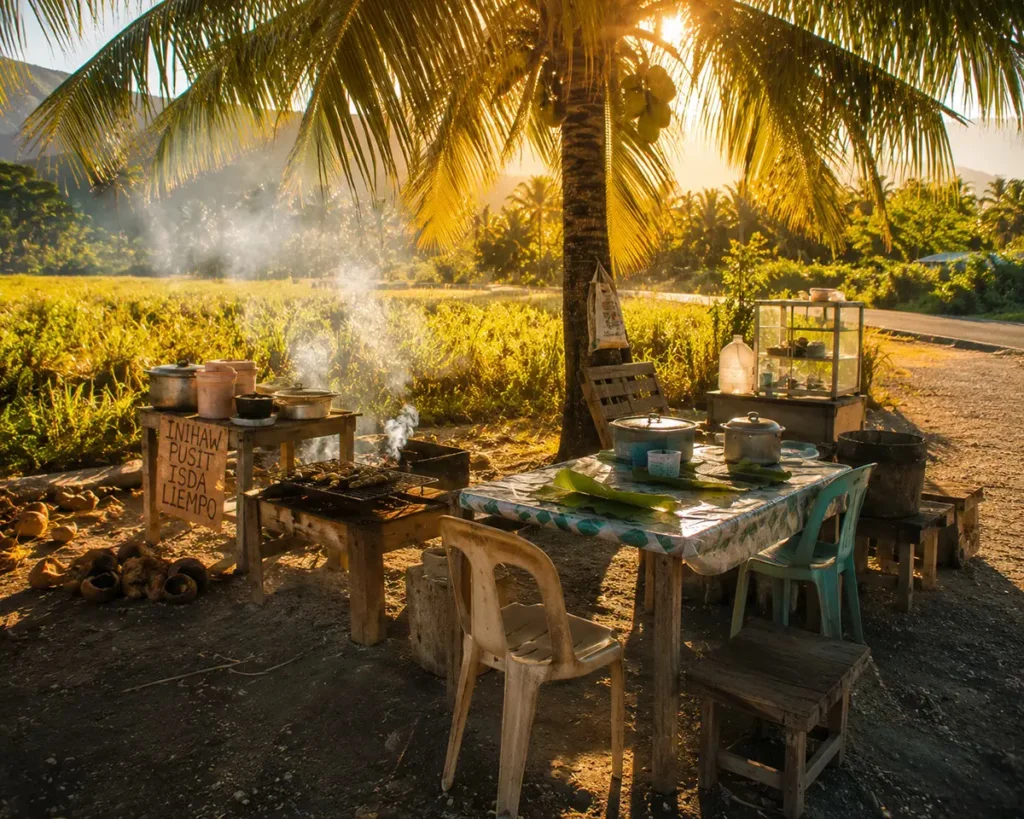
Mang Tonio’s restaurant had no walls. It had no sign either, unless you count the faded San Miguel Beer poster stapled to a coconut tree. What it did have was a wobbly plastic table, three mismatched chairs, and a cooler containing exactly four items: two bottles of warm Coke, a plastic bag of rice, and something wrapped in banana leaves that I sincerely hoped was fish. Travel in Samar, food and all, was truly shaping up to be a real adventure.
This was lunch in Eastern Samar. No menu, no prices posted, and no health department rating sticker. Just Mang Tonio squatting by a cooking fire, looking at me with the patient expression of someone who had seen confused foreigners before and knew they eventually got hungry enough to stop asking questions.
“Ano po, meron?” I asked. What do you have?
He smiled. “Meron.”
That was the entire exchange. To my surprise, five minutes later, I was eating the best grilled tuna I’d had in months, prepared on equipment that would give any health inspector a stroke. It turns out that the food on Samar is authentic Filipino food at its finest. Welcome to Samar Travel, where Yelp is useless, and your stomach becomes a trust exercise.
Key Takeaways
- Samar travel emphasizes authentic experiences over conventional restaurant reviews, requiring different skills to navigate local dining options.
- Limited infrastructure shapes the food culture, leading to informal eateries rather than traditional restaurants.
- Observing where locals gather, asking specific questions, and noting visual markers enhance the dining experience in Samar.
- Eating in Samar fosters genuine interactions, with meals often leading to conversations about local life and culture.
- While food safety can be a concern, local knowledge and observation are crucial for managing risks effectively.
The Problem with Restaurant Reviews in Rural Philippines

Here’s what nobody tells you about traveling in unusual Philippine travel destinations like Samar and Dinagat Island: the entire Western framework for evaluating food collapses. You can’t Google “best restaurants near me” when the nearest restaurant with a Google listing is 40 kilometers away. You can’t check TripAdvisor reviews when the local eatery has never heard of TripAdvisor and wouldn’t care if they had.
I learned this the expensive way during my first trip to Samar in 2015. I’d arrived in Borongan with a downloaded travel guide that recommended exactly two dining establishments. Both were closed. One appeared to have been closed for years, as evidenced by vegetation growing through the front door.
My carefully researched food strategy lasted about 90 minutes before hunger forced a change. This is how every traveler eventually learns that in rural Philippines, eating requires entirely different skills. Not restaurant reviews and not online ratings, but people skills and observational ability. Not menu navigation, but cultural intuition.
The shift feels uncomfortable at first. We’re trained to want information before commitment. We want photos of the dish, a list of ingredients, preferably some reassuring stars or forks, or cartoon chili peppers indicating heat level. In off-grid travel in the Philippines, you get none of that. You get pointed in a direction and told, “May kainan doon.” There’s food over there.
Why Samar Operates Differently
Samar isn’t deliberately trying to confuse visitors. The food culture here developed in response to geography and economics, not tourism marketing. Eastern Samar particularly suffers from infrastructure challenges that make conventional restaurant business models impractical.
Limited electricity means no reliable refrigeration. This makes inventory management a daily affair, not a weekly one. What Aling Rosa cooks today depends entirely on what arrived fresh that morning. There’s no set menu because the available ingredients change with the weather, season, and which fishermen actually went out.
Low population density makes dedicated restaurant spaces financially risky. Why maintain a storefront when you can cook at home and serve the same neighbors who would visit anyway? The result is rural Philippine dining dominated by home kitchens, roadside setups, and temporary arrangements that materialize and vanish based on demand.
Poor road conditions limit distribution networks. In Manila, restaurant owners can source ingredients from multiple suppliers. In rural Samar, you work with what’s available locally, or you don’t work at all. This forces creativity and seasonal adaptation that Western diners rarely encounter.
The Real Food Infrastructure
Once you accept that conventional restaurants barely exist, you start noticing the actual food system. It’s everywhere, just hidden in plain sight.
The roadside vendor with the bamboo cart isn’t a snack option. She’s the breakfast institution. Those banana-wrapped packages contain puto, suman, or bibingka, which constitute the morning meal for everyone in that barangay. She’s been setting up in that exact spot for 12 years. Everyone knows her schedule better than any posted hours.

The house with the small window cutout and a hand-lettered “KARINDERYA” sign is the lunch solution. Inside, Aling Marie prepares four dishes daily. She doesn’t list them because her regular customers already know what day means what dish. Tuesday is always sinigang. Friday is always fried fish. This isn’t inflexibility; it’s reliable rhythm.
The evening barbecue setup near the basketball court appears at exactly 5:30 PM. Mang Pedro grills chicken, pork, and occasionally squid while neighborhood kids play. He’s not running a restaurant. He’s financing his daughter’s college education through consistent evening sales. Everyone in town knows this. Supporting him isn’t charity; it’s community investment with delicious returns.
Navigation Tactics That Actually Work
After nine years of traveling in Samar, I’ve developed a functional approach that doesn’t require cellular data or advance planning. These aren’t tourist hacks. They’re basic survival skills for anyone traveling beyond the guidebook circuit.

Watch Where Locals Gather
People cluster around reliable food. That’s a universal truth. In Samar towns, observe movement patterns around meal times. Notice where tricycle drivers park and eat. Watch where construction workers take breaks. Follow where groups of students congregate after school. These human patterns reveal the actual food economy.
I found the best lechon in Catbalogan by watching where the election rally organizers sent their runners. Political campaigns need to feed large groups efficiently. They’re not using Google. They’re using institutional knowledge of which vendor can actually deliver.
Ask Specific People Specific Questions
Not all recommendations carry equal weight. The hotel receptionist might genuinely not know where locals eat, since she brings her lunch from home. The tricycle driver who’s lived here 20 years absolutely knows.
My working strategy: find someone working a job that requires local knowledge. Tricycle drivers, sari-sari store owners, barangay health workers, teachers. These people move through the community daily. Their food recommendations are field-tested.
The phrasing matters too. Don’t ask “where’s a good restaurant?” That triggers the tourism response, where they recommend the one air-conditioned place foreigners supposedly prefer. Ask instead, “Saan kayo kumakain?” Where do you eat? That gets you the real answer.
Learn the Visual Markers
Active food operations leave clues. Smoke rising at mealtimes means cooking is underway. Parked motorcycles suggest people are inside eating. Washing activity visible outside a home kitchen indicates recent service. Empty tables getting wiped down mean you just missed the rush, but they’re still serving.
I’ve learned to identify the cooler setup that indicates fresh inventory. That beaten Coleman cooler sitting outside isn’t a decoration. It contains today’s fish delivery, and its presence means the owner is confident enough in turnover to invest in fresh products. That confidence usually proves justified.
What Happens When Eating Becomes Conversation
The absence of formal restaurant structure creates something unexpected: genuine interaction. When there’s no menu to hide behind, no waiter managing the buffer between kitchen and customer, eating becomes inherently social. At Nanay Vilma’s karinderya in Hernani, ordering involves entering her kitchen. Not a dining room designed to look like a kitchen, but her actual home kitchen, where her grandchildren do homework at the table while she cooks. You point at pots. She explains what’s in them. You negotiate portion size. Her grandson practices English by asking where you’re from.

This isn’t a tourist experience someone designed. It’s just how the space functions. The intimacy isn’t manufactured; it’s structurally inevitable. There’s nowhere else to stand, so you stand in the kitchen, and there’s no printed menu, so conversation fills the information gap. Finally, and most importantly, there’s no credit card terminal, so cash changes hands directly, and she usually rounds down.
I’ve learned more about Samar politics over lunch at roadside setups than from any news article. When you’re the only stranger in a space where locals gather, you become the day’s interesting variable. People ask questions. They offer opinions. They debate each other using you as the excuse to discuss topics they’ve been arguing about for months.
The Information Exchange Goes Both Ways
These encounters educate visitors, but they also educate hosts. I’ve watched Aling Rosa’s perception of foreigners shift over multiple visits. The first time, she was clearly nervous about whether I’d complain about the plastic furniture or the communal water bucket. The third time, she was asking my opinion on whether her son should take the job in Manila or stay local.
That shift happened because the setup forced interaction. Had this been a formal restaurant with professional service barriers, we’d have maintained our respective roles. Customer and proprietor. Tourist and local. Instead, we became something more functional: two people sharing space and food and eventually, actual thoughts.
I’m not romanticizing this. Plenty of these interactions stay surface-level. But the potential for depth exists in ways that air-conditioned restaurants with printed menus actively prevent. The infrastructure creates possibilities.
The Safety Conversation Nobody Wants to Have
I’d be lying if I claimed this approach carried no risk. It does. I’ve gotten food poisoning twice in Samar. Once grilled pork that had spent too long in tropical heat. Once from something I still can’t identify, but that exited my system with impressive velocity.
Both incidents were miserable. Both were also educational. The first taught me to observe how long cooked meat sits exposed. The second taught me that “bizarre local specialty” sometimes just means “thing locals rarely eat because it’s an acquired taste nobody actually acquired.”
But here’s what surprises people: I’ve also gotten food poisoning twice in Manila. Once from an expensive restaurant in Makati. Once from a hotel breakfast buffet. Formal infrastructure doesn’t guarantee safety. It just provides someone to sue afterward, which helps exactly zero when you’re losing fluids from both ends.
Practical Risk Management

I’m not encouraging recklessness. I’m encouraging calibrated risk based on observation rather than Western assumptions about what “clean” looks like.
That bamboo cart with the banana-wrapped rice cakes looks rudimentary. But notice that Nanay wraps everything individually, handles food with clean plastic, and sells out by 9 AM. High turnover means fresh product. Individual wrapping means contamination control. Her rudimentary setup outperforms the buffet model, where food sits exposed for hours while teenagers cough over it.
The home kitchen with the cooking fire looks unsanitary. But notice that Aling Marie washes everything in boiled water, cooks everything thoroughly, and serves everything immediately. Her methods predate modern understanding of sanitation, but they’re functionally effective. Fire kills pathogens. Boiling purifies water. Immediate service prevents bacterial growth.
I’m not suggesting zero caution. I’m suggesting that caution should target actual risk factors rather than aesthetic comfort. The immaculate-looking restaurant with the broken refrigerator poses more danger than the street vendor who grills everything to order over open flame.
Why This Matters Beyond Food
This entire discussion about authentic Filipino food in Samar is actually about something larger: whether travelers can handle ambiguity. Not everything translates into the familiar framework. Not every experience comes with ratings, reviews, and reassuring Western-style quality markers.
Unusual Philippine travel destinations like Samar and Dinagat Island remain off most itineraries, partly because they require visitors to adapt. You can’t app your way through these locations, and you can’t rely on online research to eliminate uncertainty. You have to show up, observe, ask real humans real questions, and accept that sometimes lunch comes with surprise ingredients. That discomfort isn’t a bug. It’s the entire point. If you could navigate Samar using the same tools that work in Boracay, Samar would just be another Boracay. The difficulty creates self-selection. People who need predictability stay away. People who can tolerate adaptation discover places that mass tourism hasn’t optimized into interchangeable comfort.

The Reward Structure
What do you actually get for accepting this uncertainty? Better food? Sometimes, but not reliably. What you definitely get is better stories, better interactions, and a better understanding of how actual Filipinos live outside tourist zones.
That matters if you claim to want authentic travel experiences. Authenticity doesn’t mean staged cultural performances. It means participating in actual life as it exists for residents. In adventure travel in the Philippines, actual life means eating at Nanay’s kitchen because that’s where everyone eats. It means the grilled fish from Mang Tonio, because he’s been the Tuesday-lunch solution for this stretch of road for 15 years. It means accepting that sometimes you don’t know what you’re eating until you ask halfway through.
Every travel forum contains someone asking, “What’s the real Philippines like?” This is what it’s like. Not resort buffets, not Manila hotel restaurants,and not even the carefully curated “local favorite” restaurants made it into Lonely Planet. The real Philippines is Aling Rosa’s karinderya, where the menu is whatever she bought fresh today, and your presence is noteworthy enough that her neighbors come over to stare.
What You Actually Need to Succeed
This approach requires specific capabilities that many travelers haven’t developed because mainstream tourism doesn’t demand them. If you’re considering off-grid travel in the Philippines, such as Eastern Samar, audit yourself honestly on these points.

Basic language ability matters more than any app. You need functional Tagalog or Waray-Waray phrases. Not fluency, but enough to ask what’s available, negotiate prices, and understand basic responses. “Ano meron?” “Magkano?” “Masarap ba yan?” These simple questions unlock the entire food system.
Observational patience beats internet research. You need to actually watch how locals interact with vendors. Notice who returns repeatedly. Observe which setups generate lines. Register who’s eating what and whether they look satisfied. This takes time and attention that Google searching doesn’t require.
Social courage matters most. You need to be willing to enter someone’s kitchen, point at pots, ask questions, and endure the attention that comes from being the obvious foreigner. If that social exposure feels overwhelming, Samar will find it hard. The entire food infrastructure assumes you’ll interact.
Stomach resilience helps but develops over time. I don’t have an iron gut. I just have a gut that’s encountered enough variations that it doesn’t panic at new bacterial profiles. You build this through exposure, not through natural immunity. Start in Manila. Progress to provincial cities. Eventually attempt rural adventures. The sequence matters.
The Ending Nobody Wants to Hear
Most people won’t travel this way. That’s not criticism. It’s reality. The infrastructure exists specifically because most tourists avoid places without proper infrastructure. Samar remains relatively untouristed because it actively resists the expectations most travelers bring.
But here’s the uncomfortable question: if you claim you want authentic experiences but require Western comfort frameworks to feel safe, what exactly are you seeking? You’re not looking for authenticity. You’re looking for staged authenticity delivered in familiar packaging. That’s fine, but call it what it is.
Authentic Philippine street food experiences in places like Samar mean accepting that lunch happens on Mang Tonio’s terms, not yours. It means eating what’s available rather than what you prefer, and trusting Aling Rosa’s judgment about whether the fish is fresh because you have no alternative source of information. It also means occasionally getting sick and recalibrating your approach based on experience rather than abandoning the entire project.
The reward isn’t better food, though sometimes you get that. The reward is operating in the world as it actually exists for most Filipinos, not as it’s been modified for tourist consumption. That’s worth something, but only if you’re honest about whether you actually want it.
Your comfort zone exists for good reasons. It keeps you safe, fed, and free from diarrhea. But it also keeps you from having conversations in Nanay Vilma’s kitchen, from learning why Mang Tonio switched from farming to roadside grilling, from understanding how actual food systems function when poverty makes conventional restaurants impractical. So the real question isn’t whether Samar has good restaurants. It’s whether you’re willing to eat lunch in a place where that question doesn’t even make sense.

Final Thought
The best meal I’ve ever eaten in Samar cost 75 pesos and came from a vendor whose name I never learned. She set up every Thursday near the Borongan public market, grilling fish over coconut husks while her daughter sold the catch. The fish was so fresh it had been swimming that morning. The simplicity was perfect: salt, calamansi, fire. No menu could have prepared me for that. No review would have captured it. I found it by watching where the locals lined up and joining them. That’s the entire strategy. Watch, ask, show up, eat. Everything else is just fear dressed as standards.
Frequently Asked Questions
Risk exists anywhere you eat. I’ve gotten food poisoning from expensive Manila restaurants and been perfectly fine at dozens of roadside vendors. Safety depends more on observation than infrastructure. Watch for high turnover, fresh ingredients, thorough cooking, and immediate service. Those factors matter more than whether a place has walls and a sign. Bring anti-diarrheal medication regardless. It’s the Philippines. Bacterial profiles differ from Western gut training.
You ask. Point to the food and say, “Ano ito?” What is this? Ask “anong recommended mo?” What do you recommend? Most vendors are happy to explain, especially if you show genuine interest rather than tourist nervousness. Learn the names of common Filipino dishes before arriving. That vocabulary makes the conversation easier. Accept that sometimes you won’t know exactly what you’re eating until halfway through. That’s part of the adventure travel experience in the Philippines.
Communicate them clearly in Tagalog or Waray-Waray. Food allergies aren’t well understood in rural areas, so explain specifically what happens if you eat the restricted item. “I get very sick” works better than “I’m allergic.” Vegetarians face challenges because fish sauce and shrimp paste appear in almost everything. Severe restrictions might require bringing supplemental food. Rural Samar isn’t designed for dietary customization.
Typical karinderya meals run 60 to 100 pesos for rice and two viands. Roadside grilled items cost 20 to 50 pesos, depending on size. Street snacks like puto or suman cost 5 to 15 pesos. If someone quotes prices dramatically higher than these ranges, you’re being charged foreign tax. Politely negotiate or walk away. Most vendors charge locals and foreigners the same rate, but occasional opportunism happens.
Essential food phrases: “Ano meron?” (What do you have?), “Magkano?” (How much?), “Pwedeng makita?” (Can I see it?), “Saan ako pwedeng kumain?” (Where can I eat?), “Masarap ba yan?” (Is that good?), “Busog na ako” (I’m full), “Salamat” (Thank you). Learn the numbers 1 through 10 for price negotiation. Practice pronunciation before traveling. Locals appreciate effort even if your grammar fails.
Stay hydrated. Oral rehydration salts available at any botika are more effective than plain water. Anti-diarrheal medication like loperamide helps with travel, but doesn’t cure anything. Most cases of food poisoning resolve within 24 to 48 hours. Seek medical attention if symptoms include high fever, blood in stool, or severe dehydration. Provincial hospitals can handle common food poisoning. Don’t panic. It’s miserable but rarely dangerous for healthy adults.
Difficult but possible. Filipino food culture centers on fish and meat. Even vegetable dishes often contain shrimp paste or fish sauce. Your best options: plain rice, fresh tropical fruit, and grilled corn from street vendors. Some karinderyas will prepare vegetables without meat if you request it, but note that the flavor base is likely still made with animal products. Serious vegetarians should bring supplemental protein sources. Rural Philippine dining wasn’t designed for plant-based diets.
Filipino hospitality can feel overwhelming. People offer food constantly and feel insulted by rejection. Learn the phrase “busog na ako, salamat” (I’m already full, thank you). If pressed, accept a small portion and eat slowly. You don’t have to finish everything, but rejecting food entirely damages relationships. When visiting homes, bringing small gifts like fruit or packaged snacks softens the obligation dynamic. Remember that offering food demonstrates respect. Rejection, even polite rejection, feels personal.
Tipping culture in rural Philippines differs from Western expectations. Formal restaurants expect 10 percent tips. Informal eateries and street vendors don’t expect anything but appreciate small additions. Rounding up prices or adding 10-20 pesos makes a genuine impact at this economic level. At home kitchens, excessive tipping feels patronizing. Treat the transaction as business, not charity. Return customers matter more than big tips. Your repeat business tells the vendor their food succeeded.
Applying Western hygiene expectations to Filipino contexts. That cooking fire looks rudimentary, but it functions effectively. That plastic washing bucket looks unsanitary, but it contains boiled water. That lack of refrigeration seems dangerous, but it forces a fresh daily inventory. Judge safety by actual risk factors, such as cooking temperature and turnover rate, not by whether the setup resembles Western kitchens. Most food poisoning comes from mishandling in formal settings, not from careful, informal vendors. Your discomfort isn’t a reliable safety indicator.
Other Articles You Might Like
- Why Mindoro’s “Blandest” Traditional Food is Now Sparking Fierce Pride in Its Youth
- How Cultural Preservation Traps Mindoro Island’s Indigenous Communities in Poverty
- The Loneliest Goodbye: Making Friends as a Solo Traveler in the Philippines
- Why Samar Island Is the Philippines’ Ultimate Travel Test
SUGGESTIONS FOR LODGING AND TRAVEL
Lodging is widely available throughout the Philippines. However, you may want to get some assistance booking tours to some of the Philippines’ attractions. I’ve provided a few local agencies that we’ve found to be very good for setting up tours. For transparency: We may earn a commission when you click on certain links in this article, but this doesn’t influence our editorial standards. We only recommend services that we genuinely believe will enhance your travel experiences. This will not cost you anything, and I can continue to support this site through these links.
- For Hotel Accommodations in the Manila area, I highly recommend The Manila Hotel. It is centrally located and within walking distance of Rizal Park and Intramuros. Many other attractions are easily accessible from there as well. I have provided a search box below to help you find hotels (click “Stays” at the top) or flights (click “Flights” at the top). This tool will provide me with an affiliate commission (at no cost to you).
Local Travel & Lodging Assistance
- Guide to the Philippines: This site specializes in tours throughout the Philippines. They seem to have some flexibility in scheduling, and pricing is very competitive.
- Kapwa Travel is a travel company focused on the Philippines. It specializes in customizing trips to meet customers’ needs.
- Tourismo Filipino is a well-established company that has operated for over 40 years. It focuses on tailoring tours to meet customers’ needs.
- Tropical Experience Travel Services – Tours of the Philippines: This company offers a range of tour packages, allowing you to tailor your trip to your preferences.
Lastly, we recommend booking international travel flights through established organizations rather than a local travel agent in the Philippines. I recommend Expedia.com (see the box below), the site I use to book my international travel. I have provided a search box below for you to use to search for flights (click on “Flights” at the top) or Hotels (click on “Stays” at the top). This tool will provide me with an affiliate commission (at no cost to you).
