
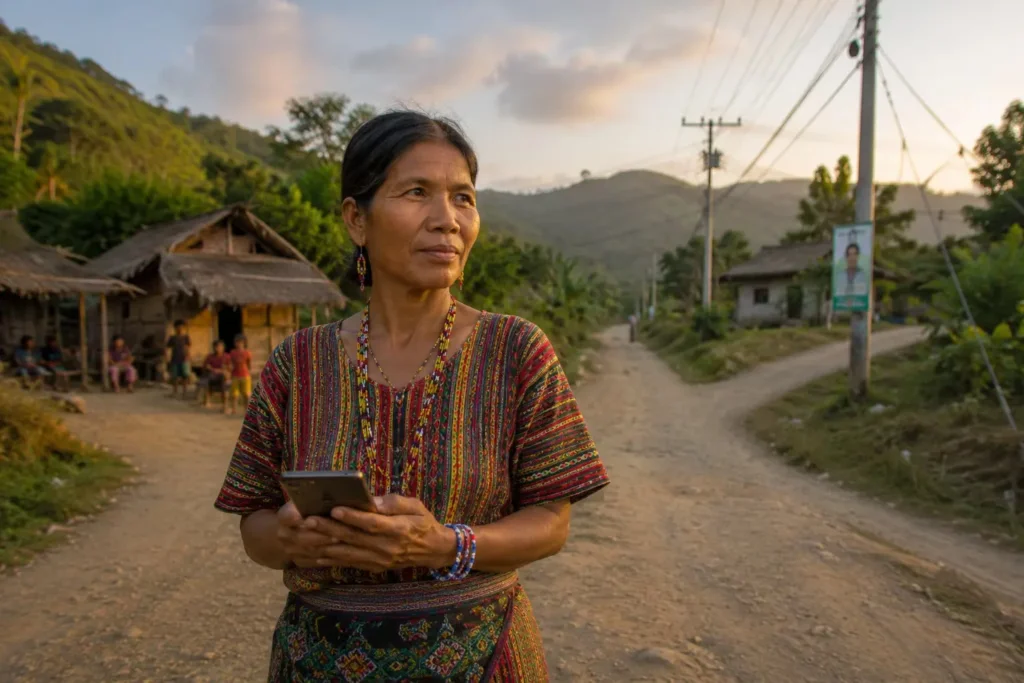
I watched a German tourist photograph a Mangyan woman in her traditional beaded necklace and handwoven skirt outside Calapan last year. He crouched, adjusted his lens three times, and never once asked her name. When he walked away, she turned to her daughter and switched immediately into shorts and a faded T-shirt she’d been carrying in a plastic bag. The beads went into her pocket.
That image stuck with me for weeks. Not because it was unusual, but because it wasn’t. We talk about preserving indigenous culture in Mindoro like we’re saving antique furniture. We fund festivals, document rituals, and pat ourselves on the back for keeping traditions alive. But here’s the question nobody wants to ask: what if the Mangyan people don’t want to be preserved? What if they’d rather have reliable electricity, quality schools, and economic opportunities than perform their heritage for tourists and anthropologists?

Key Takeaways
- The article critiques how preservation efforts often commodify Mindoro indigenous culture, prioritizing tourist demand over community needs.
- It argues that the Mangyan people desire modern infrastructure, education, and economic opportunity rather than being seen as museum exhibits.
- Cultural tourism exploits these communities, profiting outside operators while providing minimal benefits to the Mangyan.
- A focus on genuine agency allows the Mangyan to choose how to navigate modernization while respecting their culture.
- The author calls for real respect, emphasizing infrastructure equality, educational choice, and consultation with the Mangyan for their development.
I’m not suggesting we bulldoze tradition. I’m suggesting we stop treating living human beings like museum exhibits and start letting them make their own choices about modernization, even when those choices make us uncomfortable.
The Preservation Industrial Complex
There’s good money in cultural preservation. NGOs fly in with grants. Academics arrive with notepads and recording equipment. Government officials show up for ribbon-cutting ceremonies at “cultural villages” that look more like human zoos than communities.
The culture of the people of Mindoro Island has become a commodity, packaged and sold to justify programs that benefit everyone except the Mangyan themselves.
I met Father Miguel, a priest who’s worked in Mindoro for thirty years, at a small restaurant in Roxas. He ordered pancit and didn’t sugarcoat his frustration. “They want the Mangyan to stay exactly as they were a hundred years ago,” he said, jabbing his fork toward the window. “No cell phones, no modern medicine, no integration into the broader economy. It’s romantic from Manila or Europe, but it’s condescending as hell.”

The preservation crowd celebrates when a young Mangyan learns the traditional ambahan poetry form. But they’re noticeably quiet when that same young person drops out of school because the nearest high school is a three-hour hike away and offers no instruction in their language anyway.
We’ve created a system where indigenous people are rewarded for staying “authentically traditional” and subtly punished, through exclusion and lack of infrastructure investment, for wanting the same modern conveniences the rest of us take for granted.
That’s not preservation. That’s a gilded cage.
What the Mangyan Actually Want
I spent a week in a Mangyan community in Oriental Mindoro last March. Not on a cultural tour, not with an NGO, just visiting through a friend who grew up there. The conversations I heard weren’t about preserving ancient weaving techniques. They were about Internet access for distance learning. Solar panels for refrigeration so medicine wouldn’t spoil. Proper roads so emergency vehicles could reach them.
A woman named Lina, probably in her forties, showed me the traditional basket her grandmother taught her to weave. Beautiful work, intricate patterns that took days to complete. Then she showed me the plastic tub she actually uses to carry vegetables from her garden, because it’s lighter, holds more, and doesn’t fall apart in the rain.
“I can weave the baskets when tourists come,” she said with a slight smile. “But I’m not going to use them every day just to make other people feel good about my culture.”

Her teenage son wants to be an engineer. Not a cultural ambassador, not a traditional craftsperson: an engineer. He’s brilliant at math, teaches himself coding on a secondhand phone with a spotty signal, and dreams about Manila. Should we celebrate that ambition or lament the loss of another traditional lifestyle?
The preservation mindset treats his dreams as a tragedy. I treat them as hope.
Understanding the true culture of the people of Mindoro Island means understanding what they actually want for their futures, not what we think they should want for their past.
The Actual History We Conveniently Forget
Here’s what the cultural romantics never mention: Mangyan culture, like all cultures, has always been dynamic and adaptive. The “traditional” clothing we’re so eager to preserve was influenced by Chinese trade goods centuries ago. Their agricultural practices incorporated Spanish-introduced crops. Their music absorbed elements from lowland Filipino and even American sources over generations.
Culture isn’t a photograph. It’s a living organism that evolves or dies.
The version of Mangyan culture we’re trying to freeze in amber is actually just one moment in a continuous transformation that’s been happening for hundreds of years. We’ve arbitrarily decided that the mid-20th-century version is the “authentic” one worth preserving, conveniently ignoring that it was itself a product of cultural mixing and adaptation.
Eduardo, a Mangyan community leader I met through a mutual friend, put it more bluntly over coffee: “When we adopt something useful from outside, people say we’re losing our identity. When we stick to old ways that no longer work, they take pictures and call us beautiful. We can’t win.”
He’s right. We’ve created a no-win situation where indigenous people are praised for staying poor and “authentic” but criticized for wanting the same development opportunities everyone else has.
The Schools That Teach Everything Except a Future
Mindoro has several schools specifically for indigenous students. Well-intentioned programs designed to provide education while respecting cultural traditions. Sounds great on paper. In practice, many of them are disasters.
I visited one near Pinamalayan. The curriculum focused heavily on traditional culture, language preservation, and indigenous knowledge systems. Noble goals. But the math instruction was two years behind the national standard. Science equipment was nonexistent. English proficiency was so low that students who did manage to continue their education in lowland areas were immediately at a massive disadvantage. “We’re preparing them for a world that doesn’t exist anymore,” one teacher told me privately. She’d been pushing for curriculum reforms for three years and hitting bureaucratic walls at every turn. “They learn beautiful poetry and traditional farming methods, but they can’t compete for jobs or college entrance. We’re setting them up to fail, then calling it cultural sensitivity.”

The cruelest part? When these students struggle in mainstream education or employment, it’s blamed on them or their communities, never on the system that deliberately gave them an inferior education in the name of cultural preservation.
A proper education system would teach both traditional knowledge as a cultural foundation and modern skills as practical preparation. It’s not either-or. The insistence on treating it as either-or serves outside interests, not Mangyan interests.
Young people from Mindoro Island deserve educational opportunities that honor their heritage while preparing them for real-world economic participation.
The Tourism That Helps Almost Nobody
Cultural tourism in Mindoro follows a predictable pattern. Tour operators, almost never Mangyan themselves, arrange visits to indigenous communities. Tourists pay significant fees. A small portion reaches the community, usually through purchases of handicrafts sold at a fraction of their fair value. The Mangyan perform their culture, smile for photographs, and watch most of the money leave with the tour bus.
I talked to Ramon, who runs a small tour operation in Calapan. He’s honest about the economics.
“The tourists want authenticity,” he explained. “They want to see people living traditionally. If we show them a Mangyan community with satellite dishes and motorcycles, they’re disappointed. They didn’t pay to see people living like regular Filipinos. So, communities keep the modern stuff hidden when tours come through.”

The incentive structure is completely backward. Communities are economically rewarded for appearing poor and traditional, and implicitly punished for visible modernization.
Meanwhile, the tour operators, hotels, and transportation companies that capture most of the tourism revenue are uniformly modern businesses that use every available technological and marketing advantage. The irony is apparently lost on everyone.
Cultural tourism exploits the culture of the people of Mindoro Island while providing minimal economic benefit to the communities that actually practice it.
What Actual Respect Would Look Like
Respecting Mangyan culture doesn’t mean preserving it in amber. It means respecting Mangyan people enough to let them decide what aspects of their culture to maintain, modify, or abandon as they navigate modernization on their own terms.
Real respect would mean:
Infrastructure parity. Roads, electricity, Internet, and healthcare access are equivalent to those of lowland communities of similar size. Not as a reward for staying traditional, but as a basic right.
Educational choice. Schools that teach both traditional knowledge and competitive modern curricula, letting families decide the balance. Not forcing them to choose between cultural identity and economic opportunity.
Economic integration. Support for Mangyan-owned businesses that can compete in modern markets, not just handicraft tourism that keeps them economically dependent and marginalized.
Legal protection without cultural freezing. Defending land rights and preventing exploitation while simultaneously supporting whatever development path communities actually choose, even if it looks disappointingly modern to outside observers.
Actual consultation. Asking Mangyan communities what they want instead of deciding for them what they should want based on our romantic notions of indigenous authenticity.

This isn’t complicated. It’s just uncomfortable for the people who’ve built careers and identities around being the noble preservers of endangered cultures.
The people of Mindoro Island should control their own cultural evolution without outside interference disguised as preservation.
The Guilt That Drives Bad Policy
Much of the preservation impulse comes from guilt. Guilt over colonization, over marginalization, over the very real historical injustices that pushed indigenous communities to the margins in the first place. That guilt is understandable and, in many ways, appropriate.
But guilt makes terrible policy.
We can’t undo the past by freezing indigenous people in it. We can’t compensate for historical exploitation by creating new forms of benevolent control. The road to respectful coexistence isn’t through preservation, it’s through genuine equality and self-determination.
A young Mangyan woman named Teresa told me something I think about constantly. She’d just finished a degree in nursing, one of only a handful from her community to complete university.
“People tell me I should go back and preserve traditional healing practices,” she said. “But my grandmother died of an infection that antibiotics would have cured in two days. I love our culture. I don’t want to watch people die for it.”
That’s the reality the preservation romantics ignore. Traditional cultures developed in specific historical contexts with specific resource constraints and knowledge limitations. Some traditional practices are valuable and worth maintaining. Others are responses to problems we’ve actually solved.
Forcing people to maintain traditional practices that are materially worse than available alternatives isn’t cultural preservation. It’s cultural imprisonment.
The False Choice
The framing is always the same: modernization versus cultural preservation, as if Mindoro’s indigenous communities must choose between their identity and their future.
It’s a false choice, and it’s insulting.
Indigenous people everywhere have demonstrated a remarkable ability to maintain cultural identity while selectively adopting useful modern practices. Urban Filipinos maintain regional cultural identities while using smartphones. Japanese people perform tea ceremonies and work in tech companies. Norwegian communities preserve traditional folk practices while being among the most technologically advanced societies on Earth.
Why do we assume the Mangyan can’t do the same? Why do we treat them as uniquely fragile, incapable of navigating cultural change without losing their entire identity?
The assumption reveals more about our biases than about their capabilities.
The culture of the people of Mindoro Island is resilient enough to adapt and evolve without losing its essential character.

What I’m Actually Arguing For
I’m not arguing for cultural destruction, and I’m not suggesting we pave over indigenous communities with shopping malls and call it progress. Most importantly, I’m not dismissing the real value of traditional knowledge, languages, and practices.
I’m arguing for indigenous agency. For treating the people of Mindoro as full human beings with the same right to choose their own path that we take for granted for ourselves.
If a Mangyan community collectively decides to maintain traditional lifestyles with minimal outside technology, that choice deserves respect and support. But if another community decides to pursue full economic integration and modernization while maintaining language and certain cultural practices, that choice deserves equal respect and support. If individuals within communities make different choices, creating a mix of traditional and modern, that deserves respect too.
The keyword is choice. Informed, voluntary, community-driven choice. Not preservation imposed from outside by people who’ll never live with the consequences.
The Uncomfortable Question
Here’s the question that should end every cultural preservation meeting but never does: Would you accept the living conditions you’re asking indigenous communities to maintain?
Would you live three hours from the nearest high school, or would you forgo modern medicine for your children? Would you accept systematic economic disadvantages in exchange for being told your lifestyle is beautiful and authentic?
If the answer is no, if you wouldn’t accept those conditions for yourself or your family, what gives you the right to impose them on others in the name of their own culture?
The preservation impulse is often deeply patronizing. It assumes indigenous people need us to protect them from the corrupting influence of modernity, as if they’re children incapable of making nuanced decisions about cultural change and continuity.
That assumption, however well-intentioned, is the problem.
Where This Leads
The current path leads to continued marginalization dressed up as cultural respect. Indigenous communities will remain economically disadvantaged, educationally underserved, and politically powerless while being told they should be grateful we’re preserving their culture for them.
A better path recognizes that cultures survive through adaptation, not preservation. The languages, traditions, and practices that prove valuable and meaningful to their own communities will be maintained by those communities. The ones that don’t will transform or fade, as they always have throughout human history. Our job isn’t to be museum curators for living cultures. It’s to ensure equal access to resources, education, healthcare, and economic opportunity so that indigenous communities have genuine choices about their own futures.

After that, step back and let people live.
The Mangyan don’t need us to save their culture. They need us to stop using their culture as an excuse to keep them poor, isolated, and dependent on our approval.
That’s not preservation. That’s control.
And the fact that it’s dressed up in the language of respect and cultural sensitivity doesn’t make it any less controlling or any more acceptable.
My Closing Thoughts
Stop preserving. Start empowering. Let the people of Mindoro decide for themselves what kind of future they want to build, even if it doesn’t match your romantic vision of indigenous authenticity.
Their culture will survive, transform, or evolve on their terms. That’s how it’s supposed to work.
I sent a draft of this to Eduardo, the community leader I mentioned earlier. His response was four words: “Finally. Someone gets it.” That’s the only validation that matters. Not the preservation NGOs, not the academic journals, not the guilt-driven donors funding cultural museums. The people living with these questions are real. Listen to them, not to your own discomfort with cultural change.
FAQ
Absolutely, preservation should be driven by the communities themselves, not imposed from outside. Languages survive when they’re useful and meaningful to speakers, not when they’re artificially maintained through external pressure. Support should focus on creating conditions in which traditional practices are choices rather than mandatory performances.
This assumes indigenous people are passive victims of change rather than active agents who can selectively adopt modern practices while maintaining cultural identity. Cultures worldwide have demonstrated this ability. The assumption that indigenous communities cannot uniquely navigate modernization without losing their identity is patronizing and historically unsupported.
Traditional ecological knowledge is genuinely valuable and should be documented, studied, and integrated into modern environmental management. But that doesn’t require keeping entire communities in traditional subsistence lifestyles. You can value indigenous environmental knowledge while also providing modern education, healthcare, and economic opportunities.
No, I’m advocating for indigenous agency and choice. Assimilation is the forced adoption of the dominant culture. What I’m describing is voluntary, community-driven decision-making about which aspects of traditional and modern life to embrace. The distinction is critical: assimilation removes choice; empowerment creates it.
Then the economic model is exploitative and should change. Indigenous communities shouldn’t have to perform poverty and tradition for tourist consumption to earn income. Sustainable economic development means creating opportunities that don’t depend on appearing “authentic” for outside observers.
Communities have the right to determine what they pass on to future generations, not a responsibility to maintain practices that outsiders deem important. Future generations deserve inherited cultural knowledge, but they also deserve education, opportunities, and the freedom to make their own choices about cultural continuity.
Development imposed from outside without consultation is indeed neocolonialism. Development chosen by communities and implemented on their terms is self-determination. The question isn’t whether development happens; it’s who controls the process and who benefits. Infrastructure, education, and economic opportunity aren’t inherently colonial: denying them to indigenous people while enjoying them ourselves absolutely is.
Stop treating them as opposites. Provide infrastructure and services without cultural strings attached. Support community-driven cultural programs without making them prerequisites for development. Fund education that includes both traditional and modern knowledge. Ensure legal protections for land and rights without requiring communities to maintain specific lifestyles. Trust indigenous people to find their own balance.
Support without control. Provide resources, expertise, and infrastructure when requested. Document and preserve knowledge when communities want it. Defend rights and challenge exploitation. Then step back and let communities make their own decisions, even when those decisions make us uncomfortable or don’t match our expectations of what indigenous life should look like.
Other Articles You Might Like
- I Traded Boracay for Dinagat’s Stingless Jellyfish Lagoon
- Manila Tourist Safety Guide: Why Dense Cities Protect Travelers Better Than Isolation
- The Loneliest Goodbye: Making Friends as a Solo Traveler in the Philippines
- Mindoro Traditional Food You Need to Try Today
- Mindoro Fishing Families: A Tale of Survival
SUGGESTIONS FOR LODGING AND TRAVEL
Lodging is widely available throughout the Philippines. However, you may want to get some assistance booking tours to some of the Philippines’ attractions. I’ve provided a few local agencies that we’ve found to be very good for setting up tours. For transparency: We may earn a commission when you click on certain links in this article, but this doesn’t influence our editorial standards. We only recommend services that we genuinely believe will enhance your travel experiences. This will not cost you anything, and I can continue to support this site through these links.
- For Hotel Accommodations in the Manila area, I highly recommend The Manila Hotel. It is centrally located and within walking distance of Rizal Park and Intramuros. Many other attractions are easily accessible from there as well. I have provided a search box below to help you find hotels (click “Stays” at the top) or flights (click “Flights” at the top). This tool will provide me with an affiliate commission (at no cost to you).
Local Travel & Lodging Assistance
- Guide to the Philippines: This site specializes in tours throughout the Philippines. They seem to have some flexibility in scheduling, and pricing is very competitive.
- Kapwa Travel is a travel company focused on the Philippines. It specializes in customizing trips to meet customers’ needs.
- Tourismo Filipino is a well-established company that has operated for over 40 years. It focuses on tailoring tours to meet customers’ needs.
- Tropical Experience Travel Services – Tours of the Philippines: This company offers a range of tour packages, allowing you to tailor your trip to your preferences.
Lastly, we recommend booking international travel flights through established organizations rather than a local travel agent in the Philippines. I recommend Expedia.com (see the box below), the site I use to book my international travel. I have provided a search box below for you to use to search for flights (click on “Flights” at the top) or Hotels (click on “Stays” at the top). This tool will provide me with an affiliate commission (at no cost to you).


Hi Rich,
Read your excellent article and wanted to say that I had the same experience when I visited some indigenous people in the Amazon in Brazil, and talked to them about preserving their ways. They told me they rather have schools, electricity, proper sanitation, and other things we take for granted, instead of living in the jungle.