
I stood at the ferry terminal in Surigao City with my backpack and a printout of directions that looked like they’d been typed on a typewriter in 1987. The clerk behind the desk squinted at my request.
“Dinagat? Sir, why not Siargao? Much better for tourists.”
I’d heard six versions of this question in two days. My hotel manager in Manila asked it. The taxi driver in Surigao asked it. Even the guy selling me bottled water asked it.
Nobody goes to Dinagat Island on purpose, apparently. You end up there by accident, by bureaucratic assignment, or because you’re related to someone who never left.
I went because I heard about a stingless jellyfish lagoon. And because I was tired of paradise being sold to me in brochures.

Key Takeaways
- Dinagat Island, Philippines, remains largely untouched by mass tourism, attracting only travelers willing to venture beyond typical tourist spots.
- The lagoon at Lake Bababu hosts a unique species of stingless jellyfish, which offer a rare, serene swimming experience.
- Local guides like Ronaldo ensure that visitors respect nature while contributing to sustainable tourism without commercial pressures.
- Dinagat’s underdeveloped infrastructure serves as a natural filter, preserving its ecosystem and authentic experience for visitors.
- Travelers to Dinagat should embrace discomfort and prioritize respecting the local environment over seeking luxurious amenities.
The Lagoon That Tourism Forgot
Lake Bababu sits inside Sohoton Cove National Park on Dinagat’s northern coast. Getting there requires a two-hour boat ride from the main town of San Jose, a hike that should not legally qualify as a trail, and the sort of faith in rickety bamboo structures that separates travelers from tourists.
My guide was a man named Ronaldo, sixty-three years old. He’d been taking the occasional visitor to the lagoon since 1996. He didn’t advertise. He didn’t have a website. His grandson added him to Facebook three years ago against his will.
“People who need to find us, find us,” he told me while navigating around a submerged log. “The rest go to Siargao.” He said this without bitterness. It was just a fact, like the tide schedule.

When we reached the cove entrance, Ronaldo killed the motor. The water went from deep blue to emerald in the span of ten feet. Limestone cliffs rose on three sides, covered in vegetation so dense it looked as if the island were wearing a fur coat.
We paddled the last hundred meters by hand.
Swimming With Jellyfish (And Living To Tell About It)
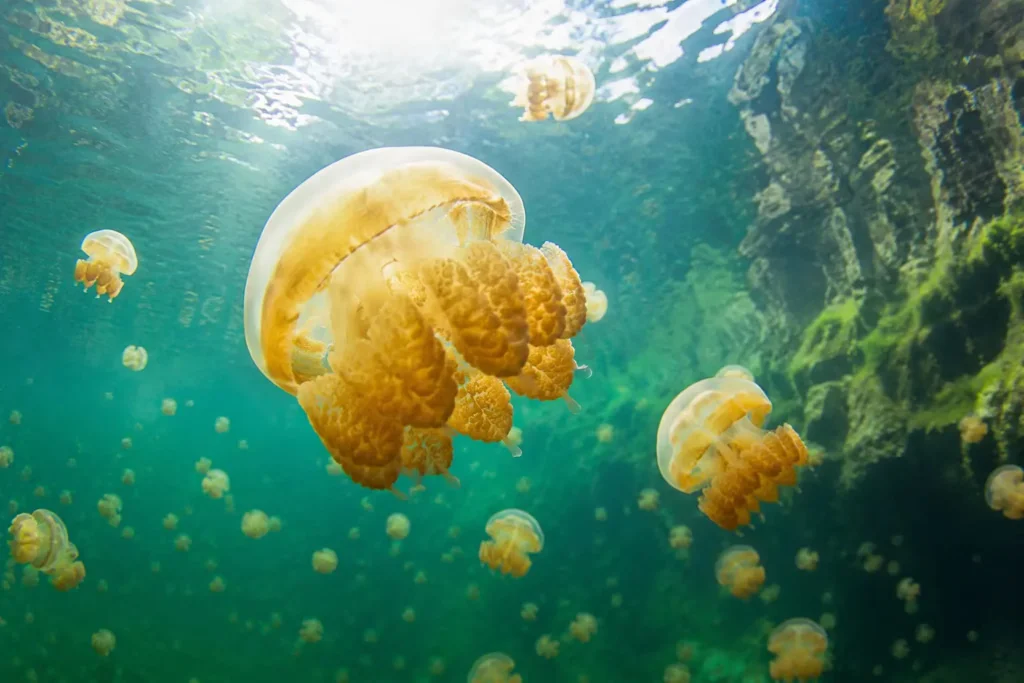
The stingless jellyfish in Lake Bababu are Mastigias papua, a species that lost its sting over thousands of years of evolution in an isolated saltwater lake. They look like small pulsing mushrooms made of glass. Hundreds of them. Thousands, maybe.
Ronaldo handed me a snorkel and nodded toward the water.
“Go slow. Don’t chase them. Let them come to you.”
I slipped into the lake and immediately understood why people pay money to swim with whale sharks and manta rays. This was that, but smaller, weirder, and with no crowd of other swimmers jockeying for the best Instagram angle. The jellyfish drifted past my mask in slow motion. Some were translucent white. Others had a faint golden tint. When the sun hit them right, they glowed.

I reached out and let one bump into my hand. It felt like touching warm Jell-O. No sting. No pain. Just a soft, pulsing pressure.
I floated there for twenty minutes, maybe longer, surrounded by creatures that had no evolutionary reason to hurt me. It felt like the ocean was finally letting me in on the joke.
The Economy Of Not Selling Out
Back on the boat, I asked Ronaldo why Dinagat Island hadn’t followed Boracay’s playbook. The stingless jellyfish lagoon could easily support a resort. Sohoton Cove National Park had the bones of a world-class eco-tourism site.
He looked at me like I’d asked why he didn’t sell his grandmother.
“We tried that already,” he said. “In the nineties, some people from Manila came. They wanted to build a resort near the cove. Big plan. They showed us drawings.”
The project died in the permitting phase. Environmental concerns, funding issues, and local opposition. The usual suspects.
“After that, we decided maybe it’s better this way,” Ronaldo continued. “If tourists come, they have to really want to come. Not because someone sold them a package.”
This wasn’t anti-tourism ideology. It was pragmatism. Dinagat doesn’t have the infrastructure to handle mass tourism. The roads are rough. The accommodation is basic. The power grid is inconsistent.

What it does have is a natural filter: inconvenience.
Only people willing to tolerate discomfort make it to Dinagat Island, Philippines. And those people, Ronaldo explained, tend to respect the place more.
What The Science Says About Stingless Jellyfish
The jellyfish phenomenon isn’t unique to Dinagat. Palau has a similar lake, Jellyfish Lake, which became famous enough to show up in nature documentaries. Tourists flocked there by the thousands.
Then the jellyfish population crashed in 2016. Marine biologists traced the collapse to warming water temperatures and chemical pollution from sunscreen.
By 2018, the jellyfish rebounded, but Palau instituted strict visitor limits and banned certain sunscreens.
Lake Bababu faces the same risks, but on a smaller scale. Fewer visitors mean less pollution. Less pollution means healthier jellyfish. Healthier jellyfish mean the ecosystem stays intact.

It’s a fragile balance, and everyone on Dinagat seems aware of it.
At the small sari-sari store near the dock, I met a woman named Liza who sold snacks and cold drinks to boatmen. She asked where I’d been.
“Lake Bababu,” I said.
She smiled. “Did Ronaldo tell you the rule?”
“What rule?”
“No sunscreen, or touching the jellyfish too much. No taking anything from the water.”
Ronaldo hadn’t explicitly mentioned these, but he’d demonstrated them. He didn’t wear sunscreen and didn’t let me grab the jellyfish. He pulled a plastic bottle out of the water and stuffed it in his bag.
The rules weren’t posted anywhere. They weren’t enforced by park rangers. They were just understood.
Boracay’s Ghost Haunts Every Island
I’ve written about Boracay before. I watched it transform from a backpacker haven into a resort industrial complex. I was there in 2018 when the government shut it down for six months to clean up the environmental damage.
The closure worked, sort of. Boracay reopened with stricter regulations, fewer hotels, and cleaner water. But the damage was done. The island had become a cautionary tale, a warning about what happens when tourism outpaces infrastructure.
Every island in the Philippines now lives in Boracay’s shadow. Local governments watch tourist arrivals like stock tickers, weighing revenue against sustainability.
Dinagat has chosen a different path, intentionally or not. It remains obscure, not because it lacks beauty, but because it lacks the infrastructure to commodify that beauty.
And maybe that’s the point.
Basic guesthouse accommodation

I spent the night in a small guesthouse near San Jose. The room had a bed, a fan, and a window with no screen. Mosquitoes came and went as they pleased. The bathroom was shared. The shower was a bucket and a dipper.
At 6 a.m., a rooster started screaming directly outside my window. At 6:15, a second rooster answered from across the street. By 6:30, I’d given up on sleep and went looking for coffee.
The guesthouse owner, a woman named Susan, was already awake. She handed me instant coffee and a plate of fried rice without asking what I wanted.
“You sleep okay?” she asked.
“Roosters are loud.”
“They’re always loud. You get used to it.”
I didn’t get used to it, but I appreciated the honesty. Susan wasn’t trying to sell me on Dinagat. She wasn’t pretending the island was something it wasn’t.
That authenticity, I realized, was worth more than a five-star resort.
Why Obscurity Is Dinagat’s Best Feature
I’m not advocating for Dinagat to stay poor or undeveloped. I’m not romanticizing poverty or pretending that tourism doesn’t bring jobs and revenue.
But there’s something valuable in a place that refuses to optimize itself for visitor convenience.
Dinagat’s rough roads and basic accommodations create a barrier to entry. That barrier filters out cruise ship crowds and Instagram tourists looking for quick content. What remains is a smaller, more intentional group of travelers.
These travelers spend more time. They hire local guides and eat at family-run restaurants. They contribute to the economy without overwhelming it. It’s not a scalable model. It won’t make Dinagat rich. But it might keep the jellyfish alive.
The Infrastructure Reality Check

Let’s be clear: Dinagat’s lack of development isn’t a strategic choice. It’s an economic reality.
The island has one main road, and calling it “paved” is generous. Public transportation consists of motorcycles with sidecars and the occasional jeepney. Internet connectivity is spotty. ATMs are rare.
For tourists used to Grab rides and Google Maps, Dinagat is a logistical nightmare.
But that nightmare is also a defense mechanism. It keeps visitor numbers manageable. It prevents the sort of rapid tourism growth that killed Boracay’s coral reefs and turned El Nido into an overcrowded mess.
I’m not saying Dinagat should never improve its roads or build better accommodations. I’m saying that improvement should happen on the island’s terms, not on tourism’s terms.
The People Who Protect Paradise Without Getting Paid For It

On my last day, I met a group of local fishermen near the dock. They were repairing nets and talking about the weather.
One of them, a man named Edgar, asked where I’d been.
“Lake Bababu,” I said.
“Ah, the jellyfish. Beautiful, no?”
“Very beautiful. Do you go there often?”
“Sometimes. We check it. Make sure no one is dumping trash or taking too many fish from the cove.”
“Does the government pay you for that?”
Edgar laughed. “No. We just do it. It’s our place.”
This is what sustainable tourism in the Philippines looks like in practice. Not government programs or NGO grants, but local people protecting their environment because it’s theirs.
No one is paying Edgar to patrol Sohoton Cove, and no one is compensating Ronaldo for limiting the number of tourists. No one is rewarding Susan for running a guesthouse that doesn’t try to be a resort.
They do it anyway, because the alternative is Boracay.
What We Owe Places That Refuse To Sell Out
Here’s the uncomfortable truth: Dinagat doesn’t need more tourists. It needs the right tourists.
If you go to Dinagat expecting Boracay-level amenities, you’ll be disappointed. If you go expecting Instagram-perfect sunsets and beachfront cocktails, you’ll be frustrated.
But if you go expecting rough roads, basic food, and a stingless jellyfish lagoon that hasn’t been turned into a theme park, you’ll understand why some places are worth protecting.
The question isn’t whether Dinagat should develop. The question is whether it can develop without losing what makes it worth visiting in the first place.
Tourism isn’t inherently destructive. But unchecked tourism is. And the difference between the two often comes down to infrastructure, regulation, and visitor intent.
Dinagat has the first two by accident and depends entirely on the third.
The Return Trip That Made Me Rethink Travel
On the ferry back to Surigao, I sat next to a Filipino family returning from a visit to relatives. The father asked where I’d been.
“Dinagat,” I said. “Lake Bababu.”
“You went all the way to Dinagat just for jellyfish?”
“Yes.”
He shook his head, smiling. “Foreigners are chaotic.”
Maybe. But I’d take chaotic over complacent.
I’ve been to Boracay, Palawan, and Cebu. I’ve swum in crystal-clear water and eaten at beachfront restaurants with views that belong on postcards.
But I’ll remember Lake Bababu jellyfish longer than any of them.
Not because it was more beautiful, but because it wasn’t trying to be. It just was.
And in a world where every beach is fighting to become the next viral destination, that’s the rarest thing you can find.
Final Thought: Paradise Doesn’t Need Your Approval

I’m not writing this to convince you to visit Dinagat. I’m writing this to remind you that not every beautiful place needs to become a tourist destination.
Some places are better off being difficult to reach, while some ecosystems thrive on neglect. Some communities benefit more from isolation than from development.
If you do go to Dinagat Island, Philippines, go with humility. Don’t expect the island to accommodate you. Accommodate the island instead.
Hire local guides. Eat local food. Respect the rules, even when they’re unwritten. Leave the jellyfish alone. Take your trash with you. Don’t complain about the roosters.
And if you find yourself frustrated by the rough roads and basic accommodations, ask yourself this: What did you expect? And why did you expect the island to change for you instead of you changing for the island?
Because paradise isn’t a product. It’s a place. And the moment we forget that, we lose it.
If you’re planning an authentic Philippine travel experience in Dinagat or another similarly underdeveloped destination, skip the sunscreen or use reef-safe alternatives. Bring cash, because ATMs are unreliable. Download offline maps. And lower your expectations about everything except the experience itself. The discomfort is part of the point. Lean into it.
FAQ
Lake Bababu is located in Sohoton Cove National Park on the northern coast of Dinagat Island. To reach it, fly to Surigao City, take a ferry to Dinagat Island (San Jose port), then hire a boat and guide for a two-hour trip to the cove. Arrange guides through local guesthouses or contacts in San Jose town.
Yes. The jellyfish are Mastigias papua, a species that evolved in isolated saltwater lakes and lost their stinging capability over thousands of years. You can swim among them and even gently touch them without getting stung. However, avoid excessive handling to protect the jellyfish population.
The dry season from March to May offers the calmest seas and easiest boat access. However, water conditions can be unpredictable year-round. Check weather forecasts before booking boat trips, and be prepared for cancellations due to rough seas. Flexibility is essential when visiting this off-the-beaten-path destination in the Philippines.
Expect to pay between 1,500 and 3,000 pesos for a boat rental and guide, depending on group size and negotiation. Park entrance fees are minimal, usually under 100 pesos. Budget accommodations in San Jose run 500 to 1,000 pesos per night. Bring cash, as credit cards and ATMs are unreliable on the island.
Yes. Dinagat has low crime rates, and locals are generally welcoming. However, the infrastructure challenges pose more risk than crime. Roads are rough, medical facilities are limited, and boat trips depend on weather conditions. Solo travelers should have travel insurance, communicate plans to someone, and maintain realistic expectations about comfort and convenience.
Additional FAQ Considerations
What should I pack for a trip to Dinagat Island?
Dinagat lacks the infrastructure, amenities, and tourist attractions of Siargao or Palawan. There are no surf resorts, luxury hotels, or well-marked tourist trails. What Dinagat offers is authenticity, isolation, and unique natural features, such as the stingless jellyfish lagoon.
Can I visit Lake Bababu without a guide?
No. The lake is inside a protected area with no marked trails or public boat access. You need a local guide who knows the route, has permission to enter the cove, and understands the ecosystem rules. Attempting to visit without a guide is impractical and disrespectful to local management efforts. Hire guides through guesthouses in San Jose.
What makes Lake Bababu different from other unusual Philippine travel destinations?
Lake Bababu’s stingless jellyfish lagoon represents a rare evolutionary phenomenon found in only a handful of locations worldwide. Unlike commercialized attractions, this site remains largely unmonetized and protected by local fishermen rather than formal tourism operators. The difficulty of access and lack of infrastructure naturally limit visitor numbers, preserving the ecosystem’s integrity.
Are there other similar destinations to Dinagat in the Visayas region?
Yes. Samar’s alternative destinations offer similar off-the-beaten-path experiences with minimal tourism infrastructure. Eastern Samar’s caves, waterfalls, and coastal areas attract adventurous travelers seeking authentic encounters without resort amenities. Like Dinagat, these locations require flexibility, patience, and respect for local communities practicing sustainable tourism in the Philippines.
What should I pack for a trip to Dinagat Island?
Pack reef-safe sunscreen, insect repellent, a basic first-aid kit, offline maps, a waterproof phone case, quick-dry clothing, sturdy water shoes, and sufficient cash. Bring your own snorkel gear if possible, though guides may provide basic equipment. A headlamp is useful for evening power outages. Don’t pack anything you can’t afford to lose or damage.
Other Articles You Might Like
- How to Visit Dinagat Islands Without Breaking What’s Special
- How to Get to Dinagat Islands Before the Resorts Do
- Best Family Travel in the Philippines: Why Pitstop Towns Beat Famous Beaches
- Manila Tourist Safety Guide: Why Dense Cities Protect Travelers Better Than Isolation
SUGGESTIONS FOR LODGING AND TRAVEL
Lodging is widely available throughout the Philippines. However, you may want to get some assistance booking tours to some of the Philippines’ attractions. I’ve provided a few local agencies that we’ve found to be very good for setting up tours. For transparency: We may earn a commission when you click on certain links in this article, but this doesn’t influence our editorial standards. We only recommend services that we genuinely believe will enhance your travel experiences. This will not cost you anything, and I can continue to support this site through these links.
- To help you find hotels (click “Stays” at the top) or flights (click “Flights” at the top, I highly recommend Hotels.com. It is centrally located and within walking distance of Rizal Park and Intramuros. Many other attractions are easily accessible from there as well. I have provided a search box below for you to find hotels (click on “Stays” at the top) or flights (click on “Flights” at the top). This tool will provide me with an affiliate commission (at no cost to you).
Local Travel & Lodging Assistance
- Guide to the Philippines: This site specializes in tours throughout the Philippines. They seem to have some flexibility in scheduling, and pricing is very competitive.
- Kapwa Travel is a travel company focused on the Philippines. It specializes in customizing trips to meet customers’ needs.
- Tourismo Filipino is a well-established company that has operated for over 40 years. It focuses on tailoring tours to meet customers’ needs.
- Tropical Experience Travel Services – Tours of the Philippines: This company offers a range of tour packages, allowing you to tailor your trip to your preferences.
Lastly, we recommend booking international travel flights through established organizations rather than a local travel agent in the Philippines. I recommend Expedia.com (see the box below), the site I use to book my international travel. I have provided a search box below for you to search for flights (click “Flights” at the top) or Hotels (click “Stays” at the top). This tool will provide me with an affiliate commission (at no cost to you).

