
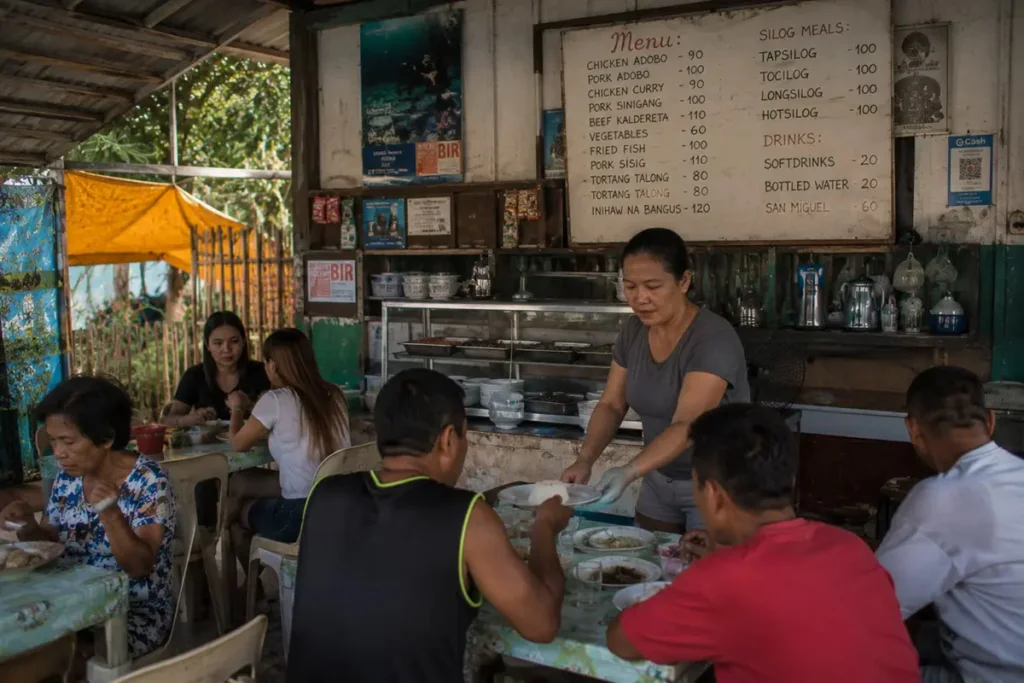
I was sitting at a carinderia in Puerto Galera when Ate Linda slammed a plate of adobo down in front of me and said something I’ll never forget: “If we become Boracay, we lose everything. You understand? Everything.” She wasn’t angry at me. She was angry at the fourth developer that month who’d walked through her neighborhood with a surveyor and a camera, taking pictures of her house like she wasn’t standing right there. So goes just about any discussion of Mindoro’s tourism development. This is a particularly heated topic among Mangyan communities, the indigenous peoples of Mindoro.
I thought about that conversation for weeks. Because here’s the thing about paradise: everyone wants a piece of it, but nobody asks the people who actually live there if they’re willing to sell. Mindoro sits right there in the middle of the Philippine archipelago, a short boat ride from Manila, blessed with beaches that could rival any in Southeast Asia. It has natural assets. It has the location. The history of Mindoro Island is one of resilience, but now it faces its biggest challenge yet: resisting the kind of overdevelopment that destroyed Boracay.
Key Takeaways
- The History of Mindoro Island includes indigenous communities who resist tourism development that threatens their livelihoods.
- Locals worry that becoming the next Boracay will lead to environmental degradation and displacement from their homes.
- Mindoro’s residents desire sustainable tourism that benefits them rather than outsider investors.
- Inadequate infrastructure in Mindoro can’t support mass tourism without harming local ecosystems.
- The fight in Mindoro reflects a broader struggle for community rights against unchecked development pressures.
The island has everything tourism developers dream about when they close their eyes and see dollar signs. But Mindoro isn’t Boracay. And if you ask the people who call it home, that’s exactly the point.
The Ghost of Boracay Future
Let me be clear about something: I’m not anti-tourism. I’ve written thousands of words encouraging people to visit the Philippines, to experience the warmth of Filipino hospitality, to support local economies. Tourism done right can be transformative.
Boracay wasn’t done right.
Before the 2018 closure, Boracay had become a cautionary tale so obvious that even the national government couldn’t ignore it anymore. The island’s infrastructure was collapsing under the weight of three million visitors a year. Hotels and resorts dumped sewage directly into the ocean. Illegal construction had eaten up the beachfront. Rising rents pushed local families out of neighborhoods their grandparents built.
The six-month shutdown was necessary, but it was also an admission of failure. The island has been loved to death, and exploited to the breaking point. Somewhere along the way, the people who actually lived there became extras in someone else’s vacation photos.
Now rehabilitation is underway, and Boracay is cleaner than it’s been in decades. But the damage to the social fabric? That’s harder to measure and even harder to fix.
The developers looking at Mindoro have apparently learned nothing from this. They see Mindoro Island’s history as a blank slate, ignoring the generations of people who’ve built lives there.
What Makes Mindoro Different
Understanding the history of Mindoro Island starts with understanding its size and significance. Mindoro is the seventh-largest island in the Philippines, split into two provinces: Oriental Mindoro and Occidental Mindoro. It’s home to around 1.4 million people, dozens of indigenous communities, and ecosystems you won’t find anywhere else on Earth.
Puerto Galera, on the northern tip, already gets a steady flow of tourists. White Beach has the resorts. Sabang has the dive shops. The infrastructure exists, but it’s still human-scale. You can still walk into a restaurant and have the owner remember your name from last year.

The rest of Mindoro remains relatively untouched by mass tourism. Not because it lacks beauty. Drive down the coast of Oriental Mindoro, and you’ll see beaches that would make travel bloggers weep. Hike into the interior, and you find waterfalls, rivers, and forests so thick, you get lost in them.
Mindoro has stayed under the radar partly by accident and partly by choice. The road infrastructure isn’t as developed. The airports are smaller. And crucially, the local communities have watched what happened to Boracay and said: not here.
The history of Mindoro Island is one of communities that have maintained their identities despite external pressures. That tradition continues today.
The People Who Said No
I met Mang Cesar at a town hall meeting in Calapan. He’s a third-generation fisherman, and he stood up during the public comment period with a piece of paper shaking in his hand.
“My grandfather fished these waters,” he said. “My father fished these waters. I fish these waters. If you build your resort, where do I fish?”
Nobody answered him. The developers had charts, projections, and promises of jobs, but they didn’t have an answer to that question.

Because here’s what the glossy presentations never show: when you convert a coastline into a resort corridor, you don’t just change the scenery. You eliminate livelihoods and displace communities. You turn people who’ve lived sustainably off the land and sea for generations into service workers in someone else’s profit model.
Ate Linda from the carinderia? Her family has lived in Puerto Galera for four generations. She’s watched property values skyrocket, which sounds great until you realize it means her kids can’t afford to stay. They’re priced out of their own hometown.
“They want us to work in the hotels,” she told me. “Clean the rooms, serve the food. But this is our place. Why should we become maids in our own home?”
That’s the question Mindoro’s locals keep asking. And increasingly, they’re organizing around the answer: We shouldn’t.
The Indigenous Communities Nobody Mentions
Here’s the part of the tourism development story that the brochures conveniently leave out: the history of Mindoro Island includes thousands of years of indigenous habitation. The island is home to several indigenous groups, including the Mangyan peoples, who’ve lived here since long before Spanish colonization.
The Mangyan aren’t a monolith. The term encompasses eight distinct ethnolinguistic groups: Iraya, Alangan, Tadyawan, Tawbuid, Buhid, Hanunoo, Ratagnon, and Bangon. Each has its own language, customs, and relationship to the land.
These communities have already been pushed into the mountains by centuries of lowland migration and development. Now they’re facing a new wave of pressure as tourism developers eye the interior highlands for “eco-resorts” and “adventure tourism.”

I spoke with a community organizer named Kuya Ramon, who works with Mangyan advocacy groups. He was blunt: “They call it eco-tourism, but who benefits? The investor from Manila who builds the resort, or the Mangyan family who loses access to their ancestral forest?”
The Philippines has laws protecting indigenous land rights. On paper, the Indigenous Peoples’ Rights Act of 1997 guarantees free, prior, and informed consent for any development on ancestral domains. In practice, government agencies enforce those protections inconsistently, and indigenous communities often lack the resources to fight well-funded developers in court.
Tourism development that ignores indigenous rights isn’t just unethical. It’s illegal. But legality only matters when authorities enforce it, and enforcement requires political will, which is often in short supply when developers stand to profit.
The history of Mindoro Island’s indigenous peoples is one of continuous resistance to displacement. This current battle is just the latest chapter.
The Environmental Math Doesn’t Add Up
Let’s talk about carrying capacity, because this is where the paradise story always falls apart.
Mindoro’s marine biodiversity is extraordinary. The Verde Island Passage, which runs between Mindoro and Luzon, is considered the center of marine biodiversity. It has more fish and coral species per square kilometer than anywhere else on Earth.
This isn’t just a fun fact for divers. It’s a critical ecosystem that supports fisheries across the region. Damage it, and you’re not just hurting Mindoro. You’re impacting food security for millions of people.

The development of mass tourism threatens this in multiple ways. Increased boat traffic damages coral reefs. Coastal construction causes sedimentation. Inadequate sewage treatment leads to nutrient pollution and algae blooms. Overfishing to supply resort restaurants depletes local stocks.
We watched this exact pattern play out in Boracay. The water quality deteriorated so badly that swimming became a health risk in some areas. The national government’s own data showed fecal coliform levels way above safe standards.
Mindoro’s infrastructure isn’t equipped to handle a Boracay-level tourism boom. The water treatment facilities, waste management systems, and environmental monitoring capacity simply don’t exist at that scale. Building them would require massive public investment, and even then, there’s a limit to how many people an ecosystem can support before it collapses.
The developers promise to build sustainably. They always do. But sustainable development isn’t about what you promise in the proposal. It’s about what you actually do when the quarterly revenue numbers come in below target, and cutting corners becomes tempting.
What “Becoming the Next Boracay” Actually Means
When developers pitch Mindoro as “the next Boracay,” they’re selling a vision of economic growth, job creation, and prosperity. When locals hear “the next Boracay,” they hear something very different.
They hear: Your land will become unaffordable. Your children will move away, and your ocean will become polluted. Your community will be displaced by outsiders who don’t know your history and don’t care to learn it.
They hear: You will become workers in a service economy that extracts value from your home and sends the profits elsewhere.
They hear: Everything you love about this place will be packaged, commodified, and sold to people who will stay for three days and leave nothing but trash and noise.
I’m not hyperbolic. This is the actual pattern we’ve seen repeated across Southeast Asia. Phuket. Bali. Boracay. The script is always the same:
First, the “discovery” phase, where backpackers and adventurous travelers arrive. The local economy benefits modestly. The community maintains control.
Then, the development phase, where investors see an opportunity. Resorts are built. Infrastructure expands. Tourist numbers spike. Money flows in, but increasingly to outside investors rather than local families.
Finally, the displacement phase, where original residents can no longer afford to live in the place they built. The culture becomes performative, reduced to staged shows for tourists. The environment degrades under pressure. The community fractures.
The history of Mindoro Island shouldn’t follow this pattern. Locals have watched this happen elsewhere. They’re not naive about what “development” means. They’re making an informed choice to say no.
The Myth of Trickle-Down Tourism
Let me address the economic argument directly, because it’s the one developers always fall back on: “Tourism creates jobs.”
Yes, it does. But what kind of jobs?
The jobs created by mass tourism development tend to be low-wage, low-skill service positions. Housekeeping. Food service. Retail. These aren’t bad jobs, but they’re not the economic transformation that’s promised in pitch meetings.

The real money in tourism goes to investors, developers, and large operators, most of whom are based in Manila or abroad. A local family running a small pension might see genuine benefit. A local person working the front desk at a multinational resort chain is making wages, not building wealth.
Research on tourism economics consistently shows that the share of tourism revenue retained in the local economy drops dramatically as development scales up. Small-scale, locally-owned tourism operations retain more value locally. Large-scale resort development extracts it.
There’s also the opportunity cost to consider. When developers convert agricultural land or fishing grounds to tourism use, you’re not just adding tourism jobs. You’re eliminating existing livelihoods. The fisherman who becomes a bellhop might have a steadier paycheck, but he’s also lost autonomy, skills, and a connection to tradition that has value beyond economics.
The Economics of the Discussion
I talked to an economist at the University of the Philippines who studies the impacts of tourism. She was careful to note that tourism can be beneficial, but the devil is in the details.
“The question isn’t whether tourism is good or bad,” she told me. “The question is: who controls it, who benefits from it, and who bears the costs? When communities have genuine control over tourism development, outcomes tend to be much better. When development is imposed from outside, the community usually loses.”
Mindoro’s resistance isn’t anti-progress. It’s a fight for self-determination. It’s about writing the next chapter in the history of Mindoro Island on its own terms.
What Sustainable Tourism Actually Looks Like
Here’s the part where I’m supposed to offer the solution, the way forward, the happy middle path that makes everyone feel better.
I don’t have one. Not a simple one, anyway.
But I can tell you what I’ve seen work in small pockets across the Philippines. Community-based tourism models where local families maintain ownership and control. Homestays instead of resorts. Local guides instead of tour operators from Manila. Revenue that stays in the community instead of getting transferred to shareholders.
I visited Pamilacan Island in Bohol a few years back. The community there transitioned from whale hunting to whale watching, but on their own terms. The boats are locally owned. The guides are former hunters. The money funds schools and health clinics in the village.
It’s not perfect. The income is seasonal. The scale is limited. But the community hasn’t been displaced, the culture hasn’t been commodified, and the whales are still there.
That’s what sustainable tourism looks like. Not zero-impact (that’s impossible), but managed impact with community consent and control.
Could Mindoro do something similar? Maybe. But it would require a complete reversal of the current development model. It would require rejecting the big investors, the master-planned resorts, the fantasy of becoming the next Boracay.
It would require powerful people to accept smaller profits in exchange for genuine sustainability. And historically, that’s a very hard sell.
Why This Matters Beyond Mindoro
If you don’t live in the Philippines, you might be wondering why you should care about a development fight on an island you’ve never heard of.
Here’s why: This same battle is happening everywhere.
Every “undiscovered paradise” faces pressure to develop, modernize, and maximize its tourism potential. And everywhere, local communities are being told the same thing: Trust us, this will be good for you.
Sometimes it is. Often it isn’t. And by the time you figure out which one you’re dealing with, it’s too late to change course.
The fight happening in Mindoro right now is about more than one island. It’s about a fundamental question: Do local communities have the right to say no to development they didn’t ask for and don’t want?
In theory, yes. In practice, economic pressure, political influence, and the assumption that growth is always good and resistance is always backward constantly undermine that right.
I think about Ate Linda and her carinderia. She likes tourists and is not opposed to tourism, and she feeds them every day. But she does oppose tourism that eliminates her ability to own that carinderia, to pass it on to her children, to remain in the place her family has called home for generations.
That seems like a reasonable position to me. But developers and government boosters treat it as an obstacle to progress.
The Real Paradise
I’ve been traveling in the Philippines for years now, and I’ve learned something important: the places that try hardest to sell themselves as paradise rarely are.
Paradise isn’t a perfectly manicured beach with imported sand. It’s not an infinity pool overlooking a view that marketers have Photoshopped into oblivion. It’s not a resort where management sanitizes and controls everything so completely that you could be anywhere in the world.
Paradise is a place where people live actual lives, where the community is intact, where you can sit at a carinderia and have the owner tell you exactly why she’s fighting to keep her home the way it is.
Mindoro isn’t perfect. The roads are rough. The infrastructure is inconsistent. You can’t get artisanal coffee on every corner.
But when I’m there, I’m not watching a performance of Filipino culture. I’m experiencing the real thing. The people I meet aren’t working a script. They’re living their lives, and I’m lucky enough to be welcomed into that for a little while.
That’s what’s at stake here. Not just an environmental question or an economic question, but a fundamental question about authenticity and control and the right of people to determine their own future.
The people of Mindoro Island have always written its history. Today’s question is: will they be allowed to continue?
The Choice Ahead
The developers will keep coming. The proposals will keep landing on desks in provincial capitals. The pressure will continue.
But every time a community like Mindoro says no, every time they organize and resist and insist on self-determination, they’re doing something important. They’re rejecting the idea that everything is for sale. They’re asserting that some things, like community, culture, and home, should not be valued solely for their economic value.
I hope they win. Not because I’m against tourism (I’m not), and not because I think Mindoro should be frozen in amber (it shouldn’t). I hope they win because developers and planners already tried the alternative, the Boracay model, and it failed the people it was supposed to benefit.
We don’t need another Boracay. We need communities that control their own development, that benefit directly from tourism when they choose to welcome it, and that have the power to say no when the cost is too high.
Mindoro is saying no. People are writing the history of Mindoro Island right now in town halls and carinderias, refusing to let developers push them out of their own homes.
The least we can do is listen.
P.S. If you’re planning to visit Mindoro, please do. Support locally owned guesthouses, eat at carinderias, hire local guides, and spend your money in ways that directly benefit the community. Tourism isn’t the enemy. Exploitative tourism is. You get to decide which kind you participate in.
FAQ
Yes, Mindoro is generally safe for tourists. Puerto Galera has been a popular destination for years. As with anywhere, use common sense, respect local customs, and stay informed about current conditions. The security concerns that sometimes affect other parts of Mindanao don’t typically apply to Mindoro.
Mindoro has significantly less tourism infrastructure and receives far fewer visitors than Boracay did at its peak. While Puerto Galera has established tourism facilities, much of Mindoro remains relatively undeveloped. The key difference is that local communities are actively resisting the mass-tourism development model that overtook Boracay.
Locals worry about environmental degradation, displacement from their own communities due to rising costs, loss of traditional livelihoods like fishing, inadequate infrastructure to handle mass tourism, and loss of community control over development decisions. They’ve watched Boracay’s struggles and want to avoid repeating those mistakes.
The Mangyan are indigenous peoples of Mindoro, comprising eight distinct ethnolinguistic groups. Tourism development threatens their ancestral lands, particularly as developers eye highland areas for eco-resorts. While laws exist to protect indigenous rights, enforcement is inconsistent, and these communities often lack resources to fight well-funded developers.
Yes, but it requires community-based models where local people maintain ownership and control. This means small-scale development, locally-owned accommodations, local guides, and revenue that stays in the community. It’s not about zero tourism, but about tourism that communities consent to and genuinely benefit from.
Other Articles You Might Like
- Mindoro Hospitality: The Heart of the Island
- Mindoro Island History: the Mangyan Indigenous Peoples’ Struggle for Survival
- Mindoro Gold Mining: Beyond the Gold That Never Existed
- Mindoro Traditional Food You Need to Try Today
- Mindoro Fishing Families: A Tale of Survival
- Mindoro Culture and Its Rich Craft Traditions
SUGGESTIONS FOR LODGING AND TRAVEL
Lodging is widely available throughout the Philippines. However, you may want to get some assistance booking tours to some of the Philippines’ attractions. I’ve provided a few local agencies that we’ve found to be very good for setting up tours. For transparency: We may earn a commission when you click on certain links in this article, but this doesn’t influence our editorial standards. We only recommend services that we genuinely believe will enhance your travel experiences. This will not cost you anything, and I can continue to support this site through these links.
- For Hotel Accommodations in the Manila area, I highly recommend The Manila Hotel. It is centrally located and within walking distance of Rizal Park and Intramuros. Many other attractions are easily accessible from there as well. I have provided a search box below to help you find hotels (click “Stays” at the top) or flights (click “Flights” at the top). This tool will provide me with an affiliate commission (at no cost to you).
Local Travel & Lodging Assistance
- Guide to the Philippines: This site specializes in tours throughout the Philippines. They seem to have some flexibility in scheduling, and pricing is very competitive.
- Kapwa Travel is a travel company focused on the Philippines. It specializes in customizing trips to meet customers’ needs.
- Tourismo Filipino is a well-established company that has operated for over 40 years. It focuses on tailoring tours to meet customers’ needs.
- Tropical Experience Travel Services – Tours of the Philippines: This company offers a range of tour packages, allowing you to tailor your trip to your preferences.
Lastly, we recommend booking international travel flights through established organizations rather than a local travel agent in the Philippines. I recommend Expedia.com (see the box below), the site I use to book my travel.

