
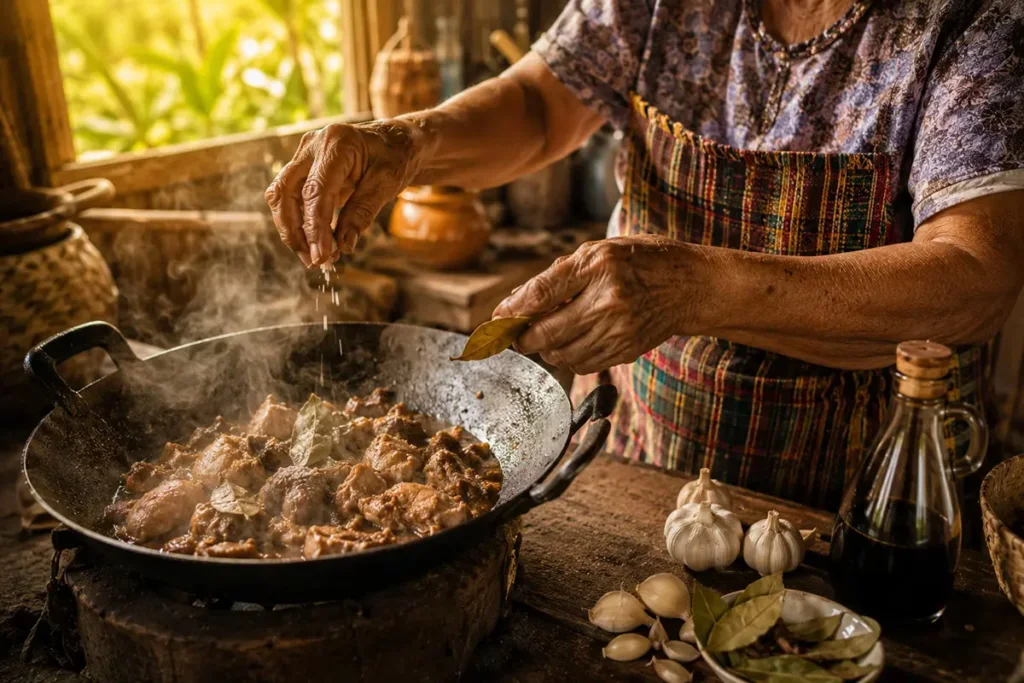
I watched Lola Teresa throw away her grandmother’s recipe for adobong manok.
Not literally. She didn’t burn the paper or tear it up; she just ignored it completely while making Sunday lunch for her family in Calapan. She eyeballed the vinegar, dumped in soy sauce until it “looked right,” and added three times the garlic her grandmother’s careful handwriting specified. When her daughter pulled out her phone to record measurements, Lola Teresa waved her off.
“Why do you need that? Just taste it.”
Her granddaughter, home from Manila for the weekend, looked horrified. “But Lola, we’re supposed to preserve these recipes exactly as they are. That’s what the cultural heritage project said.”
“Then the cultural heritage project will make terrible adobo,” Teresa said flatly.
She wasn’t wrong. The adobo was exceptional. And that exchange, in a cramped kitchen smelling of garlic and bay leaves, taught me more about culinary habits on Mindoro Island than any preserved recipe collection ever could.
Key Takeaways
- Mindoro food traditions evolve through adaptation, rather than strict adherence to original recipes.
- Good cooks in Mindoro intelligently break culinary rules to enhance flavors and accommodate available ingredients.
- Preservation efforts should focus on transmitting knowledge and techniques, not merely documenting static recipes.
- Culinary habits survive through modern adaptations made by younger generations who respect their food heritage.
- The essence of Mindoro food culture lies in its ability to change while maintaining its core character.
Here’s what nobody tells you about saving traditional food: the moment you freeze it in time, you kill it.
The Recipe Preservation Fantasy
Every few years, someone with good intentions and a grant shows up in Mindoro to document traditional recipes. They interview Lolas, photograph dishes, and create beautiful bound collections of “authentic” island cooking. These books end up on coffee tables in Manila or in the back rooms of municipal offices.
Meanwhile, actual Mindoro cooking continues to evolve without them.
I’ve been eating my way through Mindoro for eight years. I’ve had countless meals in homes from Puerto Galera to Sablayan. And I’ve noticed something the cultural preservationists miss: the best cooks here aren’t the ones religiously following old recipes. They’re the ones breaking the rules intelligently.
Take paksiw na isda, the vinegar-braised fish that shows up at nearly every island meal. The “traditional” version uses native vinegar, ginger, and not much else. But in Bulalacao, I met a fisherman’s wife named Mercy who adds coconut water to hers. Her mother-in-law initially protested. Now the whole barangay makes it that way.

“The fish here are different than twenty years ago,” Mercy explained while cleaning talakitok at her outdoor sink. “Climate change, maybe. Different feed. They’re leaner now. The coconut water adds back the richness.”
She adapted. The dish improved. The tradition survived precisely because she didn’t preserve it exactly.
Understanding culinary habits on Mindoro Island means recognizing that adaptation isn’t abandonment. It’s survival.
When Ingredients Disappear, Cooks Improvise
Here’s an uncomfortable truth about culinary habits on Mindoro Island: many ingredients that defined traditional cooking simply aren’t available anymore.
Native chickens, smaller and tougher than commercial breeds, now cost three times as much as store-bought ones. Wild boar has largely disappeared from accessible areas. Certain greens that grew wild along rivers now only appear sporadically.
You can respond to this in two ways. You can insist on authenticity and watch dishes die out because nobody can afford or find the ingredients. Or you can do what Mindoro cooks actually do: substitute intelligently and keep cooking.

In Baco, I met Nanay Elvie, who makes pinapaitan (bitter soup) that locals swear by. Traditional pinapaitan uses bile from freshly slaughtered cattle to create its distinctive bitter flavor. But fresh bile requires butchering your own animal, something fewer families do now.
Elvie’s solution? She uses a small amount of purchased bile paste, supplements with bitter melon, and adds extra spices to create complexity that doesn’t rely solely on the bile. Food purists might object. Everyone who eats her pinapaitan asks for seconds.
“If I waited to make it the ‘right’ way, I would cook it twice a year,” she told me. “This way, my grandchildren grow up knowing the taste. Maybe not exactly like my grandmother made it, but close enough that the memory stays alive.”
Close enough. That phrase should terrify preservationists and comfort everyone else.
The Myth of the Static Recipe

Whenever someone talks about “preserving” Mindoro food traditions, they’re operating from a flawed premise: that these traditions were ever static to begin with.
They weren’t.
Every recipe you think of as “traditional” is the result of previous generations adapting, substituting, and improvising. The introduction of tomatoes from the Americas. The influence of Spanish and Chinese traders. The arrival of different fish species as ocean temperatures shifted. Store-bought spices have become less expensive.
Food traditions are always a snapshot of a particular moment, not an eternal truth.
I learned this from Tatay Roel, a retired teacher in Naujan who’s genuinely knowledgeable about Mindoro food history. He showed me three different “traditional” recipes for ginataang langka (jackfruit in coconut milk) from three different decades. All claimed to be authentic. All were different.
“My grandmother made it with pure coconut milk, no water,” he explained. “Then, coconuts became harder to get in the 1970s, so people started using half water. Now, some people use canned coconut milk. Which one is traditional?”
The answer is all of them and none of them.
The recipes that survived weren’t the ones that stayed exactly the same. They were the ones flexible enough to adapt to available ingredients, changing tastes, and economic realities while maintaining their essential character.
This flexibility defines culinary habits on Mindoro Island more than any single recipe ever could.
What Actually Gets Lost
Don’t misunderstand me. I’m not saying nothing is at risk.
Plenty gets lost when food traditions change. But it’s rarely the recipes themselves. It’s the broader knowledge that surrounds them, and knowing which beach has the best talangka (small crabs) during which moon phase. It’s also understanding which greens are safe to forage and which will make you sick, and having the patience to ferment fish properly or smoke meat at the right temperature.

This kind of knowledge can’t be preserved in a recipe book. It requires people to actually do the work, learn from those who know, and pass it on through practice.
In San Teodoro, I spent an afternoon with Kuya Ramon, who still makes bagoong (fermented fish paste) the slow way. Not because he’s a traditionalist, but because he thinks it tastes better. He taught his nephew the process, but adapted it for a smaller batch size that fits modern life.
“My father made fifty kilos at a time,” Ramon said. “We had space, we had a big family. My nephew has a small apartment. So I teach him how to make five kilos. Same process, different scale. Same taste, different life.”
That’s the knowledge worth preserving: the underlying principles, not the exact measurements.
The Rules Worth Breaking
After years of eating and observing in Mindoro, I’ve identified which rules you can break and which you shouldn’t.
You can break rules about ingredients. Substitute proteins, use different vegetables, and adjust the souring agent based on what’s available. Mindoro cooks have always done this.
You can break rules about measurements. Cooking by taste rather than precise amounts isn’t laziness; it’s responsiveness to ingredient variation. This batch of vinegar is stronger than the last batch. This fish is fattier than usual. Adjust accordingly.
You can break the rules about presentation. Using plastic plates instead of banana leaves doesn’t change the taste. Neither does serving family-style instead of individually plated.
But you can’t break rules about technique without understanding why they exist.
Don’t rush the simmering time for adobo because the vinegar needs to mellow, and don’t crank up the heat on kinilaw (ceviche) because it’s not supposed to be cooked. Don’t skip salting overnight when the recipe calls for it; there’s a textural reason.
These aren’t arbitrary traditions. They’ve accumulated knowledge about how ingredients behave.
The problem with most preservation efforts is that they document the what without explaining the why. They’ll tell you a recipe calls for three hours of slow cooking, but not that this breaks down tough fibers in older chickens or wild game. Without understanding the why, you can’t adapt intelligently when circumstances change.
The Next Generation’s Kitchen

Here’s what I find hopeful about culinary habits on Mindoro Island: young people are still cooking.
Not always as their grandmothers did. Often with significant modifications for smaller households, tighter budgets, and less time. But they’re cooking.
In Calapan, I met a young couple, both working professionals, who cook traditional Mindoro meals twice a week. They’ve adapted everything. They use a pressure cooker to reduce cooking time and pre-cut vegetables from the market. They substitute ingredients freely based on what’s available and affordable.
Food preservationists might look at their sinigang made with store-bought tamarind paste instead of fresh fruit and shake their heads. But I see something different: two people in their twenties who could easily eat fast food every night choosing to make traditional food work for their modern lives.
“My wife learned from YouTube,” Carlo told me, grinning at his wife Maria. “She watches these videos of Lolas cooking, then figures out shortcuts.”
“And you complain when it’s not exactly like your mother’s,” Maria shot back.
“Because yours is better,” he said. “Don’t tell my mother I said that.”
This is how food traditions actually survive. Not through rigid preservation, but through continuous small-scale adaptation by people who care enough to keep cooking.
Breaking Rules with Respect

There’s a difference between intelligent adaptation and careless abandonment.
Good cooks in Mindoro break rules, but they do it with knowledge and intention. They understand what they’re changing and why. They’re not randomly throwing ingredients together; they’re making informed decisions based on understanding the underlying principles.
Bad adaptation happens when someone tries to make things “easier” without understanding the purpose of each step. Adding MSG to replace the complexity of proper stock. Using ketchup instead of tomatoes and calling it the same thing. Drastically reducing cooking time without adjusting other elements.
I ate at a restaurant in Puerto Galera that advertised “traditional Mindoro cuisine.” They served me adobo that was clearly rushed, with a harsh vinegar bite and undercooked garlic. The owner proudly told me they’d “streamlined” the cooking process to serve it faster.
That’s not adaptation. That’s just bad cooking with a traditional name attached.
Compare that to Nanay Lina in Roxas, who makes adobo using an electric cooker instead of charcoal. She adjusted the liquid ratio and timing to work with even electric heat rather than the fluctuating temperatures of coal. The result tastes as if it came from her grandmother’s kitchen, even though the method is completely different.
“The food doesn’t care what heats it,” she said. “It only cares that the heat is right.”
What Preservationists Get Wrong
Most food preservation projects make the same mistake: they focus on documentation rather than transmission.
They create archives. Record measurements. Photograph finished dishes. All valuable, but ultimately static.
What they don’t do is create situations where knowledge actually passes from experienced cooks to new ones. They don’t fund community kitchens where Lolas teach neighbors. They don’t support the young cooks who are adapting traditions rather than abandoning them.
I’ve seen preservation grant money go toward glossy books that sit unread, while ten kilometers away, the last person in a barangay who knows how to properly smoke fish has no one to teach because all the young people have left for Manila.
The knowledge doesn’t need to be preserved in a book. It needs to be kept alive in practice.
Here’s what would actually help culinary habits on Mindoro Island: supporting the cooks who are successfully adapting traditional practices to modern life. Give them platforms. Document their intelligent rule-breaking. Show young people that traditional cooking can fit into contemporary life without requiring them to live like their great-grandparents.
The Adobo Test
I’ve developed a simple test to determine whether someone understands Mindoro’s food culture.
I call it the adobo test.
I ask: “What makes adobo authentic?”
If they give me measurements, ingredient lists, or a specific cooking method, they don’t get it. Adobo on Mindoro varies wildly by household, municipality, and individual preference. Some use coconut milk, others don’t. Some cook it dry while others keep it saucy. Soy sauce amounts range from “enough to color the liquid” to “basically teriyaki.”
The real answer is this: Adobo is authentic when it tastes like home to the person eating it.
That’s the essence of Mindoro food culture. Not rigid recipes, but flexible frameworks that adapt to available ingredients, family preferences, and changing circumstances while maintaining their essential character.
The adobo I ate at Lola Teresa’s table was authentic because her family loves it, cooks it regularly, and is passing it on to the next generation. The fact that it doesn’t match her grandmother’s exact recipe is irrelevant.

When Preservation Becomes Museum Culture
The saddest food experiences I’ve had in Mindoro weren’t bad meals. They were good meals that nobody cooked anymore.
At a municipal cultural event in Pinamalayan, I watched a demonstration of traditional Mangyan cooking techniques. The food was prepared exactly as it would have been a century ago. Open fire, traditional implements, ingredients gathered from the forest.
It was fascinating. It was also completely disconnected from how anyone actually eats now.
The demonstrators explained each step carefully. The audience watched respectfully. And I realized I was watching museum culture, not living tradition. This knowledge wasn’t being transmitted for use; it was being performed for documentation.
There’s a place for that kind of preservation. But it’s not a replacement for supporting the messy, imperfect, constantly adapting food culture that people actually live with.
The real food traditions of Mindoro aren’t happening at cultural demonstrations. They’re happening in home kitchens where cooks are figuring out how to make their grandmother’s sinigang work with store-bought ingredients and an electric stove.
The Recipe I’ll Never Get
Tatay Roel, the retired teacher I mentioned earlier, once told me about a fish stew his mother made that he’s been trying to recreate for thirty years.
“I’ve come close,” he said. “But it’s never quite right. Something is missing.”
He has her recipe card. He’s watched a video of her making it. He’s talked to his siblings about their memories of the taste. He knows the ingredients and the process.
But he can’t replicate it exactly because the recipe doesn’t include the things that actually mattered: the specific fish available in their area in the 1960s, the particular type of wood they cooked with that affected the smoke flavor, the iron pot that added trace minerals to the broth, and his mother’s ability to judge doneness by sound and smell rather than clock time.
You can’t preserve those things in a recipe. They were products of a specific time, place, and set of circumstances that no longer exist.
Rather than mourn this, Tatay Roel has developed his own version of the stew. It’s different from his mother’s. It’s also excellent. His grandchildren will remember it as “Tatay’s fish stew” and probably won’t be able to replicate it exactly when they try in thirty years, either.
And that’s okay. That’s how food traditions work. They’re not handed down perfectly intact like museum pieces. They’re adapted, modified, and recreated imperfectly by each generation, maintaining their general character while reflecting changing circumstances.
What’s Really at Stake
So, what actually matters when we talk about preserving culinary habits on Mindoro Island?
Not the exact recipes. Those will change regardless.
What matters is keeping people cooking at all. Keeping them interested in their food heritage enough to continue making these dishes, even in adapted forms. Maintaining the knowledge of underlying techniques and principles. Preserving the context and stories that surround the food.
The threat to Mindoro food culture isn’t that adobo recipes are evolving. It’s that people might stop making adobos altogether because they think they need their grandmother’s exact ingredients, tools, and methods to do it “right.”
The greatest gift you can give to traditional food culture is permission to adapt it.
Tell young cooks: Use the pressure cooker. Substitute ingredients. Adjust for your household size. Make it work for your life. Just cook it, learn the principles, understand what you’re doing, and keep cooking.
That’s how traditions survive. Not frozen in time, but alive and changing.
Breaking Rules Like You Mean It
The irony of telling people to break rules is that you need to know the rules first.
Lola Teresa, who threw away her grandmother’s measurements, had made that adobo hundreds of times the traditional way before she started improvising. She knew what the dish was supposed to taste like. She understood the function of each ingredient. Her rule-breaking was informed by deep knowledge, not ignorance.
That’s the kind of rule-breaking worth celebrating.
If you want to adapt Mindoro food traditions, start by learning them. Make the dishes several times following traditional methods. Understand why each step exists. Learn what each ingredient contributes. Then, and only then, start intelligently adapting.
The worst thing you can do is dismiss traditional methods as outdated without understanding their purpose. The second-worst thing is to preserve them so rigidly that they become artifacts rather than living practices.
The balance point between these extremes is where Mindoro’s food culture actually lives.
A Better Kind of Preservation
If I were given money to preserve culinary habits on Mindoro Island, I wouldn’t spend it on documentation projects.
I’d spend it on regularly bringing together young and experienced cooks. Not for formal lessons, but for working meals where knowledge passes naturally through conversation and practice.
I would support the home cooks who are successfully adapting traditional recipes for modern life, rather than criticizing them for not doing it the “right” way.
And I’d create platforms for cooks to share their intelligent adaptations, successful substitutions, and solutions to modern challenges.
I’d focus on transmitting principles and techniques, not exact recipes, and celebrate the fact that Mindoro’s food culture is alive and changing, rather than mourning that it’s not exactly like it used to be.
Most importantly, I’d stop treating adaptation as a threat and start recognizing it as the survival mechanism it’s always been.

The Question Nobody Asks
Here’s what I want you to think about: in fifty years, what matters more?
Has someone perfectly preserved 2024 recipes for Mindoro dishes in an archive, documented with exact measurements and photographs?
Or that people in 2074 are still cooking recognizable versions of these dishes, adapted to whatever circumstances exist then, while maintaining the essential character and knowledge that make them Mindoro food?
I know which future I prefer. It’s the one where my future counterpart, probably using some cooking technology I can’t even imagine, writes about how Mindoro cooks are still breaking rules intelligently, still adapting rather than abandoning, still keeping their food culture alive by refusing to let it become frozen museum culture.
The recipes Lola Teresa’s great-grandchildren make won’t match hers exactly. They’ll use ingredients she’s never heard of. They’ll have different tools, different constraints, different lives.
But if they’re still cooking, still learning, still adapting with knowledge and care, then the tradition survived. Not in spite of breaking the rules, but because of it.
That Sunday afternoon in Calapan, after we finished eating her improvised adobo, I asked Lola Teresa if she worried about her family losing the traditional recipes.
She looked at me like I’d asked a very foolish question.
“Why would they lose it? They eat it every week. They know what it’s supposed to taste like. When they cook it themselves, maybe they change it a little. So what? It’s still adobo. It’s still ours.”
That’s the whole philosophy in three sentences.
What This Means
Stop trying to preserve Mindoro’s food traditions in amber. Start celebrating the intelligent rule-breaking that’s kept them alive for generations. Trust the cooks. Let the recipes evolve. Keep the principles, adapt the details, and for the love of good food, just keep cooking.
The traditions are fine. They’re doing what they’ve always done: surviving by changing.
If you want to support Mindoro’s food culture, cook something from Mindoro this week. Don’t stress about having the exact ingredients or following a recipe perfectly. Just cook it, taste it, adjust it if needed, and eat it. That’s how traditions stay alive: by being used.
FAQ
Sure, for historical and anthropological purposes. But documentation isn’t the same as preservation, and recipes in archives don’t keep food traditions alive. What keeps them alive is people cooking. The most beautifully documented recipe that nobody makes is functionally dead. A slightly adapted recipe that families cook weekly is alive. I’ll take the living version every time.
Good adaptation maintains the dish’s essential character while adjusting to changing circumstances. It’s driven by knowledge of why the original worked. Bad adaptation just slaps a traditional name on something fundamentally different. If Lola Teresa’s adobo tastes like adobo, contains the core elements of adobo, and is recognizable as adobo to other Mindoro cooks, it’s an adaptation. If someone puts teriyaki sauce on chicken and calls it adobo, that’s just renaming.
The question is how you preserve them. Documenting them is worth doing. But also ask why they’re disappearing. If it’s because better alternatives exist or circumstances have changed, maybe that’s okay. If it’s because knowledge holders are dying without passing it on, that’s a transmission problem, not a documentation problem. The solution is to create situations where teaching can happen, not just to write things down.
No. Younger generations have a responsibility to understand their food heritage, respect it, and keep it alive in ways that work for their lives. That might mean adapting it. Traditions that survive are the ones flexible enough to fit into the real lives of successive generations. Rigid traditions are performed at cultural festivals while people eat fast food at home. I’d rather see home-cooked food than museum demonstrations.
That’s been happening for centuries, and somehow Mindoro food culture still exists. The adobo made in 1824 differed from that made in 1924, which in turn differed from today’s adobo. Yet it’s still recognizably adobo. Food traditions are resilient. They maintain their essential character even as details change. The fear that one generation of adaptation will destroy everything is almost never borne out by actual history.
Learn from actual cooks in Mindoro, not from recipe collections. Watch, help, eat, ask questions. Learn multiple versions of the same dish from different cooks. Understand that variation is traditional, not a departure from tradition. Once you know several versions and understand the underlying principles, you can make informed decisions about your own adaptations. The goal isn’t to find one “correct” version to copy forever; it’s to understand the tradition well enough to contribute to its evolution.
No. I’m saying that rigid preservation kills living traditions. What’s worth preserving is the principles, techniques, cultural context, and knowledge that allow people to continue cooking these dishes in ways that make sense for their circumstances. Some things absolutely shouldn’t change arbitrarily, particularly techniques based on food safety or chemical processes. But most of what preservation projects obsess over, exact ingredients and measurements, are the least important parts. Save the knowledge. Trust the cooks.
Other Articles You Might Like
- Mindoro Fishing Families: A Tale of Survival
- Mindoro Culture and Its Rich Craft Traditions
- Samar Travel: Eating in the Heart of the Wilderness
- Mindoro Traditional Food You Need to Try Today
- Mindoro Gold Mining: Beyond the Gold That Never Existed
- Mindoro Island History: the Mangyan Indigenous Peoples’ Struggle for Survival
SUGGESTIONS FOR LODGING AND TRAVEL
Lodging is widely available throughout the Philippines. However, you may want to get some assistance booking tours to some of the Philippines’ attractions. I’ve provided a few local agencies that we’ve found to be very good for setting up tours. For transparency: We may earn a commission when you click on certain links in this article, but this doesn’t influence our editorial standards. We only recommend services that we genuinely believe will enhance your travel experiences. This will not cost you anything, and I can continue to support this site through these links.
- For Hotel Accommodations in the Manila area, I highly recommend The Manila Hotel. It is centrally located and within walking distance of Rizal Park and Intramuros. Many other attractions are easily accessible from there as well. I have provided a search box below to help you find hotels (click “Stays” at the top) or flights (click “Flights” at the top). This tool will provide me with an affiliate commission (at no cost to you).
Local Travel & Lodging Assistance
- Guide to the Philippines: This site specializes in tours throughout the Philippines. They seem to have some flexibility in scheduling, and pricing is very competitive.
- Kapwa Travel is a travel company focused on the Philippines. It specializes in customizing trips to meet customers’ needs.
- Tourismo Filipino is a well-established company that has operated for over 40 years. It focuses on tailoring tours to meet customers’ needs.
- Tropical Experience Travel Services – Tours of the Philippines: This company offers a range of tour packages, allowing you to tailor your trip to your preferences.
Lastly, we recommend booking international travel flights through established organizations rather than a local travel agent in the Philippines. I recommend Expedia.com (see the box below), the site I use to book my travel.

