
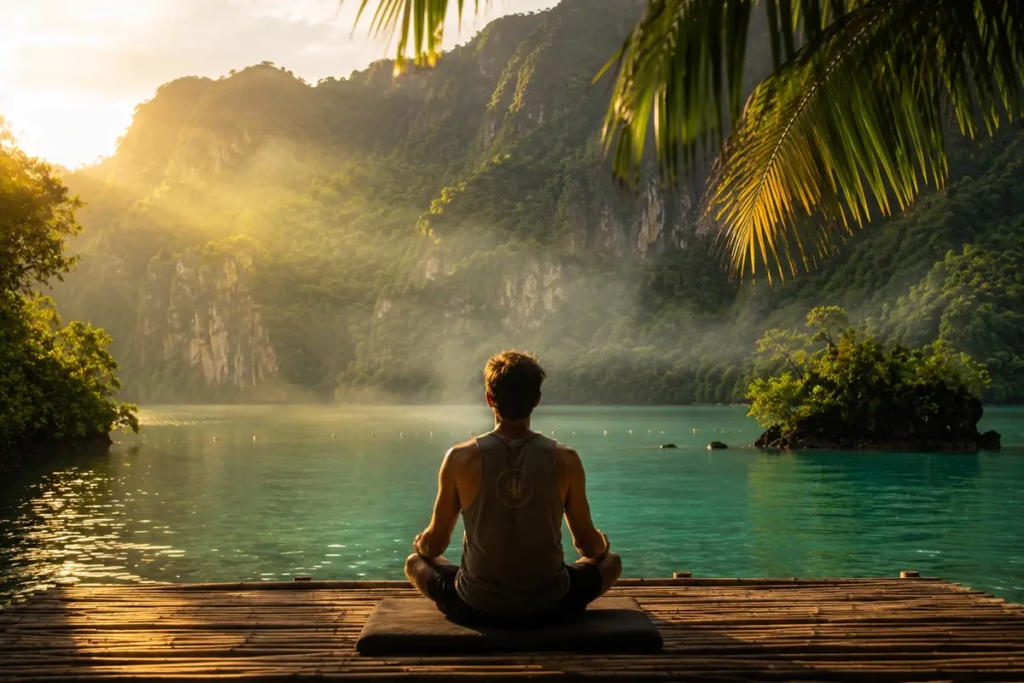
The boat engine cut out at the dock, and suddenly I understood the marketing brochure’s breathless promise about “profound silence.” No cars or horns. No background hum of civilization doing its relentless thing. Just waves lapping against bamboo posts and the rustle of palm fronds overhead. This was my first solo travel excursion in the Philippines. I’d paid good money to reach this remote wellness retreat center on the northern tip of Palawan, following the trail blazed by countless burned-out professionals seeking some version of themselves they’d apparently misplaced. I had heard of these retreats being called “silent retreats” in the Philippines, but I really wasn’t prepared for what that meant. The silence hit me like a physical thing. Not peaceful. Not calming. Terrifying, actually.
I caught myself reaching for my phone three times in the first ten minutes, even though I’d voluntarily surrendered it at check-in. The retreat coordinator, a soft-spoken woman named Leah from Batangas, watched this dance with knowing eyes. “The first day is always the hardest,” she said. “Most guests don’t expect the quiet to be so loud.”
That phrase stuck with me: the quiet being loud. It’s the perfect contradiction at the heart of solo wellness travel in the Philippines. We sign up seeking transformation, healing, clarity, all those aspirational words that look beautiful on Instagram. But what we actually get, at least initially, is something far more unsettling. We get confronted by ourselves, without distraction, without escape routes. And for first-timers especially, that silence reveals a truth most would rather avoid: we’ve gotten very good at hiding from ourselves.

Key Takeaways
- Wellness retreats in the Philippines promise transformation but often expose deeper personal issues due to enforced silence and lack of distractions.
- First-time attendees frequently find the experience challenging as silence amplifies unresolved thoughts and emotions.
- The industry packages silence as a luxury, but true growth requires confronting discomfort and being present with oneself.
- Integration practices after the retreat are essential for lasting change and understanding insights gained during the experience.
- Visitors need to assess their intentions: Are they seeking genuine healing or merely a temporary escape?
The question you need to ask yourself is whether you came here to heal or just to hide better.
The Marketing Mirage: Selling Solitude as Salvation
Wellness retreats in the Philippines have perfected the art of packaging silence as a luxury product. Scroll through any retreat’s website, and you’ll find the same seductive promises: “disconnect to reconnect,” “find your authentic self,” “embrace transformative solitude.” The photos show serene faces in meditation poses, sunrise yoga on pristine beaches, and journal entries that presumably contain profound revelations rather than anxious scribbles, wondering what you’re doing here.
The marketing works because it taps into something real. We are exhausted and usually overstimulated. Hungry for something that feels like depth in a world that increasingly feels like noise. The wellness industry, worth over four trillion dollars globally, has recognized this hunger and built an empire around it.
What’s the Real Story?
But here’s what the brochures don’t emphasize: the product they’re selling is not comfort. It’s a confrontation.
I spent an afternoon talking with Miguel, who manages guest services at a retreat center in Siargao. He’s been in the wellness industry for seven years, long enough to spot patterns. “The guests arrive with this excitement,” he told me. “They’ve read all the testimonials, seen the Instagram posts, maybe a friend recommended us. They expect to feel peaceful immediately.”
He paused, weighing his words carefully.
“By the second day, maybe half of them are questioning why they came. The silence we promise? It amplifies everything they’ve been avoiding. Some people love us for that. Others leave early and write angry reviews saying we didn’t deliver the relaxation they paid for.”
His colleague, Anna, a mindfulness instructor from Cebu, nodded in agreement. “The hardest part of my job is explaining that discomfort is not failure. When someone comes to me in tears during silent meditation, panicking because thoughts won’t stop racing, I have to help them understand that this is exactly what’s supposed to happen. The silence isn’t making them anxious. It’s revealing anxiety that was already there.”
Stumbling Blocks
This is the wellness paradox: the very environment designed to facilitate healing can magnify every insecurity, doubt, and unresolved issue you’ve successfully buried under productivity and distraction. The silence doesn’t create problems. It just stops you from ignoring them.
Influencer narratives rarely capture this unglamorous middle stage. You’ll see the “before” shot at the airport, excited and fresh. You’ll see the “after” shot, glowing and transformed, captioned with some variation of “best decision ever.” You won’t see day two, sitting on your bed at 3 PM, wondering if you’ve made a terrible mistake, feeling more disconnected than when you arrived. But that’s where the real work begins for solo travelers in the Philippines seeking genuine transformation.

The Deafening Silence: Psychological and Emotional Realities for First-Timers
Sarah, a marketing executive from Singapore, arrived at a seven-day silent retreat in the mountains of Benguet with what she described as “cautious optimism.” She’d read all the right books, practiced meditation for six months, felt prepared.
“I lasted four hours before I had a complete meltdown,” she told me over coffee months later, back in Manila. “Not even a full day. After four hours of minimal talking and no phone, I was catastrophizing about everything. My relationship. My career choices. Whether I was wasting my life. Things I hadn’t consciously worried about in years suddenly felt urgent and overwhelming.”
She didn’t leave, though she considered it. Instead, she white-knuckled through the first two days until something shifted. “It wasn’t that the thoughts stopped,” she explained. “It’s that I stopped being so terrified of them. I realized I’d been running from my own mind for years.”
This pattern repeats with remarkable consistency among solo travelers at Philippine wellness retreats. First-timers arrive expecting peace, only to encounter psychological chaos. The neuroscience behind this is straightforward: our brains are social organs, constantly calibrated for connection and external stimulation. Remove that stimulation suddenly, and the brain doesn’t relax. It searches, often frantically, for the missing input.
The Result of Changing Patterns
Dr. Ramon Gutierrez, a psychologist who consults with several Philippine retreat centers, explained it to me this way: “Modern life has trained us to outsource our internal regulation. Feel anxious? Check your phone. Feel lonely? Scroll social media. Feel uncertain? Consume content that reinforces your worldview. These aren’t solutions; they’re numbing agents. At a silent retreat, those numbing agents get removed. The anxiety, loneliness, and uncertainty are still there. You just can’t avoid them anymore.”
The first forty-eight hours are typically the worst. Guest journals from various retreats, which some centers anonymously compile for research purposes, reveal a consistent arc. Day one: excitement, nervousness, determination. The Second day: doubt, discomfort, sometimes anger at having paid for this experience. On the Third day, a subtle shift, curiosity emerging alongside the discomfort.
Marco, a chef from Davao, described his first silent retreat experience as “like quitting caffeine, but for distraction.” He said, “Your body and mind scream that something’s wrong, that you need the thing you’ve removed. It feels like deprivation, not healing. But if you push through that withdrawal period, something interesting happens. You realize you don’t actually need constant input. The silence stops feeling hostile and starts feeling neutral. And eventually, it feels generous.” That progression from hostile to neutral to generous defines successful retreat experiences in the Philippines. But many first-timers never make it past hostile. They interpret discomfort as failure rather than a process. They came seeking healing, but when healing requires facing difficult truths, they retreat into different forms of hiding.

Healing or Hiding? The Crucial Self-Assessment Moment
Here’s the uncomfortable question every solo traveler faces at Philippine wellness retreats, usually around day two or three: Are you actually doing the work, or are you just performing wellness in a more foreign location?
The problem is easier to see in others than in yourself. Watch retreat participants for a few days, and you’ll notice patterns. Some throw themselves into every optional activity: extra yoga sessions, nature hikes, craft workshops. They’re in constant motion, filling the silence with approved retreat activities. Others become obsessed with optimizing the experience, constantly asking staff whether they’re meditating correctly, journaling effectively, breathing properly.
Both patterns can be forms of avoidance.
“We offer activities because some structure helps people feel safe,” Anna, the mindfulness instructor, told me. “But activities can also become escape routes. I’ve seen guests who never sit in silence alone. They’re always in group sessions or asking questions. The retreat ends, and they feel relaxed, maybe, but not transformed. They used our activities the same way they use Netflix at home: to avoid being alone with themselves.”
The explanation for this avoidance lies in what psychologists call “experiential avoidance,” the attempt to escape uncomfortable thoughts, feelings, or sensations. We’re incredibly creative in finding ways to avoid discomfort, even when we’ve explicitly signed up to confront it. The mind doesn’t want to change; it wants to maintain familiar patterns, even dysfunctional ones.
True healing requires leaning into exactly what you want to avoid. Sitting in silence when your mind is screaming for distraction. Feeling the loneliness without immediately reaching for connection. Confronting the narratives you’ve built about yourself and asking whether they’re actually true.
The Choice is Yours, Always
The solution isn’t complex, but it’s not easy either: you have to practice radical honesty about your own avoidance patterns.
Filipino mindfulness coach Elena Reyes, who leads programs at several retreat centers, suggests a simple daily check-in: “Ask yourself three times each day: Am I being present with discomfort, or am I managing my experience to avoid it? Am I curious about what’s arising, or am I trying to make it stop? Am I here to transform, or to take a break?”
She emphasizes that taking a break is fine. Legitimate rest is valuable. But be honest about what you’re doing. “Don’t confuse a vacation with a vision quest,” she said with a slight smile. “Both are good. Just don’t pay vision quest prices for vacation behavior.”
Practical steps help solo travelers prepare for Philippine wellness retreats. Start small. Commit to twenty minutes of unstructured silence daily. No meditation techniques, no breathing exercises. Just sitting quietly with whatever arises. Notice when your mind generates reasons why you should do something else. Notice when your body wants to move. Don’t judge these impulses. Just observe them.
Dr. Gutierrez recommends journaling immediately after these periods of silence. “Not about insights or revelations,” he clarified. “About what you noticed and what thoughts came up? The sensations you felt? What you wanted to avoid. This builds meta-awareness, the ability to observe your own patterns without being controlled by them.”
The goal isn’t to eliminate discomfort. It’s to develop a different relationship with it. One where discomfort informs rather than controls you.

Silence is Not Blank, It’s a Mirror
Most first-timers make a fundamental mistake: they imagine silence as emptiness, a void to fill with peace and clarity. This misconception sets them up for shock when silence turns out to be densely populated with thoughts, feelings, memories, and sensations they’ve been successfully ignoring.
Silence isn’t blank. It’s a mirror. And mirrors show you what’s actually there, not what you hoped to see.
This realization hit me on day four of my own first retreat. I’d spent three days treating silence like an enemy to conquer or a test to pass. I was constantly evaluating my performance: Was I relaxed enough? Mindful enough? Transformed enough? The silence reflected this anxious self-monitoring back to me until I couldn’t ignore the pattern.
I wasn’t present at all. I was performing presence, which is just another form of distraction.
Filipino wisdom traditions have long understood silence as active rather than passive. The Tagalog concept of “tahimik na kalooban,” roughly translating to “quiet spirit” or “peaceful inner being,” doesn’t refer to external silence. It describes an internal state of settled attention, a quality of awareness that remains steady regardless of external noise or stillness.
A Thought Worth Sharing
“My Lola used to say that noise is easy to find, but silence must be cultivated,” shared Benito, a retreat groundskeeper in his sixties who occasionally assists with cultural orientation sessions. “She didn’t mean literal silence. She meant the ability to remain calm here.” He tapped his chest. “That takes practice and courage. Noise is comfortable because it demands nothing from you. Silence demands everything.”
Filipino spiritual practices, whether rooted in indigenous traditions or layered with Catholic contemplative practices, often frame silence as generative rather than empty. Silence is where clarity emerges. Where truth becomes audible. Where the authentic self can finally be heard beneath the competing voices of expectation and performance.
This reframing transforms the solo travel experience in the Philippines. Discomfort stops being a problem to solve and becomes information to consider. Anxiety arising during meditation isn’t failure; it’s data about what your nervous system has been carrying. Loneliness surfacing during silent meals isn’t pathology; it’s awareness of genuine needs you’ve been meeting superficially.
The mirror of silence is confrontational precisely because it’s honest. You can’t charm it or negotiate with it. You can’t curate what it reflects. It shows you who you are when you’re not busy being who you think you should be.
That’s terrifying. It’s also the entire point.

Moving Beyond the Fear: Integration and Real Transformation
By day five, something shifted. The silence stopped feeling like pressure and started feeling like space. Thoughts still arose, plenty of them, but I stopped treating each one as urgent. The mirror effect persisted, but I was less interested in fixing what I saw and more curious to understand it.
This shift isn’t mystical. It’s habituation combined with exhausted defenses. Your mind eventually stops screaming about the missing stimulation. Your protective patterns recognize they’re not needed constantly. The nervous system settles into a different baseline.
But here’s what most first-time solo travelers to Philippine wellness retreats miss: this isn’t the transformation. It’s the beginning of the possibility of transformation.
Real transformation happens in integration, not just in the retreat experience itself. How you carry the insight back into regular life determines whether the retreat was healing or just a temporary escape.
Voice of Experience
Patricia, a lawyer from Makati, spent ten days at a retreat center in Bohol. She described profound shifts: clarity about toxic patterns in her relationships, recognition of how she used work to avoid emotional processing, and genuine moments of peace she hadn’t experienced in years.
“Then I got home,” she said, laughing without much humor. “Within three days, I was right back in every old pattern. I’d convinced myself I’d changed fundamentally. Turns out I’d just taken a break from my life, not actually transformed it.”
Her second retreat, six months later, was different. She prepared differently, approaching it not as a cure but as a catalyst by working with a therapist before and after. She built in integration practices: daily meditation that continued after returning home, weekly check-ins with friends about her patterns, and environmental changes that supported her insights rather than sabotaged them.
“The retreat didn’t change me,” she reflected. “It showed me what needed to change. I had to do the change.”
The Takeaway
Integration practices matter more than the retreat experience itself. Journaling becomes essential, not during the retreat but after. Writing about how retreat insights apply to specific situations at home, at work, and in relationships. Tracking moments when you fall back into avoidance patterns without judgment, just observation.
Community helps. Finding people who understand the work of inner development, whether through continued meditation practice, therapy, or honest friendships. Silence taught you to listen to yourself, but you still need connection. The goal isn’t permanent solitude; it’s bringing settled awareness into engaged life.
Filipino psychologist Dr. Gutierrez emphasizes building what he calls “polarity practices”: balancing silence with connection, solitude with community, and introspection with engagement. “The retreat removes you from normal life so you can see it clearly,” he explained. “But you have to return to normal life. Integration means bringing retreat awareness into daily chaos, not trying to make your whole life feel like a retreat.”
Transformation stories that stick share common elements among solo travelers returning from the Philippines: people who embrace discomfort rather than avoid it, who treat insights as beginnings rather than endings, and who build support structures for ongoing practice. They’re also people who accept that transformation isn’t linear. You will backslide and forget. And, you’ll catch yourself running from silence again.
The difference is that you’ll notice faster and return to practice more easily.
The Challenge That Wellness Retreats Pose to Us All
Let me be direct: most people aren’t ready for what silence actually offers. They want wellness without discomfort, transformation without confrontation, and healing without admitting how much they’ve been hiding.
The retreat industry knows this. That’s why so many retreats emphasize amenities, gourmet meals, and Instagram-worthy locations. These things aren’t bad, but they can obscure the central challenge: Are you willing to stop performing and start being present to what actually is?
Silence doesn’t care about your intentions. It doesn’t reward you for showing up. It simply reflects whatever you bring to it, including your avoidance, your fear, your desperate desire to be anywhere but here with yourself.
The healing happens when you stop trying to escape that reflection. You sit with loneliness until you understand the difference between loneliness and solitude. When you face anxiety, you must recognize it as energy rather than a threat. When you let silence be loud with your actual thoughts rather than filling it with curated ones.
Filipino retreat guide Elena said something that’s stayed with me: “Westerners often come expecting silence to give them something, to deliver peace or clarity like a product. But silence takes before it gives. It takes your illusions, your performance, your carefully constructed story about who you are. What remains after that taking, that’s what’s real. That’s what you came here to find.”

Your Challenge for Today
If you’re considering solo travel in the Philippines for a wellness retreat, get honest about why. Are you seeking healing or hiding? Are you ready to let silence take what it needs to take? Can you sit with the discomfort of discovering who you are when you’re not busy being who you think you should be?
If the answer is no, that’s fine. Take a vacation instead. Rest without calling it a transformation. There’s no shame in that.
But if the answer is yes, or even maybe, then prepare yourself. The silence will scare you. It’s supposed to. Fear means you’re approaching something real. The question is whether you’ll run from it or lean into it.
The retreats are there. The silence is waiting. The only question is whether you’re ready to stop performing wellness and start experiencing it, messy and uncomfortable as that might be.
Save this guide for when the fear hits. Share your moments of genuine struggle, not just your Instagram highlights. And if you’re serious about wellness beyond marketing hype, follow along. I’ll keep sharing the real talk that the brochures won’t tell you.
Because transformation isn’t pretty. But it’s worth it.
One more thing the brochures won’t mention: low expectations and high commitment. The participants who report the most profound experiences are those who expected difficulty, prepared for discomfort, and committed to staying regardless of how they felt on day two. The ones who expected bliss and got confrontation often leave disappointed. Expect nothing. Commit fully. Let the silence surprise you with what it actually offers rather than what you demanded from it.
Frequently Asked Questions
Start with three to five days if you’re new to extended silence and solo travel. Long enough to push past initial discomfort, short enough that fear doesn’t make you leave prematurely. Seven- to ten-day retreats offer deeper work but can overwhelm first-timers. Be honest about your readiness rather than trying to prove something
Most reputable Philippine wellness retreats have protocols for participants struggling with silence or solitude. Talk to staff immediately rather than suffering alone or leaving impulsively. The discomfort is often temporary and part of the process. However, genuine mental health crises require professional intervention. Know the difference between growth discomfort and an actual emergency.
Look for retreats with trained staff, clear emergency protocols, and realistic marketing that mentions challenges alongside benefits. Be suspicious of promises about guaranteed transformation or enlightenment. Read reviews that mention struggles, not just glowing testimonials. Contact retreat coordinators with specific questions about how they support participants through difficult moments.
Yes, but they face different challenges. Introverts might find external silence comfortable but still struggle with internal noise. Extroverts often find the lack of social interaction most difficult. Both personality types benefit from confronting their relationship with solitude. The discomfort looks different, but the growth opportunity exists for everyone.
Absolutely. Start a basic meditation practice weeks before if you’ve never meditated. Gradually reduce screen time and practice short periods of intentional silence at home. Journal about your expectations and fears. Work with a therapist if you have unresolved trauma. Preparation doesn’t eliminate discomfort but makes it more manageable and productive.
A wellness-focused vacation lets you opt in and out of introspection. A retreat structures the environment to minimize escape routes from self-confrontation. Both are valuable for different purposes. Be honest about what you need. Calling a vacation a retreat doesn’t make it one, and pretending retreat work is vacation-level relaxing sets you up for disappointment.
Build specific practices before you leave the retreat: daily meditation time, weekly journaling, and monthly check-ins about patterns you want to change. Share your insights with trusted friends and ask them to help you stay accountable. Don’t expect to maintain retreat-level peace in daily life. Instead, aim to notice faster when you’ve fallen back into old patterns and return to awareness more quickly.
Philippine retreats often incorporate local spiritual traditions, emphasize community even within solitude, and cost significantly less than Western equivalents. The tropical setting offers sensory experiences distinct from those of mountain or desert retreats. But the fundamental work of confronting yourself in silence remains the same regardless of location. Choose based on your budget, comfort with solo travel, and specific practices that interest you.
Other Articles You Might Like
- Two Weeks on Siargao Island: A Day-by-Day Itinerary
- I Traded Boracay for Dinagat’s Stingless Jellyfish Lagoon
- Soar, Splash & Snack: Everything You Need to Know About Exploring Davao
- Mindoro Traditional Food You Need to Try Today
- Mindoro Island History: the Mangyan Indigenous Peoples’ Struggle for Survival
- Mindoro Culture and Its Rich Craft Traditions
SUGGESTIONS FOR LODGING AND TRAVEL
Lodging is widely available throughout the Philippines. However, you may want to get some assistance booking tours to some of the Philippines’ attractions. I’ve provided a few local agencies that we’ve found to be very good for setting up tours. For transparency: We may earn a commission when you click on certain links in this article, but this doesn’t influence our editorial standards. We only recommend services that we genuinely believe will enhance your travel experiences. This will not cost you anything, and I can continue to support this site through these links.
- For Hotel Accommodations in the Manila area, I highly recommend The Manila Hotel. It is centrally located and within walking distance of Rizal Park and Intramuros. Many other attractions are easily accessible from there as well. I have provided a search box below to help you find hotels (click “Stays” at the top) or flights (click “Flights” at the top). This tool will provide me with an affiliate commission (at no cost to you).
Local Travel & Lodging Assistance
- Guide to the Philippines: This site specializes in tours throughout the Philippines. They seem to have some flexibility in scheduling, and pricing is very competitive.
- Kapwa Travel is a travel company focused on the Philippines. It specializes in customizing trips to meet customers’ needs.
- Tourismo Filipino is a well-established company that has operated for over 40 years. It focuses on tailoring tours to meet customers’ needs.
Tropical Experience Travel Services – Tours of the Philippines: This company offers a range of tour packages, allowing you to tailor your trip to your preferences. Lastly, we recommend booking international travel flights through established organizations rather than a local travel agent in the Philippines. I recommend Expedia.com (see the box below), the site I use to book my travel.

