
Key Takeaways
- The Mangyan people suffer due to conservation efforts that displace them, despite their long history of sustainable land management.
- Environmental initiatives in Mindoro often prioritize green narratives over the rights and lives of Indigenous communities.
- Laws intended to protect Indigenous rights frequently conflict with environmental regulations, leading to dispossession.
- Despite impressive conservation statistics, the true cost includes loss of cultural identity and traditional ecological knowledge.
- To truly support sustainability, we must prioritize inclusion and elevate Indigenous voices in environmental planning.
A Day in the Mangyan Village
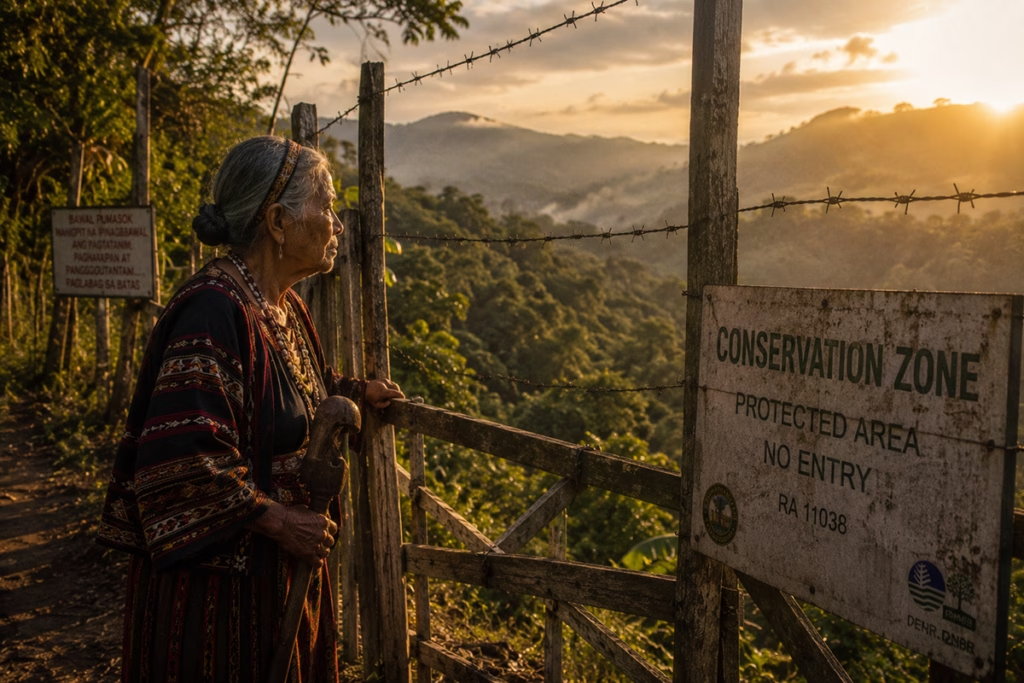
Lila held a handful of soil and let it fall through her fingers like sand through an hourglass. We sat under the shade of a massive dao tree, just outside the newly erected fence that now marked the boundary of a protected conservation zone. The land beyond that fence, now off-limits to her people, had been her family’s home for seven generations.
“They said we were harming the forest,” she told me, her voice steady but her eyes wet. “We are the forest.”
She was sixty-three years old, a Mangyan elder from a village in the highlands of Mindoro. She spoke Tagalog slowly, choosing each word with care. Three families sheltered under a tarpaulin; they had been relocated six months earlier. The government called it “voluntary resettlement.” Lila called it exile.
I’d come to Mindoro chasing a different story, one about eco-tourism success and renewable energy projects. Instead I found a pattern repeated across the island: environmental wins on paper, human losses in practice. The irony burned. Projects designed to protect the natural resources of Mindoro Island were displacing the very people who’d stewarded them for centuries.
This is the story most environmental campaigns don’t tell. It’s messy, uncomfortable, and it complicates the tidy narrative that planting trees and designating protected areas automatically equal progress. But if we’re serious about sustainability, we need to talk about who pays the price when “green” projects roll into town.
The Promise of “Green” Development: Narratives vs. Reality
Mindoro has become a darling of the Philippine environmental movement. Flip through government press releases or scroll through NGO Instagram feeds, and you’ll see glowing reports: new marine protected areas, expanded national parks, solar farms promising clean energy for rural communities, and eco-tourism ventures bringing jobs and revenue.
The island’s natural resources are indeed remarkable. Mindoro Island’s forests contain over 700 plant species, many of which are endemic. Its marine ecosystems support vibrant coral reefs. The highlands provide critical watershed services for lowland agriculture. Conservation advocates call it a biodiversity hotspot that demands protection.
The narrative is seductive. Foreign donors love it. Domestic politicians campaign on it. International media profiles it. Mindoro is proof, they say, that economic development and environmental protection can coexist. It’s a win for biodiversity, a win for climate action, a win for local communities.
Except when you actually talk to the local communities, the story shifts.
The Local Perspective
Ramon, a Mangyan farmer I met near the town of Sablayan, had lived his entire life cultivating a small patch of land his grandfather cleared decades ago. Last year, the wildlife sanctuary expanded to include his land. Officials told him his farming practices, specifically his use of controlled burns to clear undergrowth, violated conservation laws. ‘I asked them, how did the forest survive for a hundred years if what we do destroys it?’ he said, shaking his head. ‘They had no answer. They just said the law is the law.

His story isn’t unique. Across Mindoro, Mangyan communities report similar experiences: sudden restrictions on traditional hunting, fishing, and foraging; denial of permits to gather rattan or timber for housing; forced relocations framed as “voluntary” but backed by legal threats; and most painfully, the criminalization of practices their ancestors had used sustainably for generations.
The official story celebrates conservation milestones and the protection of Mindoro Island’s natural resources. The lived experience is dispossession dressed in green.
Laws and Policies as Tools of Dispossession
On paper, the Indigenous Peoples’ Rights Act of 1997 should protect communities like Lila’s and Ramon’s. IPRA recognizes ancestral domains, grants Indigenous groups the right to manage their own lands, and requires free, prior, and informed consent before any development project proceeds.
In practice, IPRA collides with a thicket of overlapping environmental laws, and when that happens, Indigenous rights usually lose.
Protected area designations, enshrined in the National Integrated Protected Areas System Act, often supersede IPRA claims. When the government reclassifies land as a national park or wildlife sanctuary, the new designation can overnight outlaw traditional activities, including swidden agriculture, hunting, and even gathering firewood. Suddenly, practices that sustained a community for centuries become criminal offenses.

I sat down with Atty. Maria Santos, a lawyer who’s worked on ancestral domain cases for fifteen years. She walked me through the legal maze, her frustration evident.
The Legality Aspect
“IPRA sounds great in theory,” she said. “But when a government agency declares an area a critical habitat or a protected zone, Indigenous claims get sidelined. The environmental law takes precedence. Communities are told they can stay, but they can’t farm, hunt, or gather. Essentially, they’re being told to live like museum exhibits in their own home.”
The result is a cruel irony. Laws designed to empower Indigenous peoples and laws designed to protect the natural resources of Mindoro Island end up working against both. Communities lose their livelihoods and cultural identity. The environment loses the traditional ecological knowledge that kept it healthy for generations.
Case in point: In 2019, a Mangyan community in northern Mindoro was forcibly relocated from land that had been newly designated as a critical watershed. Officials cited erosion risk and water quality concerns. The relocation site, however, was miles from their ancestral lands, with poor soil and no access to the forest resources they depended on. Within a year, families were struggling to feed themselves. Some returned illegally to their old lands, risking arrest.
Who benefits from that kind of “environmental protection”? Not the forest. Certainly not the people.
The Hidden Cost of “Environmental Wins”

Numbers are clean. Hectares protected, carbon sequestered, endangered species counted. Environmental wins look impressive on spreadsheets and donor reports. Mindoro’s conservation zones now cover thousands of hectares, protecting critical habitat for the Mindoro bleeding-heart dove, the tamaraw, and countless other species.
But numbers don’t capture what Lila described to me: the grief of losing the burial grounds where her ancestors rest, now inside a no-access conservation zone. They don’t measure Ramon’s humiliation when park rangers accused him of illegal logging for gathering fallen branches to repair his roof. They don’t quantify the cultural erosion as young Mangyan children grow up disconnected from the forests that once shaped their identity.
I spoke with Dr. Evelyn Reyes, an anthropologist who’s studied Mindoro’s Indigenous communities for over two decades. She was blunt.
“When you displace a community from their ancestral land, you don’t just relocate bodies,” she said. “You sever a relationship with a place that shapes language, ritual, knowledge systems, and identity. For the Mangyan, the forest isn’t a resource. It’s a relative. Cutting that bond is a form of violence, even if it’s legal.”
The Economic Implications
The economic costs are staggering, too. Families who once practiced subsistence farming with occasional cash income from forest products are now entirely dependent on external aid or wage labor in towns where they face discrimination. Health outcomes worsen. Malnutrition rates climb. Social cohesion fractures under the stress of forced resettlement.
Meanwhile, the environmental gains are questionable. Studies show that Indigenous-managed forests often have better biodiversity outcomes than fortress-style conservation that excludes human activity. The Mangyan didn’t destroy Mindoro’s ecosystems; they co-evolved with them. Removing them from the equation eliminates centuries of accumulated ecological knowledge about the island’s natural resources and how to sustain them.
The real kicker? Many of the eco-tourists and green donors funding these projects have no idea this is happening. They see photos of pristine forests and reforestation milestones. They don’t see the displaced families living in tarpaulin shelters at the forest’s edge, criminalized for trying to go home.
Greenwashing works because it hides the human cost behind feel-good metrics.
Sustainability Without Inclusion Is a Mirage
Here’s the uncomfortable truth that most environmental campaigns avoid: sustainability divorced from social justice isn’t sustainable at all.
Conservation projects that exclude or displace the people who’ve lived on the land for generations almost always fail in the long term. When communities are treated as threats rather than partners, they lose the incentive to protect ecosystems. Their traditional knowledge is ignored, and projects miss critical insights about local ecology. They often return, creating conflict and enforcement nightmares. Globally, the data support this. A 2021 study published in Nature Sustainability found that Indigenous-managed lands had equal or better conservation outcomes compared to government-protected areas, often at a fraction of the cost. Communities with secure land tenure and decision-making power protect forests more effectively than top-down fortress conservation models.

I asked Dr. Reyes why this approach isn’t the norm in the Philippines when managing the natural resources of Mindoro Island and similar regions.
“Control,” she said immediately. “Government agencies and big NGOs don’t want to cede power. Genuine community-led conservation is messy. It requires negotiation, compromise, and long-term relationship-building. It’s easier to draw a line on a map, fence it off, and declare victory.”
Typical Exceptions
But there are exceptions. In Palawan, some Indigenous communities have successfully partnered with conservation groups to manage ancestral domains. They’ve implemented sustainable harvesting quotas, replanted degraded areas, and even run eco-tourism ventures that generate income while protecting biodiversity. The key difference? The communities had legal recognition of their land rights and genuine decision-making authority.
Mindoro could follow that model. The island’s natural resources could be protected through genuine partnership rather than displacement. Instead, current approaches repeat the same mistakes that have undermined conservation efforts worldwide: treating people as problems rather than solutions.
If you care about climate change, biodiversity, or environmental sustainability, you should care about this. Because protecting the planet while dispossessing the people who’ve protected it for centuries isn’t conservation. It’s colonialism in green clothing.
From Passive Supporter to Critical Ally: What You Can Do
So what does it look like to actually support the Mangyan and other Indigenous communities facing displacement in the name of conservation?
First, learn to spot greenwashing. Not all “green” projects are created equal. Ask hard questions: Who was consulted before this project started? Do local communities have decision-making power or just token representation? Are traditional land rights recognized? If a project can’t answer those questions clearly, be skeptical.
Second, amplify Mangyan voices. Organizations like the Mangyan Heritage Center and the Mindoro Biodiversity Conservation Foundation are led by or closely partner with Indigenous communities. They provide platforms for local advocacy and storytelling. Follow them. Share their posts. Donate if you can, but more importantly, listen to what they’re actually asking for.
Third, demand accountability from the environmental organizations you support. If you donate to conservation groups working in Mindoro or elsewhere in the Philippines, ask them directly: How are you ensuring free, prior, and informed consent? How are Indigenous rights being protected? What role do local communities play in managing the natural resources of Mindoro Island? If they can’t give you a straight answer, redirect your support.
Fourth, push for policy change. Contact your representatives if you’re Filipino, or international NGOs if you’re abroad. Demand that environmental protection and Indigenous rights be treated as complementary, not competing priorities. Support legislation that strengthens IPRA enforcement and ensures ancestral domain claims aren’t overridden by conservation designations.
Finally, get comfortable with complexity. Real sustainability isn’t as simple as planting trees or expanding protected areas. It requires centering the people who’ve lived sustainably on the land for generations. It means accepting that conservation isn’t just about nature; it’s about justice.
True climate justice doesn’t choose between people and the planet. It recognizes that one’s health depends on the other’s dignity.
Who Really Benefits When “Green” Projects Push Out the People?

Here’s the question that keeps me up at night: Who actually benefits when a conservation project displaces an Indigenous community?
The forest loses the traditional stewards who maintained it for centuries. Not the Mangyan, who lose their land, their culture, and their livelihoods. The environment sees conservation fail. And the natural resources of Mindoro Island, which thrived under Indigenous management for generations, certainly don’t gain a thing from the transition.
So, who wins? The government officials who tout conservation statistics at international climate conferences? The foreign donors who get glossy photos for their annual reports? The eco-tourists who get pristine landscapes scrubbed clean of inconvenient human presence?
I thought about this as I left Mindoro, as Lila’s words echoed in my head: “We are the forest.”
She’s right. The Mangyan aren’t separate from Mindoro’s ecosystems. They’re part of them. And any environmental strategy that doesn’t recognize that isn’t just incomplete; it’s a lie.
If you care about the planet, care about the people who’ve been protecting it long before it was trendy. Interrogate the feel-good stories you see on social media. Follow the money. Demand transparency. And remember that the most sustainable conservation isn’t done to communities, it’s done with them.
Share this story. Join the conversation. And the next time someone celebrates an environmental win, ask the question that matters: At whose expense?
Stay curious. The truth is rarely as tidy as the press release.
If you want to go deeper, start by researching the concept of “conservation refugees,” communities displaced by protected area designations worldwide. It’s a global pattern, and Mindoro is just one example. The more you learn, the harder it is to see conservation the same way again.
FAQ
The Mangyan are an Indigenous group native to Mindoro Island in the Philippines. They’re actually composed of several distinct ethnolinguistic groups, including the Iraya, Alangan, Tadyawan, and Hanunuo, among others. They’ve lived in Mindoro’s mountains and forests for centuries, practicing swidden agriculture, hunting, gathering, and maintaining rich cultural traditions. Today, they number around 100,000 people, mostly in rural and upland areas where they’ve traditionally managed Mindoro Island’s natural resources.
It’s a tragic case of misguided policy colliding with good intentions. When land is designated as a protected area or conservation zone, laws often prohibit traditional practices such as shifting cultivation, hunting, and even the gathering of forest products. Policymakers view these practices as threats to biodiversity, ignoring centuries of evidence that the Mangyan have successfully stewarded these ecosystems. As a result, traditional activities become criminalized, forcing communities to relocate.
Absolutely. Mindoro has globally significant biodiversity and faces real threats from commercial logging, mining, and unsustainable agriculture. Mindoro Island’s natural resources include rare endemic species and critical ecosystems. But effective conservation doesn’t require displacing the people who’ve protected those forests for centuries. Research shows that Indigenous-managed lands often have better conservation outcomes than exclusionary protected areas. The problem isn’t whether to protect Mindoro’s ecosystems; it’s how we do it and who gets to participate.
Additional FAQ Considerations
What is IPRA, and why doesn’t it protect the Mangyan from displacement?
The Indigenous Peoples’ Rights Act of 1997 is supposed to protect ancestral lands and guarantee Indigenous communities the right to free, prior, and informed consent for any projects affecting them. But IPRA often conflicts with environmental laws like the National Integrated Protected Areas System Act. When that happens, environmental designations usually take precedence, overriding ancestral domain claims. The result is that IPRA’s protections are weakened or ignored entirely, even when Indigenous communities have sustainably managed natural resources for generations.
Are there examples of conservation projects that work with Indigenous communities instead of displacing them?
Yes. In Palawan, some Tagbanwa communities have partnered with conservation organizations to co-manage protected areas. They set sustainable harvesting limits, conduct reforestation, and run eco-tourism projects. The key is that these communities have legally recognized land rights and real decision-making power, not just token consultation. These partnerships often deliver better environmental and social outcomes than top-down conservation models, proving that protecting natural resources and respecting Indigenous rights aren’t mutually exclusive.
How can I tell if a “green” project is actually greenwashing?
Ask who’s in charge and who was consulted. If a project claims to protect the environment but doesn’t mention how it engaged local communities, that’s a red flag. Look for evidence of free, prior, and informed consent. Check whether Indigenous land rights are recognized and respected. If the project treats local people as obstacles rather than partners in managing natural resources, it’s likely greenwashing. Genuine conservation centers the communities that have lived on the land, not just the land itself.
Still More FAQ Considerations
What can international supporters do to help the Mangyan without causing more harm?
Listen first. Amplify Mangyan voices through organizations like the Mangyan Heritage Center. Support policy advocacy that strengthens Indigenous rights. If you donate to environmental groups, ask them directly how they’re protecting ancestral lands and ensuring community consent in their management of Mindoro Island’s natural resources. Avoid parachuting in with “solutions” developed without local input. True solidarity means following the lead of the communities most affected, not imposing external agendas, even well-meaning ones.
Are the Mangyan the only Indigenous group in the Philippines facing this problem?
No. Across the Philippines, Indigenous peoples like the Lumad in Mindanao, the Aeta in Luzon, and others face similar displacement due to mining, logging, agribusiness, and yes, conservation projects. Globally, millions of “conservation refugees” have been displaced by protected area designations. The Mangyan’s experience is part of a much larger pattern, which is exactly why it demands attention and systemic change.
Other Articles You Might Like
- Visiting Mindoro Island Responsibly: The Truth About Its Jungles
- Mindoro Natural Resources: Why Communities Need Power to Refuse
- Mindoro Island’s Ultimate Natural Attractions: Why Loneliness Is Part of Transformation
- Forget Boracay, Dinagat Island Tourism Will Challenge You Instead
- Why Mindoro’s Natural Attractions Demand You Slow Down and Focus on One Place
SUGGESTIONS FOR LODGING AND TRAVEL
Lodging is widely available throughout the Philippines. However, you may want to get some assistance booking tours to some of the Philippines’ attractions. I’ve provided a few local agencies that we’ve found to be very good for setting up tours. For transparency: We may earn a commission when you click on certain links in this article, but this doesn’t influence our editorial standards. We only recommend services that we genuinely believe will enhance your travel experiences. This will not cost you anything, and I can continue to support this site through these links.
- For Hotel Accommodations in the Manila area, I highly recommend The Manila Hotel. It is centrally located and within walking distance of Rizal Park and Intramuros. Many other attractions are easily accessible from there as well. I have provided a search box below to help you find hotels (click “Stays” at the top) or flights (click “Flights” at the top). This tool will provide me with an affiliate commission (at no cost to you).
Local Travel & Lodging Assistance
- Guide to the Philippines: This site specializes in tours throughout the Philippines. They seem to have some flexibility in scheduling, and pricing is very competitive.
- Kapwa Travel is a travel company focused on the Philippines. It specializes in customizing trips to meet customers’ needs.
- Tourismo Filipino is a well-established company that has operated for over 40 years. It focuses on tailoring tours to meet customers’ needs.
- Tropical Experience Travel Services – Tours of the Philippines: This company offers a range of tour packages, allowing you to tailor your trip to your preferences.
Lastly, we recommend booking international travel flights through established organizations rather than a local travel agent in the Philippines. I recommend Expedia.com (see the box below), the site I use to book my travel.

