
Key Takeaways
- Mindoro jungles are not untouched; they are shaped by local communities, agriculture, and survival needs.
- Tourism can help, but it often leaves a negative impact, leading to environmental stress and cultural tensions.
- The reality of conservation involves integrating human livelihoods with ecological health, not erasing people from the landscape.
- Local initiatives and responsible tourism practices can support both the environment and community well-being.
- Understanding and acknowledging the complexities of the Mindoro jungles is essential for meaningful preservation efforts.
The Trail That Told the Truth
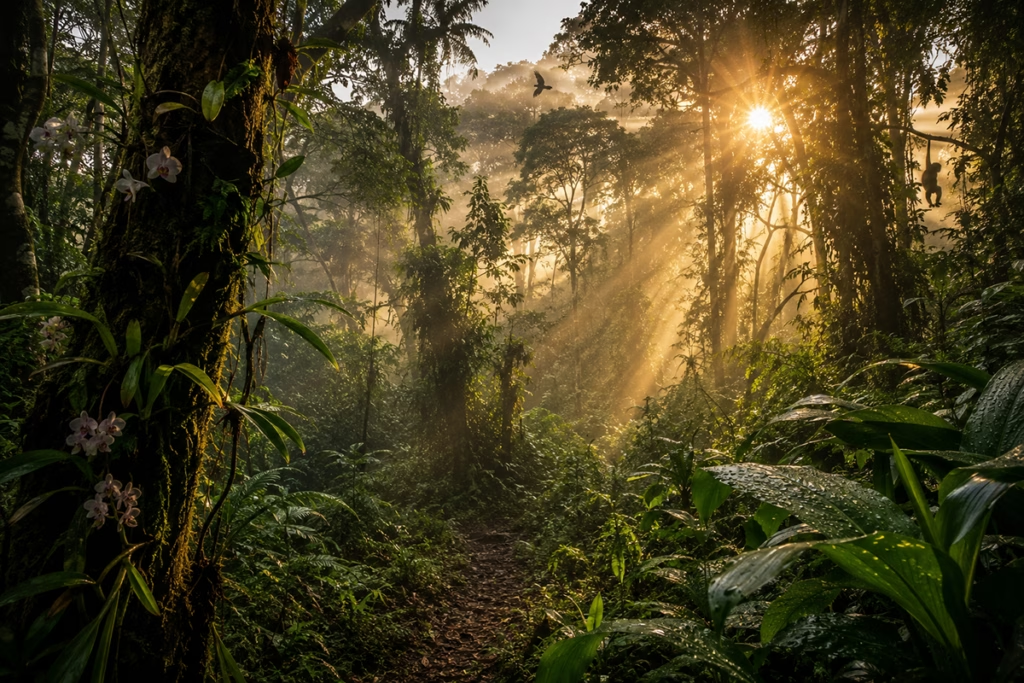
The guide stopped at a fallen tree, wiped sweat from his forehead with a rag that had seen better decades, and said something I didn’t expect: “My cousin cut this last month for firewood.” We were two hours into what the travel blogs called Mindoro’s “pristine wilderness,” also known as the Jungles. The kind of place where Instagram captions overflow with words like untouched, virgin, and paradise. The trail wound through dense canopy, orchids clung to moss-covered branches, and somewhere in the distance, a hornbill called out along with other Mindoro wildlife. It looked every bit the part.
But Mang Rodel, my guide, wasn’t selling me a fantasy. He was showing me his backyard, and his backyard had bills to pay.
That tree wasn’t felled by loggers or corporations. It was cut by someone who needed to cook dinner and heat water for a sick child. The “untouched” jungle wasn’t being destroyed by cartoon villains. It was being nibbled at the edges by people doing what people do: surviving. This is the gap between what travelers expect and what’s actually happening among the natural attractions on Mindoro Island. We arrive wanting Eden. We leave with photos that suggest we found it. But the real story, the one that matters, is tangled up in the lives of people we’ll never meet and struggles we’d rather not think about.
If you want to understand Mindoro’s jungle, you have to stop romanticizing it. And if you want to help preserve it, you need to start with the truth.
The Footprints You Don’t See in the Brochures
Mang Rodel’s family has lived on the edge of the forest for three generations. His grandfather hunted wild boar. His father gathered rattan. Rodel himself guides tourists and occasionally helps with small-scale logging when money gets tight. None of them consider themselves environmentalists, but all of them know the forest better than any outsider ever will.
“People think nobody lives here,” he told me, pausing to point out a barely visible side trail. “That path goes to my uncle’s farm. That one leads to a Mangyan village. This whole area, people use it every day.”
The Mangyan, Mindoro’s indigenous people, have inhabited these forests for centuries. Their agricultural practices, hunting patterns, and resource use are woven into the landscape. Calling the jungle “untouched” erases them completely. But it’s not just indigenous communities. Lowland farmers push further into forest edges when coastal and valley lands can’t support growing families. They clear small plots for rice, root crops, and livestock. It’s called kaingin, slash-and-burn agriculture, and it’s both a survival strategy and an environmental stressor.

The Generational Changes
I met Aling Rosa near the town of Sablayan. She and her husband farm a hectare carved from the forest margin twenty years ago. Their three kids finished high school because of that land. But she knows the cost.
“The rains come harder now,” she said, gesturing toward a gully that hadn’t existed when they first arrived. “The soil washes away. We use more fertilizer, but it doesn’t help as much.”
She didn’t need a scientist to explain soil degradation or watershed disruption. She lives it. And she can’t afford to stop farming, because there’s no alternative income that pays enough to feed her family.
This is the real human footprint among Mindoro Island’s natural attractions: not malicious, not industrial, but relentless, as poverty always is. Small cuts, repeated daily, by people who have no choice.
What “Pristine” Actually Looks Like Up Close
Mindoro is home to species found nowhere else on Earth. The tamaraw, a dwarf buffalo, clings to existence in the island’s interior. The Mindoro bleeding heart dove, the Mindoro hornbill, the Mindoro Imperial pigeon: all endemic, all vulnerable.
But endemism is a double-edged sword. It makes these species irreplaceable. It also makes them fragile.
Dr. Ana Lim, a conservation biologist I spoke with in Puerto Galera, explained it bluntly: “You can’t separate ecology from economics here. The tamaraw survives in areas that are too steep for farming. The moment that changes, the tamaraw loses.”

The jungle’s biodiversity depends on specific conditions: intact canopy, undisturbed soil, and minimal human traffic. But those conditions are eroding. Trails widen with each passing group of trekkers. Campfire sites multiply. Plastic bottles turn up in streams that didn’t see trash a decade ago.
And then there are the invasive species, hitchhikers that arrive on boots, in packs, in the guts of animals. A single introduced plant or insect can cascade through an ecosystem, outcompeting native species and destabilizing food webs.
I asked Dr. Lim if she thought Mindoro’s forests would survive the next fifty years.
She paused, choosing her words carefully. “Survive? Yes. But in what form? That depends entirely on whether we acknowledge reality or keep pretending.”
The reality is this: Mindoro’s jungle is not a museum exhibit. It’s a living system under pressure from every direction. And the biggest threat isn’t evil. It’s neglected, dressed up as admiration.
The Tourists Who Love It to Death
Tourism is supposed to be the solution. Sustainable ecotourism, community-based tourism, and responsible travel. All the buzzwords that make us feel good about hopping on a plane and wandering through someone else’s backyard.
And to be fair, tourism does bring money. Guides like Mang Rodel earn more from a week of trekking than they would from a month of manual labor. Guesthouses, restaurants, and transport services all benefit. For some families, tourism is the difference between subsistence and stability.
But here’s the uncomfortable truth: even the most well-meaning travelers leave a mark. I watched a group of backpackers at a river crossing, filling their water bottles directly from the stream. One of them casually tossed a protein bar wrapper into the current. When I pointed it out, he looked genuinely surprised, fished it out, and apologized. He wasn’t a bad person. He just wasn’t paying attention.

Multiply that moment by thousands of visitors each year exploring natural attractions on Mindoro Island. Trail erosion, human waste, litter, noise pollution, and stress on wildlife. It adds up.
The Impact of Tourism
Mang Rodel doesn’t blame tourists. “They come here because they love nature,” he said. “But they don’t see what happens after they leave.”
What happens is this: locals spend hours cleaning up campsites, repairing trails, and dealing with complaints from communities affected by increased foot traffic and noise. The income helps, but it doesn’t cover the long-term costs.
And then there’s the cultural tension. Tourism commodifies indigenous traditions, turning ceremonies into performances and sacred sites into photo ops. The Mangyan communities I spoke with expressed deep ambivalence: grateful for the income, resentful of the intrusion.
One elder, Lolo Danilo, put it simply: “They say they want to learn from us. But they don’t listen. They just take pictures.”
If we’re serious about visiting Mindoro responsibly, we need to stop pretending our presence is neutral. It’s not. Every step we take is a transaction, and we need to know what we’re buying.
What If Wild Isn’t the Point?
Here’s where I’m going to lose some of you.
We fetishize wilderness. We treat untouched nature as the pinnacle of environmental value, the gold standard against which all landscapes are measured. But that’s a deeply Western, deeply romantic idea, and it doesn’t always match reality.
Mindoro’s jungle isn’t wild in the way we imagine. It’s shaped by centuries of human presence, by indigenous agricultural practices, by hunting and gathering, by paths walked daily for generations. It’s as much a cultural landscape as a natural one. And that’s not a failure. That’s just what landscapes are when people live in them.

The ecologist Emma Marris argues that we should embrace “novel ecosystems,” landscapes where human influence and nature coexist in unexpected ways. Not pristine, but functional. Not wild, but resilient.
Mindoro’s forests are novel ecosystems. They’re not the Eden we imagined, but they’re still worth protecting: not in spite of human presence but because of the complex relationships between people and place.
Preservation doesn’t have to mean locking people out. It can mean integrating human needs with ecological health, finding ways for communities to thrive without exhausting the land.
I’m not suggesting we abandon conservation. I’m suggesting we abandon the fantasy that conservation means erasing people. Because in Mindoro, the people are already there, and they’re not going anywhere.
The People Actually Doing the Work
The good news is that some communities are finding ways forward.
In Sablayan, a coalition of Mangyan leaders, local government, and conservationists created a protected area with community-managed buffer zones. Families can still farm, hunt, and gather, but within agreed limits. In exchange, they receive support for alternative livelihoods: handicrafts, agroforestry, and ecotourism guiding.
It’s not perfect. Funding is inconsistent, enforcement is patchy, and outside pressures, mining interests, and land grabbing still threaten the arrangement. But it’s a start.

Mang Rodel is part of a guide cooperative that reinvests fees into trail maintenance and waste management. They also run education programs for visiting groups, explaining the real challenges facing the forest.
“I tell tourists the truth now,” he said. “I used to just show them birds and orchids. Now I show them the farms, the villages, the problems. Some people don’t like it. They say I’m ruining the experience.”
I asked him if he cared.
He grinned. “If they don’t want the truth, they can hire someone else.”
Supporting these efforts doesn’t require grand gestures. It requires paying attention. Hire local guides, not foreign-run tour companies. Stay in community-owned guesthouses, not resorts. Ask questions, listen to answers, and stop treating the place like a theme park.
Advocate for policies that support both conservation and livelihoods. Donate to grassroots organizations, not international NGOs that funnel money into overhead. And for the love of all that’s good, pack out your trash.
The Jungle Doesn’t Care What You Expected

So, here’s where we are.
Mindoro’s jungle is not the untouched paradise the blogs promised. It’s a working landscape, shaped by poverty, survival, and the daily struggles of people you’ll never hear about.
It’s also beautiful, biodiverse, and irreplaceable. It deserves protection. But protection based on fantasy is worthless.
If we’re going to preserve the natural attractions on Mindoro Island, we need to start by acknowledging what they actually are: not Eden, but home. Not wild, but lived in. Not pristine, but precious.
And we need to ask ourselves what role we’re willing to play. Are we here to take photos and feel good? Or are we here to engage with the messy, complicated reality of people and place?
The jungle doesn’t care what you expected. It only cares what you do next.
Will you keep chasing the myth? Or will you deal with the truth?

Mindoro isn’t the only place suffering from the gap between image and reality. Every “hidden paradise” in the Philippines has a version of this story. The question is whether we’re willing to hear it. If you’ve traveled somewhere and discovered the truth beneath the marketing, share it. The more honest we are, the better chance we have of making travel something other than extraction.
FAQ’s – The Truth About Mindoro’s Jungle
It’s not an exaggeration. Mindoro’s forests have been inhabited and used by indigenous Mangyan communities for centuries. Add to that lowland farmers, small-scale loggers, hunters, and tourists, and you have a landscape shaped by constant human presence. Untouched is a marketing term, not a description of reality.
No. Responsible tourism can support conservation if done right. Hire local guides, stay in community-owned accommodations, respect cultural boundaries, and minimize your footprint. The goal isn’t to stay away. It’s about showing up thoughtfully and contributing to solutions rather than problems.
Not at all. It means conservation needs to be realistic. Protecting Mindoro’s biodiversity requires working with local communities, not against them. The most effective conservation projects integrate human livelihoods with ecological health. Pretending people don’t exist, or that they’re the enemy, guarantees failure.
Poverty. It drives unsustainable farming, overhunting, illegal logging, and resource extraction. Until local communities have viable alternatives, the pressure on the forest will continue. Large-scale threats like mining and land grabbing are also serious, but they exploit the same underlying economic desperation.
Yes. The tamaraw population hovers around 600 individuals, confined to a shrinking habitat. Habitat loss, poaching, and disease are constant threats. The Mindoro hornbill, bleeding heart dove, and other endemic species face similar pressures. Without intervention, extinction is a real possibility within our lifetimes.
Additional FAQ Considerations
How can I tell if a tour operator or guide is actually supporting local communities?
Ask direct questions. Where does the money go? Are guides and staff local? Do they reinvest in conservation or community projects? Look for cooperative or community-run initiatives. Avoid companies that make grand claims about “giving back” without specifics. And pay attention to how they talk about local people. If they’re props in the story rather than the point, that’s a red flag.
What’s one thing I can do right now to help?
Stop spreading the untouched paradise myth. Share honest stories about the places you visit. Amplify local voices. Donate to grassroots organizations working directly with Mindoro communities. And the next time you see a travel blog gushing about pristine wilderness, ask: Who lives there, and what’s their story?
Isn’t this article just saying humans ruin everything?
No. It’s saying humans are part of everything. The goal isn’t to remove people from nature. It’s to find ways for people and nature to coexist without one destroying the other. That requires honesty, humility, and a willingness to abandon fairy tales in favor of complexity.
You mentioned novel ecosystems. Does that mean we should just accept degraded landscapes and give up on restoration?
Not at all. It means recognizing that some landscapes will never return to a pre-human state, and that’s okay. Novel ecosystems can still support biodiversity, provide ecosystem services, and hold cultural value. Restoration should aim for resilience and function, not an imaginary past.
Will Mindoro’s jungle survive the next century?
That depends entirely on choices made in the next decade. If economic pressures continue unchecked, if tourism grows without accountability, if conservation remains disconnected from local realities, then no. But if communities, governments, and visitors commit to honest, integrated solutions, there’s a chance.
Other Articles You Might Like
- Mindoro Natural Resources: Why Communities Need Power to Refuse
- Mindoro Island’s Ultimate Natural Attractions: Why Loneliness Is Part of Transformation
- Healing or Hiding? The Truth About Solo Wellness Retreats in the Philippines, And Why Silence Scares First-Timers Most
- Forget Boracay, Dinagat Island Tourism Will Challenge You Instead
- Why Mindoro’s Natural Attractions Demand You Slow Down and Focus on One Place
SUGGESTIONS FOR LODGING AND TRAVEL
Lodging is widely available throughout the Philippines. However, you may want to get some assistance booking tours to some of the Philippines’ attractions. I’ve provided a few local agencies that we’ve found to be very good for setting up tours. For transparency: We may earn a commission when you click on certain links in this article, but this doesn’t influence our editorial standards. We only recommend services that we genuinely believe will enhance your travel experiences. This will not cost you anything, and I can continue to support this site through these links.
- For Hotel Accommodations in the Manila area, I highly recommend The Manila Hotel. It is centrally located and within walking distance of Rizal Park and Intramuros. Many other attractions are easily accessible from there as well. I have provided a search box below to help you find hotels (click “Stays” at the top) or flights (click “Flights” at the top). This tool will provide me with an affiliate commission (at no cost to you).
Local Travel & Lodging Assistance
- Guide to the Philippines: This site specializes in tours throughout the Philippines. They seem to have some flexibility in scheduling, and pricing is very competitive.
- Kapwa Travel is a travel company focused on the Philippines. It specializes in customizing trips to meet customers’ needs.
- Tourismo Filipino is a well-established company that has operated for over 40 years. It focuses on tailoring tours to meet customers’ needs.
- Tropical Experience Travel Services – Tours of the Philippines: This company offers a range of tour packages, allowing you to tailor your trip to your preferences.
Lastly, we recommend booking international travel flights through established organizations rather than a local travel agent in the Philippines. I recommend Expedia.com (see the box below), the site I use to book my travel.

