
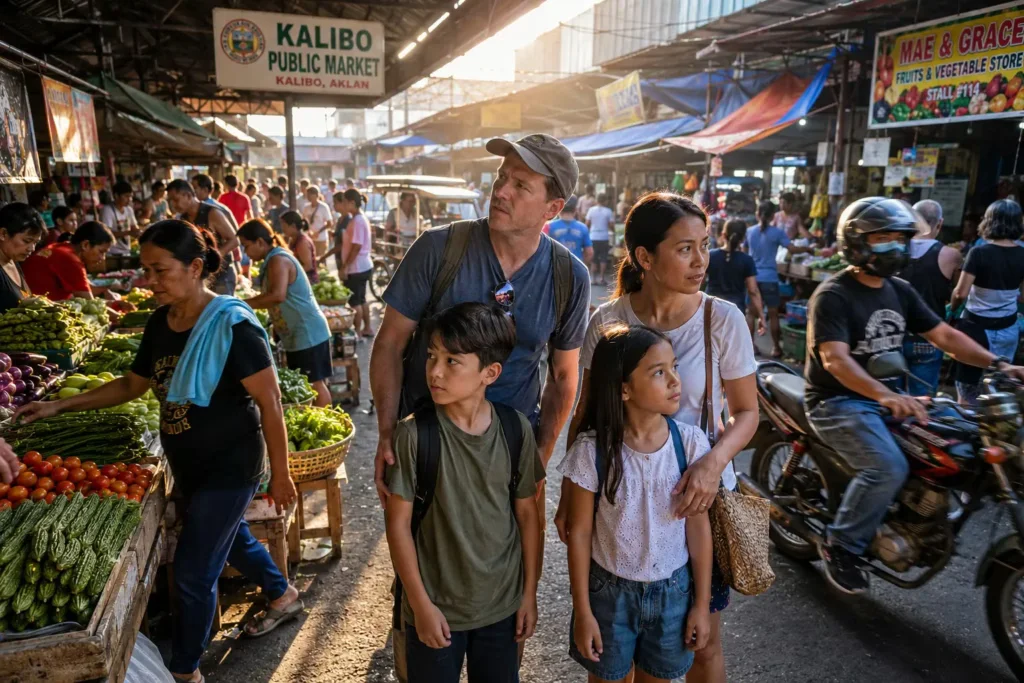
My nine-year-old daughter slumped against a dusty plastic chair at Kalibo’s public market. The bus ride from Manila had taken eight hours. Her brother was complaining about the heat. My wife shot me that look, the one that says, “This better be worth it.” Around us, vendors shouted prices for fresh bangus and mangoes. Motorcycles weaved between shoppers carrying mesh bags stuffed with vegetables. A stray dog trotted past, unconcerned. Not a single tourist in sight, just Filipinos living their Tuesday. I’d promised my family an authentic Philippines travel experience. What I’d delivered was exhaustion, confusion, and zero Instagram-worthy moments. We weren’t supposed to be here at all. Kalibo was just the airport we’d fly into before catching a van to Boracay, that famous white-sand beach you’ve seen a thousand times online.
But somewhere between planning and packing, I made a decision about our family travel in the Philippines. We weren’t going to Boracay. We were staying right here in this “pitstop” town that most tourists race through without a second glance. Six months later, my family talks about that trip more than any other vacation we’ve taken. The moments that bonded us weren’t on perfect beaches. They happened in places travel influencers never mention, among people whose names you’ll never see in guidebooks.
Key Takeaways
- The author and family experienced Kalibo, Philippines, instead of the typical Boracay vacation, discovering deeper cultural connections.
- They found authentic experiences and meaningful interactions with locals, such as vendors and festival participants.
- Kalibo challenges the notion of being a mere pitstop and showcases rich traditions and community life.
- Traveling in Kalibo offered opportunities for real bonding over shared challenges and uncurated moments.
- The piece calls for families to seek out lesser-known destinations for genuine travel experiences, highlighting that the true Philippines lies beyond crowded tourist spots.
Here’s what I learned: The real Philippines lives in the towns everyone skips.
The Beach Fantasy That’s Killing Family Travel in the Philippines

I’ll be honest. I almost booked Boracay as everyone else is planning family travel in the Philippines.
The photos are stunning. White sand that looks like powdered sugar. Water so turquoise it seems Photoshopped. Resorts promising “paradise found” and “tropical escape.” For families burned out from work and school, that sounds perfect.
But I’d been to Boracay before, years ago, before the rehabilitation closure. Even then, the beaches were packed shoulder to shoulder. Vendors approached every thirty seconds. The water near the shore had a faint odor I didn’t want to identify. Every restaurant menu was priced for foreigners with too much money and too little time.
Is this Paradise?
Paradise? Maybe once. Now it’s a carefully managed tourist trap where authenticity goes to die.
The Philippines has a problem with popular family travel destinations. Its most famous spots are collapsing under their own popularity. Boracay, El Nido, Coron: all stunning, all overcrowded, all slowly losing what made them special in the first place. The travel industry packages these places like products, and families consume them like fast food.
My friend Carlos took his family to Boracay last year. They spent three days fighting crowds, paying inflated prices, and watching their kids play on their tablets in a beachfront hotel. “We could’ve done that at home for a tenth of the price,” he told me later. His kids barely remember the trip.
That’s the hidden cost nobody talks about when planning family travel in the Philippines. Popular destinations promise relaxation but deliver stress. They market cultural immersion but manufacture staged experiences. Families return home exhausted, wallets lighter, with generic vacation photos that look like everyone else’s.
The emotional toll hits harder than the financial one. You spend months saving and planning. You want your kids to experience something real, something that expands their worldview. Instead, you get a sanitized resort bubble that could exist anywhere on the planet.
I refused to do that to my family.
The Kalibo Nobody Sees

Kalibo isn’t typically a destination for family travel in the Philippines. It’s infrastructure. An airport. A bus terminal. A place you pass through on your way to somewhere “better.”
That perception is exactly why it matters.
We checked into a small guesthouse three blocks from the public market. No pool, no buffet breakfast, no English-speaking concierge. Just a clean room, a friendly owner named Tess who spoke limited English, and ceiling fans that actually worked. Cost per night: about the same as a single appetizer in a Boracay resort.
Tess asked where we were headed the next day. When I said nowhere, she looked confused. “You stay here? In Kalibo?”
“That’s the plan,” I said.
The Unexpected Responses
She smiled, said something in Aklanon I didn’t understand, then disappeared into her kitchen. Ten minutes later, she brought us fresh lumpia and pansit she’d made for her family’s dinner. “Welcome,” she said. “Eat.”
That first night set the tone for everything that followed.
The next morning, we walked to the Magsaysay Park. It’s not in any guidebook I’ve read. Just a modest green space where locals jog, kids play basketball, and vendors sell taho and fish balls from pushcarts. We bought breakfast from a woman named Lina who’d been selling taho there for sixteen years.
“You’re the first foreigners I’ve served this year,” she said in careful English. “Maybe the first ever.”
My son asked why her taho tasted better than the kind we got in Manila. Lina laughed. “Because I wake up at 4 a.m. to make it fresh. No shortcuts.” She showed him the cloth strainer she used, explained how she caramelized the syrup, and let him taste the soybeans before they were processed. He was mesmerized.
There was More to See than We Realized
Later, we wandered through the Kalibo Cathedral, a beautiful structure built in the 1800s that most tourists never enter because they’re too busy rushing to their next ferry. Inside, an older woman named Maria was arranging flowers. She told us about the Ati-Atihan Festival, Kalibo’s massive cultural celebration every January that transforms the entire town into a pulsing, joyful riot of music, dance, and devotion.
“People come for Ati-Atihan but leave before it ends,” Maria said. “They take photos, then go to the beach. They don’t stay to understand why we celebrate.” Maria explained how Ati-Atihan honors both the Santo Niño and the Indigenous Ati people, blending Catholic and pre-colonial traditions into something uniquely Filipino. She talked about the decades of preparation, the neighborhood rivalries, and the pride locals take in their costumes and performances. My daughter asked a dozen questions. Maria answered everyone with patience and enthusiasm.

This, I realized, is what authentic family travel in the Philippines looks like. Not a curated cultural show performed for tourists. Not a sanitized experience designed to make foreigners comfortable. Just real people sharing real stories because someone bothered to ask.
Our Outcome
We spent three days in Kalibo doing almost nothing that could be considered tourism. Eating at carinderias where no English was spoken, and menus didn’t exist. Riding a jeepney to a nearby barangay where my wife’s former college roommate’s cousin lived. Attended a neighborhood birthday party because Tess’s nephew turned seven, and she insisted we come.
At that birthday party, I watched my kids play patintero in the street with a dozen Filipino children who didn’t share their language but shared their laughter. Nobody cared about selfies or Wi-Fi. They just played until dark, sweaty, filthy, and utterly content.
My wife leaned over and whispered, “This is what I wanted. This right here.”
When Family Travel in the Philippines Gets Hard, Families Get Real

Let me be clear: Kalibo wasn’t always easy.
The jeepney to the barangay was packed, hot, and wildly unpredictable. My daughter got motion sickness. My son complained loudly about the heat. I had no idea where we were going or when we’d arrive. The driver stopped seemingly at random, shouting destinations I couldn’t understand.
At one point, I questioned everything. What was I doing to my family? Why hadn’t I just booked the beach resort like a typical person?
Then my son looked out the window and said, “Dad, look.”
Recognizing the Real Philippines for the First Time
We were passing through a rural stretch of rice paddies and small houses. A farmer waved at our jeepney as we passed. Kids chased each other through fields, silhouetted against the afternoon sun. A carabao stood knee-deep in water, unbothered by the world. It was the Philippines that tourists never saw because they were trapped in air-conditioned vans speeding toward their next photo op.
“This is what the country actually looks like,” my son said.
He was nine years old, and he got it.
That night, after we returned to Kalibo, my daughter said her stomach hurt from the jeepney ride, but it was worth it. My wife admitted she’d been nervous about my plan to skip the beaches but was glad we did. We sat on the guesthouse’s small balcony, eating banana cue from a street vendor, and talked about the day like it was an adventure we’d survived together.
That’s when I understood the real gift of difficult travel. When things get uncomfortable, families stop performing and start connecting. There’s no script for navigating a crowded jeepney or ordering food when nobody speaks English. You figure it out together and laugh at your mistakes. You depend on each other.
Safe, sanitized tourist experiences remove that friction. Everything’s easy, everything’s predictable, and nothing’s memorable. You follow the itinerary, check the boxes, and return home with nothing that bonds you together.
The hard moments are the moments that matter in family travel.
Pitstop Towns Are Anything But
The travel industry has done Kalibo dirty.
Online, it’s described as a “gateway,” “transport hub,” or “stopover point.” Guidebooks dedicate half a paragraph to it before launching into pages about Boracay. The implicit message is clear: Get through Kalibo as fast as possible. Nothing to see here.
That’s not just wrong. It’s an insult to the thousands of people who live, work, and build their lives there.
Kalibo is the capital of Aklan Province. It’s home to over 80,000 people. It hosts one of the Philippines’ most significant cultural festivals. Its economy includes agriculture, textile weaving, and small manufacturing. It has a rich history dating back to pre-colonial times, when it was a thriving settlement of the Ati people before Spanish colonization reshaped the region.
The Injustice of It
Calling it a pitstop erases all of that.
Here’s why the term “hidden gem” applies to Kalibo: it’s genuinely overlooked, culturally significant, and rewarding for travelers willing to step off the beaten path. It’s not hidden because it’s secret. It’s hidden because tourism marketing has trained us to look past it.
The same is true for dozens of towns across the Philippines that deserve consideration for family travel. Roxas City, Tacloban, Dipolog, Tagbilaran: all dismissed as transit points, all bursting with stories, culture, and people who deserve more than to be rushed past by foreigners chasing Instagram photos.

Talk To The Locals
I talked to a tricycle driver named Roel who’s lived in Kalibo his entire life. “Foreigners treat us like furniture,” he said bluntly. “They ask for directions, we help, they leave. Nobody stays. Nobody asks what we think, what we need, what makes our town special.”
Roel told me about his daughter’s dance group preparing for Ati-Atihan. He showed me photos of his neighborhood festival costumes, handmade over months. He talked about the economic struggles, the hope that tourism might bring jobs, and the frustration that tourism only benefits Boracay while Kalibo gets nothing.
“We’re proud of our town,” Roel said. “But nobody cares.”
That conversation stuck with me for months. Because Roel’s right. The tourism industry extracts value from places like Kalibo while pretending they don’t exist. Foreigners fly in, spend zero pesos locally, and vanish. The locals who make tourism infrastructure possible see nothing in return.
That’s not just bad travel. It’s exploitation.
How Your Family Can Do This Too

You don’t need a graduate degree in cultural anthropology to successfully travel with your family in the Philippines. You just need to slow down and care.
Here’s how we did it, broken into practical steps any family can follow.
The Keys To a Successful Family Adventure
Transportation: Skip the private van. Take the bus. Yes, it’s slower. Yes, it’s less comfortable. But it costs a fraction of the price and puts you side by side with Filipinos as they go about their lives. Jeepneys are even better. My kids were terrified at first; by day three, they were hopping on like locals.
Accommodation: Avoid international hotel chains. Look for family-run guesthouses or small inns where owners live on-site. Ask for recommendations in local Facebook groups or travel forums focused on the Philippines. We found our Kalibo guesthouse on a regional forum where a local suggested it. Tess’s hospitality made the trip.
Food: Eat where locals eat. Carinderias, street vendors, and neighborhood restaurants serve better food at better prices than any tourist-targeted spot. If you’re worried about food safety, watch where Filipinos are eating. Crowded carinderia? That’s fresh food moving fast. Empty tourist restaurant? That’s food sitting under heat lamps.

Activities: Stop planning every hour. Walk around. Get lost. Talk to people. Vendors, drivers, shopkeepers, and neighbors are often thrilled to share stories if you approach with genuine curiosity and respect. Bring your kids into conversations; Filipinos adore children and will go out of their way to help families.
The Most Critical Steps
Preparation: Teach your kids basic Tagalog phrases before you go. “Salamat,” “magkano,” “pakiusap,” and “pasensya na” go a long way. Explain that things will be different, uncomfortable, and sometimes confusing. Frame it as an adventure, not a problem. Set their expectations early so they don’t spend the trip complaining about the lack of Wi-Fi.
Respect: Don’t take photos of people without asking. Don’t treat locals like props. Don’t complain about things being “weird” or “different.” You’re a guest. Act like one. If something makes you uncomfortable, sit with that discomfort. It’s called growth.
Safety: Use common sense when traveling with family in the Philippines. Don’t flash wealth. Keep valuables secure. Be aware of your surroundings. But don’t let paranoia kill the experience. The Philippines is overwhelmingly safe for families. Most risks come from reckless behavior, not inherent danger.
This kind of travel isn’t for everyone. It requires patience, flexibility, and a willingness to embrace uncertainty. If you need everything planned, controlled, and predictable, stick to resorts. But if you want your kids to grow, your family to bond, and your memories to last, this is the way.
The Real Question You’re Avoiding About Family Travel
So what are you actually looking for when you plan family travel in the Philippines?

I’m serious. Stop and think about it. Are you chasing photos that prove you went somewhere cool, or are you checking boxes on a list someone else made? Perhaps you’re running from your real life for a week before returning to the same routine?
Or are you trying to connect with your family, with a place, with people different from you?
Because if it’s the latter, you won’t find it in popular destinations. You’ll find it in the places nobody told you to go. The towns everyone skips. The experiences that don’t come with five-star reviews and professional photography.
What We Experienced
My family spent three days in Kalibo and a few more in nearby towns, most of which tourists can’t even name. We didn’t see white-sand beaches, and we didn’t stay in luxury resorts. We didn’t do anything that would make our friends jealous.
But my kids talk about that trip constantly. They remember Tess’s lumpia, Lina’s taho, Maria’s stories, and playing patintero in the street and riding a jeepney like locals. They remember feeling out of place, uncomfortable, and challenged in ways that forced them to adapt and grow.
Six months later, my daughter said something that floored me: “That was the best trip we ever took because it felt real.”
She’s eleven. And she nailed it.
Time to Redefine Family Travel
Family travel in the Philippines shouldn’t be about escaping reality. It should be about experiencing a fuller, richer, more challenging reality than the one you know. That only happens when you stop curating and start living.
So here’s my challenge to you: Rethink your next family trip to the Philippines. Look past the beaches everyone talks about. Skip the resorts that promise safety and comfort. Find a “pitstop” town nobody mentions. Stay there. Talk to people. Eat their food. Learn their stories.
It won’t be easy. It won’t always be comfortable. But it will bond your family in ways a beach vacation never will.
And if you do it, tell me about it. Share your pitstop town stories. Challenge the travel industry’s lazy narratives. Prove that families can handle real travel, not just sanitized vacations.
Because the Philippines you’re missing is the one worth finding. And the family connection you’re chasing lives in the uncomfortable, unplanned, unforgettable moments you can’t get anywhere else.
The One Thing Nobody Tells You About Family Travel in the Philippines

Here’s what surprised me most about travel in Pitstop Town: it’s cheaper.
Significantly cheaper.
We spent less in five days across Kalibo and nearby towns than most families spend in two days at a Boracay resort. Accommodation, food, transportation, activities: all cost a fraction of tourist-zone pricing. My family of four ate like royalty at carinderias for what a single resort breakfast would’ve cost.
The travel industry wants you to believe authentic experiences are expensive. They’re not. Curated ones are. Real life is shockingly affordable when you stop paying people to stage it for you.
So, if the budget’s been holding you back from traveling with family in the Philippines, stop using beach resorts as your baseline. The real country costs less, delivers more, and changes you in ways no amount of white sand ever will.
Now go find your own pitstop town. I’ll be waiting to hear what you discover.
FAQ’s – About Family Travel in the Philippines
Yes, overwhelmingly so. The Philippines is a family-oriented culture where children are cherished and protected. Smaller towns are often safer than major cities or crowded tourist zones because communities are tight-knit and locals look out for visitors. Use common sense: keep valuables secure, stay aware of your surroundings, and trust your instincts. We encountered no safety issues in Kalibo or the surrounding areas during our family trip to the Philippines.
Most Filipinos speak at least basic English, especially in public-facing roles like transportation and food service. Learn a handful of Tagalog phrases to show respect and effort. Use translation apps when needed. But honestly, warmth and patience go further than perfect language skills. Filipinos are incredibly gracious with foreigners who try, even clumsily. Your kids will pick up words faster than you expect.
Set expectations before you go. Frame the trip as an adventure, not a vacation. Explain that discomfort is part of the experience and growth. When complaints arise, acknowledge them, then redirect attention to what’s interesting or new. Involve kids in problem-solving: how do we order food, navigate this market, or communicate? Make them active participants, not passive consumers. Complaints dropped dramatically once our kids felt like contributors, not tourists.
Additional FAQ Considerations
Are there specific pitstop towns you recommend for family travel in the Philippines?
Beyond Kalibo, consider Tagbilaran (Bohol), Roxas City (Capiz), Dipolog (Zamboanga del Norte), and Tacloban (Leyte). All are regional capitals with rich culture, local markets, and authentic daily life. They’re accessible, safe, and rarely crowded with tourists. Research local festivals or events happening during your travel window; timing your visit around these adds incredible cultural depth without extra cost.
How do we find family-run guesthouses or local accommodations for family travel in the Philippines?
Search regional Facebook groups dedicated to the province or town you’re visiting. Post asking for family-friendly accommodation recommendations. Locals often suggest places not listed on major booking platforms. Check Agoda or Booking.com, but filter for small properties with high ratings and personal reviews mentioning hospitality. Look for phrases like “the owner was so kind” or “felt like family.” Those signal the experiences you want.
What should we do if we feel uncomfortable or out of place during family travel in the Philippines?
Sit with it first. Discomfort is often unfamiliarity, not danger. Observe how locals behave and follow their lead. If you’re genuinely concerned about safety, trust your instincts and leave. But most discomfort comes from being outside your routine, which is exactly where growth happens. Talk to your family about what feels strange and why. Those conversations build resilience and cultural awareness that last far beyond the trip itself.
Other Articles You Might Like
- How to Avoid Island Hopping Scams in the Philippines
- Secret Beaches Philippines: How to Find Hidden Gems
- Manila Tourist Safety Guide: Why Dense Cities Protect Travelers Better Than Isolation
- Discover the Charm of Bacolod City: A Complete Guide for Older Adventurers
SUGGESTIONS FOR LODGING AND TRAVEL
Lodging is widely available throughout the Philippines. However, you may want to get some assistance booking tours to some of the Philippines’ attractions. I’ve provided a few local agencies that we’ve found to be very good for setting up tours. For transparency: We may earn a commission when you click on certain links in this article, but this doesn’t influence our editorial standards. We only recommend services that we genuinely believe will enhance your travel experiences. This will not cost you anything, and I can continue to support this site through these links.
- For Hotel Accommodations in the Manila area, I highly recommend The Manila Hotel. It is centrally located and within walking distance of Rizal Park and Intramuros. Many other attractions are easily accessible from there as well. I have provided a search box below to help you find hotels (click “Stays” at the top) or flights (click “Flights” at the top). This tool will provide me with an affiliate commission (at no cost to you).
Local Travel & Lodging Assistance
- Guide to the Philippines: This site specializes in tours throughout the Philippines. They seem to have some flexibility in scheduling, and pricing is very competitive.
- Kapwa Travel is a travel company focused on the Philippines. It specializes in customizing trips to meet customers’ needs.
- Tourismo Filipino is a well-established company that has operated for over 40 years. It focuses on tailoring tours to meet customers’ needs.
- Tropical Experience Travel Services – Tours of the Philippines: This company offers a range of tour packages, allowing you to tailor your trip to your preferences.
Lastly, we recommend booking international travel flights through established organizations rather than a local travel agent in the Philippines. I recommend Expedia.com (see the box below), the site I use to book my international travel. I have provided a search box below for you to search for flights (click “Flights” at the top) or Hotels (click “Stays” at the top). This tool will provide me with an affiliate commission (at no cost to you).

