
I stepped off the plane at Ninoy Aquino International Airport at 11 p.m. on a Tuesday. The air was thick, the terminal crowded, and the taxi queue looked like a rugby scrum. Every travel forum I’d read screamed the same advice: Get out of Manila as fast as possible.
I ignored it.
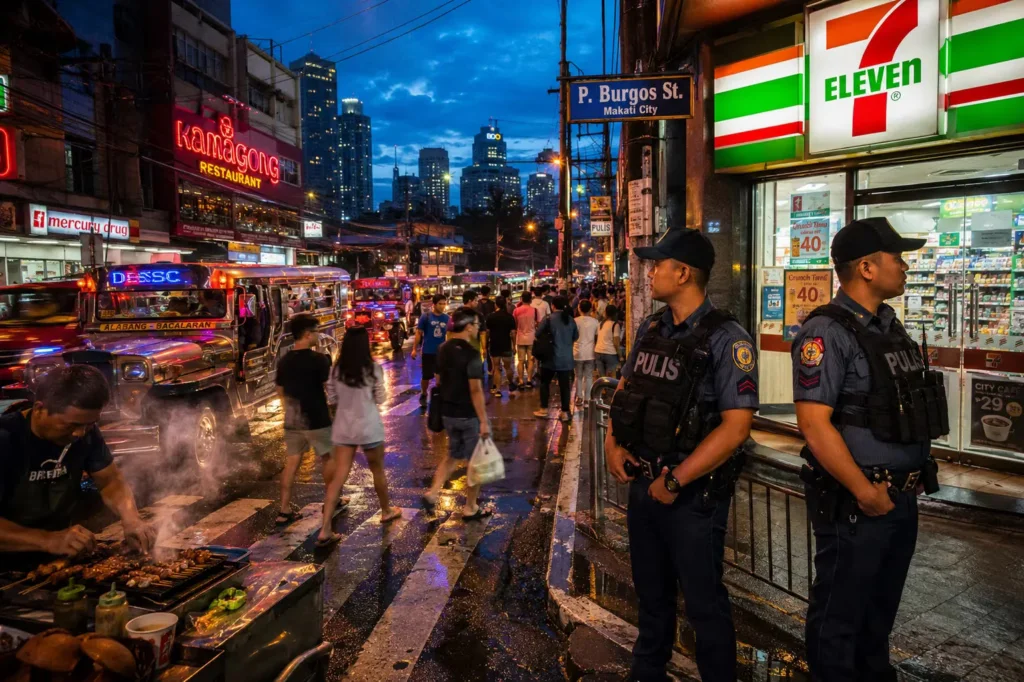
Within twenty minutes, I was in a cab weaving through Makati’s neon-soaked streets. Motorcycles darted between lanes. Street vendors grilled meat on sidewalk corners. Groups of teenagers laughed outside 7-Eleven. And every fifty meters, I spotted something I hadn’t expected: police officers, some in uniform, some plainclothes, positioned casually but deliberately at intersections, outside convenience stores, near ATMs.
I felt safer than I had at any gated resort I’d visited in Southeast Asia.
That realization made no sense on paper. Manila has a reputation for pickpockets, traffic chaos, and urban grit. Resort towns market themselves on safety, seclusion, and controlled environments. Yet here I was, surrounded by fifteen million people and constant motion, feeling a strange calm I couldn’t initially explain.
It took three weeks of living in Manila to understand why. The chaos hides an intricate web of vigilance that most tourists never notice. The police presence isn’t passive. The community networks aren’t abstract. And the disorder that frightens visitors creates a responsiveness that sanitized resorts can’t replicate.

Key Takeaways
- Despite its chaotic reputation, Manila provides unique safety dynamics that tourists often overlook.
- A strong police presence and community vigilance contribute to an unexpected sense of security in the city.
- Upcoming technology initiatives, like the Safe City Project, aim to enhance Manila safety for tourists by improving response times and engagement.
- Tourists should engage with local communities and police, as this helps to navigate the urban landscape more safely.
- Rethinking assumptions about safety can lead to richer travel experiences in Manila, which offers authentic urban culture.
This is the safety paradox that defines tourist safety in the Philippines. And it’s the counterintuitive truth travelers keep ignoring.
The Anatomy of Chaos: Why Manila’s Disorder Hides Order
I’ve stayed at beach resorts in Boracay, Palawan, and Bohol. They were beautiful. Quiet. Orderly. And complacent.
At one resort in El Nido, I watched a woman’s phone disappear from her beach chair while she swam. The security guard was stationed at the resort entrance, half a kilometer away. No alarm system and no cameras. No witnesses. Just tropical silence and a $900 loss.
In contrast, Manila operates on distributed awareness. The chaos forces everyone to stay alert. Street vendors watch their corners. Jeepney drivers track who gets on and off. Police officers position themselves where crowds converge, not where it looks prettiest.
I met Officer Dante Marcelo outside a mall in Quezon City. He’d been with the Manila Police District for twelve years. I asked him about the Philippines safety for tourists and why the city felt different from what I’d expected.
“Resorts are quiet because nothing happens there,” he said. “Here, everything happens. So we have to respond fast. You can’t hide in Manila. Too many eyes.”
He explained that the National Capital Region Police Office operates over 1,300 patrol posts across Metro Manila. Officers rotate shifts at high-traffic locations: malls, transport hubs, tourist districts. They don’t just patrol; they interact, and they know the vendors. They recognize patterns and spot irregularities before incidents escalate.
Personal Observations
I saw this firsthand near Rizal Park. A tourist dropped his wallet while taking a photo. Before he even noticed, a street vendor grabbed it and shouted after him. When the tourist hesitated, uncertain if this was a scam, an officer materialized from the crowd, confirmed the wallet’s contents, and handed it back. Total time: ninety seconds.
That kind of rapid intervention doesn’t happen in isolation. It happens because Manila’s disorder creates constant communication. Vendors alert officers. Officers engage locals. Locals protect their turf because they live there, work there, and rely on the daily flow staying stable.
Maria Santos, who runs a sari-sari store in Tondo, put it bluntly: “Tourists think we’re all criminals. We’re not. We protect our streets because we have to live here. You steal from tourists in my neighborhood; you lose your reputation. Nobody will do business with you.”

Watchful Protection: The Counterintuitive Police Presence
The Manila police don’t patrol like resort security. They blend.
At resorts, security guards stand at gates with clipboards. They check IDs wearing crisp uniforms. They project authority through distance. It’s a theater designed to reassure guests without engaging them.
In Manila, police officers wear everyday clothes mixed with tactical vests. They buy snacks at the same stalls as commuters, and joke with tricycle drivers. They position themselves where they can see without being conspicuous. It’s not theater. It’s embedded vigilance.
This approach is called community-oriented policing, and Manila has been refining it since the early 2000s. According to data from the Philippine National Police, crime rates in Metro Manila dropped 18% between 2016 and 2022, even as tourist numbers surged. Theft incidents in major commercial districts like Makati and BGC fell by 23% over the same period.
Why? Because the police adapted to the city’s rhythm instead of imposing an external model. Understanding safety in the Philippines for tourists requires recognizing this fundamental shift in how urban protection actually works.
Why Does This Work Better?
Senior Inspector Reynaldo Torres, who oversees patrol operations in Ermita, explained it this way: “We don’t wait for crime to happen. We watch behavior. A guy loitering near an ATM for 20 minutes without a transaction? We approach. A group splitting up to follow a tourist? We intervene before contact. It’s preventative, not reactive.”
This strategy works precisely because Manila is chaotic. Criminals rely on anonymity. They need crowds where they can disappear. But when police officers are already in those crowds, watching patterns rather than waiting for alarms, the anonymity evaporates.
I tested this myself. I walked through Quiapo Market at midday carrying a camera and a backpack, both obvious tourist markers. Within ten minutes, I counted four officers within twenty meters of me. None approached. None stared. But all of them tracked my movement peripherally. When I stopped to buy bottles of water, one officer repositioned to maintain a line of sight.
It felt invasive for about five seconds. Then I realized: This is what active safety looks like. Not a gate and a guard. Constant, adaptive presence.

2026 Vision: The Smart Safety Upgrades Transforming Manila
Manila isn’t resting on its current system. It’s upgrading.
In late 2023, the Metro Manila Development Authority announced the Safe City Project, a technology initiative slated for full deployment by early 2026. The plan integrates 12,000 new CCTV cameras across the National Capital Region; all connected to a centralized monitoring hub that uses AI-assisted pattern recognition.
Here’s what that means for tourist safety in the Philippines: Instead of officers manually reviewing footage after an incident, the system flags unusual behavior in real time. Someone is loitering near an ATM. A vehicle is repeatedly circling the same block. A sudden crowd dispersal. Alerts go directly to patrol officers’ mobile devices, enabling a response within minutes.
Engr. Luis Fernandez, the project’s technical lead, walked me through a pilot program already running in Bonifacio Global City. “We’re not surveilling people,” he clarified. “We’re watching patterns. The AI doesn’t care who you are. It cares if you’re acting like someone about to commit a crime.”
What Does This Really Mean?
The system has already reduced response times by 40% in BGC. A pickpocketing attempt near a bus terminal was flagged, an officer intercepted within two minutes, and the suspect was apprehended before the victim even realized their wallet was targeted.
Beyond cameras, the initiative includes a community reporting app called SafeMetroManila, launching in late Q1 2026. Residents and tourists can report suspicious activities, upload photos, and receive real-time safety alerts for their location. Officers can push warnings about active scams, traffic incidents, or weather hazards directly to users in affected areas.
For travelers, this addresses three major pain points:
- Pickpocketing: Enhanced camera coverage at transport hubs and tourist sites makes opportunistic theft far riskier.
- Traffic safety: Real-time alerts help tourists avoid congested or accident-prone routes.
- Emergency response: GPS-enabled panic buttons connect users directly to the nearest patrol unit, cutting average response time to under five minutes citywide.
Critics worry about privacy. Fair concern. But the system operates under strict data retention policies: footage auto-deletes after 30 days unless flagged for investigation, and AI analysis focuses on behavior, not identity. The bigger picture? Manila is building infrastructure that amplifies what already works: rapid response, community engagement, and layered vigilance. The Philippines safety for tourists will become even more robust as these systems mature.

Why Tourists Keep Ignoring This Secret Advantage
So why do tourists still avoid Manila?
Because fear sells better than nuance.
Every major travel advisory warns about Metro Manila. The U.S. State Department lists it as “Level 2: Exercise Increased Caution.” Travel forums are full of stories about scams, theft, and chaos. Guidebooks recommend spending as little time in the city as possible before escaping to “real” destinations.
None of this is entirely wrong. Manila does have crime. It does have scams. But the narrative is frozen in 2005, ignoring fifteen years of infrastructure investment, police reform, and community organizing. This outdated framing actively damages the Philippines’ safety for tourists by scaring them away from the very systems designed to protect them.
How To Change Perceptions
I spoke with Emily Tan, a digital nomad from Canada who’s been living in Makati for eight months. “I almost skipped Manila entirely,” she admitted. “Everyone said it was dangerous. But I needed a visa extension, so I stayed a week. Then another. Now I won’t leave.”
What changed her mind? She stopped treating Manila like a threat and started treating it like a city with its own logic.
“The chaos is functional,” she explained. “It’s not random. Traffic moves in patterns. Vendors know the safest corners. Police are everywhere if you look. But tourists don’t look. They stay scared, Uber directly to their hotel, and fly out the next day.”
This disconnect between perception and reality reflects a broader issue in travel culture: the preference for control over engagement. Resorts offer predictability. Manila offers complexity. Most travelers opt for predictability because it feels safer, even when the data says otherwise.
Happening As You Read This
But digital nomads and adventurous families increasingly reject sanitized travel. They want authenticity, local culture, and real urban experiences. Manila offers all of that, but only if you’re willing to adapt.
The problem is cultural misunderstanding. Tourists see crowded streets and assume danger. They see informal vendors and assume scams. They see a police presence and assume there is high crime. They’re reading the signals backward.
Police presence in Manila isn’t a symptom of danger. It’s a response to density. In some districts, the city has 46,000 people per square kilometer. That requires active management, not passive gates.
Street vendors aren’t waiting to scam tourists. They’re running businesses. Reputation matters. Repeat customers matter. Scamming tourists might net $20. Keeping a regular customer nets $20 every week for years. Crowds aren’t a cover for criminals. They’re witnesses. In Manila, theft happens in isolated spots, not packed intersections. Criminals want privacy. Chaos denies them that.

How to Harness Manila’s Safety Paradox
Understanding Manila’s safety dynamics is useful. Applying them is better.
Here’s how to maximize the Philippines’ safety for tourists during your visit:
Trust visible police presence. Officers in Manila want to be seen. If you feel uneasy, walk toward them, not away. They’re positioned at high-traffic areas specifically to intercept problems early. Don’t hesitate to ask for directions or assistance. It’s part of their job.
Engage with vendors and locals. The sari-sari store owner, the jeepney driver, the woman selling mangoes: they’re your safety network. Smile. Make small talk. Buy something small. When locals recognize you as a regular, even temporarily, they watch out for you.
Use the SafeMetroManila app when it launches. Download it before you arrive. Enable location services. Check alerts daily. Report anything suspicious. You’re not just a user; you’re contributing to the network.
Avoid isolated areas, not crowded ones. Tourists instinctively flee crowds. In Manila, that’s backward. Stick to busy streets, especially after dark. Empty alleys and poorly lit side streets are where risk concentrates.
Learn basic Tagalog phrases. “Magkano?” (How much?), “Salamat” (Thank you), “Nasaan ang pulis?” (Where is the police?). Even a few words of speaking signal respect and familiarity. It changes how locals perceive and interact with you.
The Less Obvious
Carry a mobile power bank and a local SIM. Staying connected is safety. If your phone dies, you lose access to maps, translation, emergency contacts, and the SafeMetroManila app. A prepaid Smart or Globe SIM costs $5 and provides 1 GB of data for a month.
Watch how locals behave, then mirror it. How do they cross streets? Where do they wait for transport? How do they handle vendors? Local behavior reflects safety knowledge earned through daily experience. Copy it.
Keep valuables distributed and concealed. Don’t wear expensive jewelry. Keep your phone in a front pocket or secure bag. Divide cash between wallet, bag, and hotel safe. This isn’t unique to Manila, but it’s essential in any dense urban environment.
Ask the police for route advice. Officers know which areas see frequent incidents and which are safe. If you’re walking somewhere unfamiliar, ask an officer if the route is advisable. They’ll steer you right.
Respect the rhythm of the city. Manila operates on organized chaos. Traffic flows in patterns you’ll learn. Street food appears at specific times. Markets open and close on schedules. Once you sync with these rhythms, navigating becomes intuitive.

The Thought-Provoking Challenge: Rethink What Safety Means in Travel
So here’s my challenge: Are we too comfortable with surface judgments?
Manila is often labeled dangerous because it’s loud, crowded, and unfamiliar. Resorts get labeled safe because they’re quiet, controlled, and designed for foreigners. But safety isn’t aesthetic. It’s functional.
Real safety comes from systems: vigilant communities, responsive authorities, layered awareness. Manila has those systems. Many resorts don’t.
Yet we keep choosing resorts because they feel safer, even when they’re not. We trade actual protection for the illusion of control. We avoid chaos because we assume disorder equals danger.
That assumption costs us authentic experiences, genuine interactions, and real safety.
I’m not saying Manila is perfect. It’s not. Crime exists. Scams happen. Traffic is maddening. But pretending resorts are inherently safer ignores how the Philippines’ safety for tourists actually works in practice.
The next time you plan a trip to the Philippines, ask yourself: Am I avoiding Manila because it’s dangerous, or because it challenges my assumptions about what safety looks like?
Are you willing to trade a gated resort for a city where fifteen million people watch each other’s backs every single day?
Are you ready to stop confusing quiet with safety?
Manila taught me that safety isn’t the absence of chaos. It’s the presence of people who care enough to maintain order within it. That’s not a travel tip. That’s a standard worth adopting everywhere.
Afterthought
I still visit resorts. They’re beautiful, relaxing, and perfect for certain trips. But I no longer assume they’re safer than cities. I’ve learned to evaluate protection based on systems, not aesthetics. That shift changed how I travel, where I go, and how much I trust the places I visit. It might change yours, too.

Frequently Asked Questions
Yes, but context matters when considering tourist safety in the Philippines. Solo travelers should stick to well-trafficked areas like Makati, BGC, and Intramuros. Avoid isolated streets after dark. Engage with locals and police when uncertain. Manila’s safety systems work best when you participate in them rather than avoid them.
Metro Manila’s crime rate has decreased significantly since 2016. According to Philippine National Police data, theft incidents in major tourist districts dropped 23% between 2016 and 2022. While it’s higher than Singapore, it’s comparable to Bangkok and lower than certain districts in Jakarta.
Walk toward a visible police presence or enter a busy establishment, such as a mall or restaurant. Use your phone to call the tourist police hotline (dial 1366). If you’re near a sari-sari store or vendor, ask for help. Locals often intervene or direct you to nearby officers.
Yes. Use Grab, the dominant ride-sharing app, for maximum safety and fare transparency. Licensed airport taxis are also reliable if you use the official queue and insist on the meter. Avoid unmarked vehicles or drivers who refuse to use meters.
Yes, when it launches in early 2026. The app will be available in English and will function for anyone with a Philippine SIM card or data connection. It’s designed specifically to assist both residents and visitors with real-time safety alerts.
Additional FAQ Considerations
How can I tell if a police officer is legitimate?
Legitimate officers wear uniforms with clear identification badges and carry official PNP IDs. If approached by someone claiming to be a plainclothes police officer, ask to see their ID and badge number. You can also call the tourist police hotline (1366) to verify.
Is it safe to use ATMs in Manila?
Yes, but use ATMs inside malls, banks, or guarded facilities. Avoid standalone machines on quiet streets. Watch for anyone loitering nearby. Police often position themselves near high-traffic ATMs precisely because they’re common targets for theft.
What neighborhoods should tourists avoid in Manila?
Tondo, parts of Quiapo after dark, and isolated areas of Divisoria have higher crime rates. Stick to Makati, Bonifacio Global City, Malate, Ermita, and Intramuros. These districts have heavy police presence and well-developed tourist infrastructure.
How do I avoid common scams in Manila?
Never hand your credit card to someone outside your line of sight. Confirm taxi meter activation before departure. Avoid street money changers; use banks or authorized exchange counters. Be wary of strangers offering unsolicited help with ATMs or directions.
Can families with children feel safe in Manila?
Absolutely. Families should stay in family-friendly districts like BGC or Makati, use reputable transport, and visit during daytime hours. Malls and parks have strong security. Kids often attract positive attention from locals, which adds an extra layer of community watchfulness. The Philippines is safe for tourists, especially for families who engage respectfully with local culture.
Other Articles You Might Like
- How to Avoid Island Hopping Scams in the Philippines
- Secret Beaches Philippines: How to Find Hidden Gems
- Best Family Travel in the Philippines: Why Pitstop Towns Beat Famous Beaches
- Where to Take the Best Travel Photos in the Philippines: A Totally Extra Guide
SUGGESTIONS FOR LODGING AND TRAVEL
Lodging is widely available throughout the Philippines. However, you may want to get some assistance booking tours to some of the Philippines’ attractions. I’ve provided a few local agencies that we’ve found to be very good for setting up tours. For transparency: We may earn a commission when you click on certain links in this article, but this doesn’t influence our editorial standards. We only recommend services that we genuinely believe will enhance your travel experiences. This will not cost you anything, and I can continue to support this site through these links.
- For Hotel Accommodations in the Manila area, I highly recommend The Manila Hotel. It is centrally located and within walking distance of Rizal Park and Intramuros. Many other attractions are easily accessible from there as well. I have provided a search box below to help you find hotels (click “Stays” at the top) or flights (click “Flights” at the top). This tool will provide me with an affiliate commission (at no cost to you).
Local Travel & Lodging Assistance
- Guide to the Philippines: This site specializes in tours throughout the Philippines. They seem to have some flexibility in scheduling, and pricing is very competitive.
- Kapwa Travel is a travel company focused on the Philippines. It specializes in customizing trips to meet customers’ needs.
- Tourismo Filipino is a well-established company that has operated for over 40 years. It focuses on tailoring tours to meet customers’ needs.
- Tropical Experience Travel Services – Tours of the Philippines: This company offers a range of tour packages, allowing you to tailor your trip to your preferences.
Lastly, we recommend booking international travel flights through established organizations rather than a local travel agent in the Philippines. I recommend Expedia.com (see the box below), the site I use to book my international travel. I have provided a search box below for you to search for flights (click “Flights” at the top) or Hotels (click “Stays” at the top). This tool will provide me with an affiliate commission (at no cost to you).

