Beyond the Filtered Facade
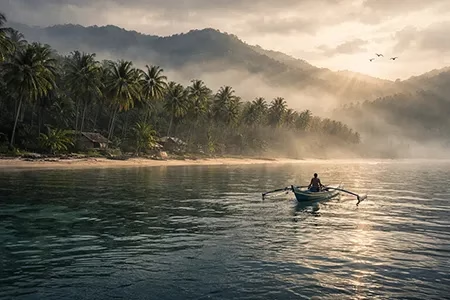
I stepped off the boat in Guiuan, Eastern Samar, as a solo traveler and immediately knew something was wrong. Not dangerously wrong, just different wrong. The kind that makes your modern brain panic slightly.
No Wi-Fi password printed on a cute chalkboard and no Instagram-worthy café with Edison bulbs. No hostel owner asked if I wanted to join tomorrow’s island-hopping tour.
Just heat, humidity, and a local named Mang Edgardo squinting at me as I’d arrived at the wrong party. “You here for the caves?” he asked, spitting betel nut juice into the dirt.
I nodded. He laughed. “Better bring extra underwear. You’ll need it.”
That’s Samar in one interaction: raw, unpolished, and completely indifferent to your curated travel aesthetic. Among unusual Philippine travel destinations, this island stands apart. Not because it tries to be different, but because it refuses to be anything else.
What Travelers Actually Want vs. What Samar Offers
Most travelers today chase experiences they can package. The perfect sunset. The smiling local child. The street food that looks bizarre but tastes safe.
We want a challenge, but on our terms, and we want adventure, but with cell service. We want authenticity, but with a backup plan and good lighting.
Samar doesn’t care about any of that. It tests you and makes you uncomfortable. It rewards bravery over beauty, grit over glamour.
And here’s the uncomfortable truth: that’s exactly what makes it worth visiting. While other unusual Philippine travel destinations rush to install Wi-Fi towers and build resort complexes, Samar remains stubbornly, beautifully itself.
The Island’s Unvarnished Reality

When Locals See Tourism as a Character Test
Elena Rosario runs a small sari-sari store in Basey. She’s watched tourists come through for fifteen years. “The ones who complain about the heat, the roads, the lack of coffee shops? They leave early,” she told me, refilling my water bottle without asking.
“The ones who stay? They’re different. They ask questions, eat what we eat, and don’t treat us like scenery.”
That distinction matters here more than anywhere I’ve traveled in the Philippines. Samar locals don’t need tourism. The economy survived for generations without it.
When you show up, you’re not a customer. You’re a guest being evaluated. Will you respect their home, or just extract content from it?

Roberto Tan, a guide in Calbayog, put it more bluntly: “We can tell in five minutes if someone’s here to listen or here to perform. If it’s the second, we give them the short version of everything.”
This is what separates Samar from easier destinations. Visitors earn their experience through respect, not money.
Cultural Roots That Aren’t Props
Samar’s history is scarred and sacred. Spanish colonization. American occupation. World War II devastation. Typhoon Yolanda, which destroyed entire communities in 2013.
These aren’t fun facts for your travel blog. They’re living memories that shape how people see outsiders.
When you visit the Sohoton Caves, you’re not just seeing limestone formations. You’re entering a space that sheltered wartime resistance fighters. A place where locals hid from invaders.
The environment isn’t a backdrop. It’s a survivor, just like the people.
And if you show up treating it like your personal photo studio, locals notice. They remember. And your experience shrinks accordingly.

The Bravery Test of Samar Tourism
The Problem: Instant Gratification Tourism
Most Philippine destinations cater to comfort. Boracay rebuilds its infrastructure every few years. El Nido packages adventure into tidy day tours. Even Siargao, which markets itself as “raw,” offers smoothie bowls and coworking spaces.
Samar offers none of that safety net. Roads flood without warning. Power outages last for days. Your guide might have to cancel because his uncle died, and the funeral takes priority.
There’s no customer service hotline. No TripAdvisor rating system is pressuring anyone to perform hospitality.
You either adapt or you leave frustrated. This reality positions Samar among the most challenging and unusual Philippine travel destinations you’ll encounter.
The Explanation: Why Samar Stays Difficult
The infrastructure gap isn’t an oversight. It’s geography, economics, and priority.
Samar is the third-largest island in the Philippines, but one of the least developed. Roads through mountainous terrain cost millions. Cellular towers require ongoing maintenance in typhoon-prone areas. Tourist facilities need investors who see return potential.
That return hasn’t materialized yet. So, the island remains largely as it’s been for decades: wild, isolated, and unapologetically itself.
Weather compounds everything. The region sits in Typhoon Alley. Boats cancel. Roads wash out. Plans dissolve.
If you need certainty and schedules, Samar will break you.

The Solution: Show Up Ready, Not Entitled
The reward isn’t easy. Its authenticity is earned through discomfort.
When you trek to Biri Island’s rock formations, you’re not following a sanitized trail. You’re navigating real terrain with real risks. The sense of accomplishment isn’t manufactured.
When you stay in a local’s home in Jipapad because there’s no hotel, you’re not “slumming it.” You’re being trusted with genuine hospitality. That trust is rare.
When you eat whatever’s available because restaurants don’t exist, you’re not “roughing it.” You’re participating in daily life as it actually happens.
How to Prepare for Samar’s Test
Here’s how to prepare for Samar’s test:
Mentally: Accept that your itinerary is a suggestion, not a contract. Flexibility isn’t optional.
Physically: Bring real gear. Waterproof bags, sturdy shoes, and first aid supplies. There’s no relief ten minutes away.
Emotionally: Check your ego. You’re not the hero discovering a hidden paradise. You’re a visitor in someone else’s home.
Financially: Bring cash. Lots of it and in small bills. ATMs are scarce and often empty.
Technologically: Download offline maps. Accept that you might disappear from social media for days.
That last one? For many travelers, it’s the hardest requirement of all.
The Samar Solo Travel Adventurer’s Playground

One Person, One Island, Zero Safety Net
I met Sarah Mendoza in a Calbiga guesthouse. Australian, thirty-two, traveling solo through Samar for three weeks. “I needed to prove something to myself,” she admitted over warm San Miguel.
She’d just returned from a solo trek to Langun-Gobingob Cave, one of the largest cave systems in Asia. No tour group. No guide for the last section. Just her headlamp, a local’s hand-drawn map, and her own nerve.
“I got lost twice,” she said, laughing now but still shaky. “Once underground, once trying to find the damn trailhead. Both times, locals found me. They didn’t judge. They just helped.”
That’s the Samar solo travel experience. It tests you and humbles you. It shows you what you’re capable of when comfortable options disappear.
Sarah admitted she cried twice: once from fear in the cave’s deepest chamber, once from gratitude when a farmer’s wife fed her without asking for payment.
“I’ve traveled to thirty countries,” she said quietly. “I’ve never felt this raw anywhere else. Or as proud of myself.”
Growth Hurts More Than Glamour
Solo travel in Samar strips away the performance. No one’s watching. No one cares about your journey except you.
You face your fears because there’s no alternative. The fear of isolation and failure. Fear of irrelevance when your phone can’t validate your existence.
The silence forces introspection. The difficulty forces resilience. The lack of distraction forces presence.
It’s not fun in the moment. But it’s transformative in retrospect.
This transformation separates Samar from other unusual Philippine travel destinations. Growth requires friction, and Samar provides plenty of it.
Safety and Mindset for Solo Travelers
Real talk: solo travel in Samar requires preparation.
Register with locals. Tell your guesthouse owner your plans. Check in with someone daily.
Trust women’s intuition. If something feels wrong, it probably is. Locals respect boundaries and trust that instinct.
Carry a backup of everything. Phone battery, water, cash, food. Assume help is hours away.
Learn basic Waray phrases. “Maupay nga adlaw” (good day) and “Salamat” (thank you) open doors.
Accept help graciously. Filipinos will offer assistance. Say yes. Refusing is insulting.
The mindset shift matters most: you’re not conquering Samar. You’re learning from it.
The Culture-Seeker’s Reward
Named Locals, Real Wisdom
Tatay Ernesto, seventy-four, lives in a bahay kubo outside Basey. He survived Typhoon Yolanda by tying himself and his wife to a coconut tree. “The wind tried to take us,” he said, showing me the scars on his arms. “But we’re Samarnon. We don’t let go easily.”
He didn’t tell me this for sympathy. He told me to explain why locals here view resilience differently. Survival isn’t an Instagram caption. It’s a family legacy.
Nanay Rosing, who weaves traditional banig mats in Catbalogan, showed me patterns that carry meaning. “This design is for safe travels,” she explained, her hands moving with practiced grace. “This one is for protection. Tourists see mats. We see prayers woven into fiber.”
She didn’t sell me one. She gave it to me. “You’ll need the protection more than I need the money.”

These encounters define what makes Samar special among the Philippines’ unusual travel destinations. The people aren’t performing culture. They’re sharing it.
Listening Is the Real Immersion
True cultural engagement in Samar means shutting up and paying attention. Not performing wokeness. Not collecting stories to prove your sensitivity.
Just listening. Really listening.
When locals share history, they’re not entertaining you. They’re trusting you with memory. When they explain traditions, they’re not performing culture. They’re educating.
The difference between a tourist and a traveler in Samar is simple: tourists photograph. Travelers absorb.
How to Engage Respectfully
Ask permission before photographing people. Always. Don’t assume smiles mean consent.
Learn names. Use them. Remember them. People aren’t “friendly locals.” They’re Mang Jose, Ate Linda, and Kuya Ramon.
Eat what’s offered. Don’t wrinkle your nose. Don’t ask what’s in it while chewing.
Pay fairly. If something costs fifty pesos and you try to negotiate to thirty, you’re not being savvy. You’re being cheap.
Stay longer than feels comfortable. Real conversation happens after the pleasantries.
Samar rewards depth, not breadth. One meaningful connection beats ten surface interactions.
Why No Wi-Fi Might Be Your Best Travel Companion

The Forced Disconnect
I went four days without reliable internet in Eastern Samar. Not by choice. The cell towers were down after a storm.
The first day, I panicked. How would I navigate? How would I prove I was having experiences? What if people forgot I existed?
The second day, I relaxed. Slightly.
The third day, something shifted. I noticed more. The sound of rain on nipa palms. The way vendors arranged fish by color. The rhythm of local conversation.
The fourth day, I realized I hadn’t thought about my follower count once. I’d just lived.
That sounds precious, I know. But it’s true. The absence of Wi-Fi didn’t diminish the experience. It concentrated it.
From External Validation to Internal Fulfillment
We’ve trained ourselves to believe experiences only matter if others witness them. If it’s not posted, did it happen? If no one likes it, was it worth doing?
Samar breaks that addiction through necessity, not philosophy.
You hike to hidden waterfalls because you want to see them, not photograph them, and you talk to locals because you’re curious, not collecting content. You sit with discomfort because processing it matters more than documenting it.
The shift is subtle but profound. Your ambition redirects inward. Am I growing and learning? Am I present?
Those questions matter more than engagement metrics. This quality positions Samar distinctly among the unusual Philippine travel destinations: it forces you inward rather than outward.
Travelers Who Returned Changed
Mark, a software developer from Manila, spent two weeks in Samar conducting research for his thesis. “I intended to write about ecotourism infrastructure gaps,” he told me via email months later. “I ended up writing about how technology addiction prevents genuine human connection.”
His thesis advisor rejected it for being too personal. He published it independently. It went viral.
Carla, a retired teacher from Cebu, visited Samar to scatter her husband’s ashes in his hometown. She stayed three months. “I found a version of myself I’d forgotten existed,” she wrote in her blog. “The version that didn’t need external validation to feel valuable.”
Neither returned with better photos than they’d have gotten in Palawan or Boracay.
Both returned fundamentally different.
What Are You Willing to Risk for Real Travel?

Here’s the uncomfortable question: Are you actually ready for places like Samar?
Not theoretically ready. Not “I love adventure” ready. Actually ready.
Ready to smell bad for days because showers are cold and irregular, and to eat food you can’t identify. Ready to sleep poorly because roosters and karaoke don’t respect your circadian rhythm.
Are you ready to fail and to get lost? To feel clumsy, to need help. To admit you don’t know what you’re doing. Especially if you are a solo traveler in Samar.
Ready to be humbled by an island that doesn’t care about your travel resume, your Instagram following, or your carefully curated personal brand.
Most travelers aren’t. And that’s okay. Comfort travel has its place. I’m not here to shame anyone for choosing ease.
But if you’re chasing transformation, it won’t arrive via algorithm. It requires friction. Discomfort. Risk.
Why Samar Stands Apart
Samar offers all three in abundance. The question is whether you’re brave enough to accept the offer.
Among unusual Philippine travel destinations, Samar makes no apologies. It doesn’t compete with Boracay’s beaches or Palawan’s lagoons. It offers something different entirely: the chance to test yourself against real challenges and emerge changed.
Neighboring islands, such as Dinagat Island, share this quality. Remote, undeveloped, demanding. These unusual Philippine travel destinations reward curiosity and courage, not comfort.
The Real Reward

Bravery in Samar doesn’t get you viral content. It gets you something rarer: self-knowledge earned through challenge. Connection built through vulnerability. Stories you’ll tell for decades because they mattered to you, regardless of who else cares.
That’s not marketable. It’s not scalable. It won’t grow your audience.
But it will grow you.
And maybe that’s the point of travel after all. Not collecting experiences. Becoming someone who deserves the experiences you collect.
Take the Test
Next time you plan a trip, ask yourself: Am I seeking ease or growth? Validation or transformation? A story to tell others, or one that changes how I see myself?
If it’s the former, skip Samar. There are easier islands.
If it’s the latter, book the ticket. Pack light. Bring extra underwear, as Mang Edgardo said.
And prepare to be tested in ways Instagram never prepared you for.
Share your bravest travel moment in the comments. I’ll read everyone. Save this article for the next time you need a reminder that real travel requires risk. Follow for more unfiltered truths about the Philippines that guidebooks won’t tell you.
Samar is waiting. The question is whether you’re ready.
P.S. I never did make it to all the caves Mang Edgardo recommended. Power outages and road closures cut my trip short. I left frustrated, incomplete. Three months later, I realized that incompleteness was the point. Samar doesn’t owe me closure. It gave me something better: a reason to return. This time, with better boots and lower expectations. That’s growth, too.
Frequently Asked Questions
1. Is Samar safe for tourists?
Samar is generally safe, even for solo travel, but it requires more caution than tourist-heavy areas. Register your plans with locals, avoid isolated areas after dark, and monitor the weather closely. The bigger risks are logistical, not criminal. Roads, boat schedules, and infrastructure can fail without warning. Preparation and flexibility matter more than fear.
2. What’s the best time to visit Samar?
March through May offers the most stable weather, though it’s hot and humid. Avoid November through January, when typhoon risk peaks. But even “good” months can surprise you with storms. Plan buffer days into your itinerary and accept that nature controls your schedule here.
3. How do I get around Samar without a car?
Jeepneys, habal-habal motorcycles, and tricycles cover major routes. Expect delays, discomfort, and improvisation. Many destinations require hiring a private motorcycle or negotiating with locals for transport. Flexibility and cash solve most problems. Google Maps works offline; download regional maps before arrival.
4. Can I visit Samar as a first-time traveler to the Philippines?
Technically, yes, but I wouldn’t recommend it. Samar rewards experience and adaptability. If this is your first trip to the Philippines, start with Cebu or Palawan to get a sense of local customs and logistics. Return to Samar when you’ve built confidence navigating Philippine travel realities.
5. What should I pack for Samar?
Waterproof bags, quick-dry clothing, sturdy hiking shoes, a headlamp, a first aid kit, offline maps, a power bank, cash in small bills, water purification tablets, and insect repellent. Forget fashion; prioritize function. If you can’t carry it wet for six hours, leave it at home.
6. Is there good accommodation in Samar?
Define “good.” Basic guesthouses and homestays are available in larger towns such as Calbayog, Catbalogan, and Borongan. Expect fan rooms, cold showers, and intermittent power. Five-star resorts don’t exist here. If you need Western comfort standards, Samar will disappoint you.
7. How much cash should I bring to Samar?
More than you think. ATMs are scarce and frequently empty or offline. Bring enough cash for your entire trip, plus fifty percent extra for emergencies. Small bills are essential; vendors often can’t break five-hundred or thousand-peso notes.
8. What’s the food situation in Samar?
Simple, local, and delicious if you’re open-minded. Rice, fish, vegetables, pork. Don’t expect menus or variety. Eat what locals eat. Street food is generally safe if cooked fresh. Restaurants are rare outside major towns. If you have serious dietary restrictions, bring your own supplies.
9. Is Samar good for solo female travel?
It can be, with preparation and awareness. Filipino hospitality is genuine, and communities often look out for solo women. However, infrastructure gaps mean help is sometimes far away. Trust your instincts, check in with guesthouse owners regularly, and avoid isolated areas without local guides.
10. Why should I choose Samar over more developed islands?
You shouldn’t, if you prioritize comfort and convenience. Choose Samar if you want challenge, authenticity, and transformation. If you want to test yourself, not just take photos. If you believe the best travel stories come from difficulty, not ease. Samar rewards bravery, not your Instagram strategy. Among unusual Philippine travel destinations, it stands as one of the most demanding and rewarding.
Other Related Articles that may be of Interest
You may also find the following articles interesting.
Suggestions For Lodging and Travel
Lodging is widely available throughout the Philippines. However, you may want to consider getting assistance booking tours to some of the Philippines’ attractions. I’ve provided a few local agencies that we’ve found very good for setting up tours. For transparency, we may earn a commission when you click on certain links in this article, but this doesn’t influence our editorial standards. We only recommend services that we genuinely believe will enhance your travel experiences. This will not cost you anything, and I can continue to support this site through these links.
Local Lodging Assistance
Guide to the Philippines: This site specializes in tours across the Philippines, offering flexible scheduling and competitive pricing. I highly recommend them for booking local arrangements for a trip like this one. You can book flights and hotels through the Expedia link provided below.
Hotel Accommodations: I highly recommend The Manila Hotel for a stay in Manila. I stay here every time I travel to the Philippines. It is centrally located, and many attractions are easily accessible. Intramuros and Rizal Park are within walking distance. I have provided a search box below for you to find hotels (click “Stays” at the top) or flights (click “Flights” at the top). This tool will provide me with an affiliate commission (at no additional cost to you).
Kapwa Travel is a travel company focused on the Philippines. It specializes in customizing trips to meet customers’ needs.
Tourismo Filipino is a well-established company that has been operating for over 40 years. It specializes in tailoring tours to meet customers’ needs.
Tropical Experience Travel Services – Tours of the Philippines: This company offers a range of tour packages, allowing you to tailor your trip to your preferences. Lastly, we recommend booking international travel flights through established organizations rather than a local travel agent in the Philippines. I recommend Expedia.com (see the box below), the site I use to book my international travel. I have provided a search box below for you to use to find flights (click “Flights” at the top) or Hotels (click “Stays” at the top). This tool will provide me with an affiliate commission (at no cost to you).